I Wasted 10 Years of My Life Being “Busy.” Here Is What Actually Changed Everything
There is a version of me that I am not proud of. He woke up at 11 a.m., refreshed Twitter before his eyes fully opened, and called scrolling through motivational quotes “research.”
He had seventeen browser tabs open at all times, a journal he had written in exactly twice, and a deeply held belief that he was always, somehow, on the verge of a breakthrough.
Trending Now!!:
That version of me was exhausting to be around. I know, because I was him for nearly a decade.
It always started on Sunday.
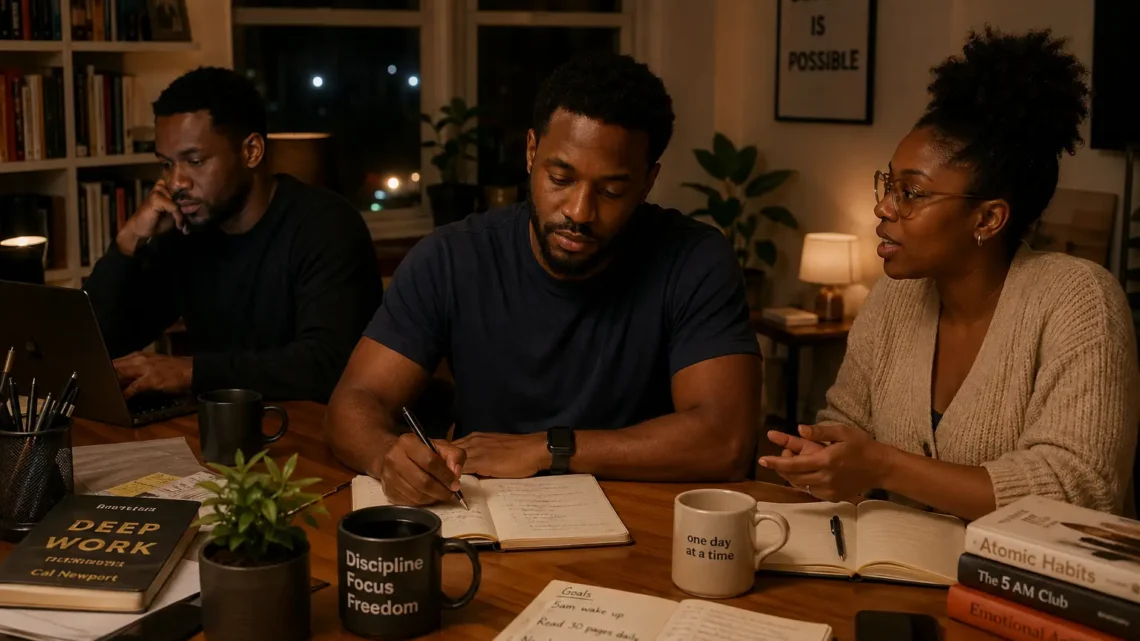
I would sit at my desk, crack open a fresh notebook, and feel that electric, almost spiritual surge of possibility. I wrote things like “5 a.m. wake-up” and “read 30 pages daily”, and “no phone before 9 a.m.” I drew little boxes next to each goal. I underlined the important ones twice. By Sunday midnight, I genuinely believed I was a changed man.
By Wednesday, the notebook was under a pile of clothes.
This cycle ran for years. I called it “planning.” My older brother Emeka called it something else entirely.
“You love the idea of changing more than you love actually changing,” he told me one evening, not looking up from his laptop. We were in his apartment in Abuja. He was building a financial model. I was telling him about my new productivity system.
“That’s not fair,” I said.
“Name one habit you’ve kept for more than three weeks.”
I opened my mouth. I closed it. I looked at the wall.
Emeka went back to his spreadsheet.
That silence did more for my personal development journey than any YouTube video I had ever watched at 2 a.m. about waking up at 4 a.m.
The first real change I made was not glamorous. It did not involve a cold plunge, a gratitude journal or a $400 sunrise alarm clock. It involved setting my phone across the room before bed, so I physically had to stand up to turn off my alarm.
That’s it. That was the whole system.
The productivity gurus online would have laughed. But that one small friction point, that tiny inconvenience of having to get out of bed, broke the snooze button addiction I had nursed since university. Habit stacking research backs this up now, but back then I just knew it worked and I did not understand why.
The first morning I actually got up, I stood in my kitchen at 6:47 a.m. and had no idea what to do with myself. I had planned for the waking up. I had not planned for the being awake.
So I made tea. I sat by the window. I watched the street below come to life slowly, a woman walking a dog that refused to move, a man arguing quietly into his phone, a bread seller balancing a tray on her head with the casual grace of someone who had never heard of a core workout.
I did not meditate. I did not journal. I just sat there and breathed.
And something in me, some knot I had been carrying around for years, loosened just slightly.
A few months into this slow, unglamorous self-improvement experiment, I discovered the concept of deep work through a book a colleague recommended. The idea was simple: your most cognitively demanding tasks deserve blocks of uninterrupted focus time. No notifications. No multitasking. No “quickly checking” anything.
I tried it on a Tuesday morning. I set a timer for 90 minutes, silenced everything, and worked on a writing project I had been “almost finishing” for four months.
I finished it in one sitting.
I sat back in my chair and stared at the screen. I felt the way I imagine people feel after they finally pay off a debt they forgot was eating them alive. Lighter. A little stunned. Slightly annoyed that nobody had forced me to do this sooner.
My friend Chidera called me that evening. She was a therapist and had been gently suggesting for years that my chaotic relationship with time was not a productivity problem but an anxiety problem.
“So you actually finished it?” she said.
“All of it.”
“How?”
“I just… didn’t stop.”
A pause on the line. Then, “King. That’s called focus. Humans used to do that all the time before the internet.”
“You don’t have to be smug about it.”
“I’m not being smug. I’m being relieved.”
Here is where I have to be honest about the part of the self-improvement story that nobody puts in their highlight reel.
Around month four of my new routine, I got greedy.
I added a workout. Then a second journaling session. Then, a weekly review template I copied from a productivity podcast. Then, a reading goal of two books a month. Then a side project. Then, a second side project because the first one was “too small.”
Within six weeks, I was more exhausted than I had ever been during my lazy years. I was technically doing all the right things and I was miserable. I started resenting my alarm. I started skipping the workout to protect the journaling and skipping the journaling to protect sleep. The whole system collapsed like a building with too many floors and not enough foundation.
I called Emeka.
“I broke it,” I said.
“What did you add?”
I listed everything.
A long silence. Then, “You do know that more is not the same as better?”
“I thought I was scaling up.”
“You were hoarding habits. There’s a difference.”
That conversation introduced me to the idea that sustainable personal growth is not about doing the most. It is about doing the right things consistently over time. Time management experts call it prioritization. Emeka called it “stop being greedy with yourself.”
I stripped everything back. I kept three anchors: the early wake-up, the 90-minute deep work block, and a 20-minute walk in the evening. Everything else became optional.
The relief was immediate.
The productivity content online is obsessed with transformation. Before and after photos. Revenue screenshots. Six-figure side hustles. “I changed my life in 30 days” thumbnails with a shocked face and a red arrow.
Nobody talks about what real change actually looks and feels like, which is mostly just quiet.
About eight months in, I noticed I had stopped thinking about productivity at all. I woke up, did the work, moved my body, slept.
Not because I was disciplined in the motivational poster sense of the word. But because the habits had become as automatic as brushing my teeth. The goal-setting felt natural rather than aspirational. The growth mindset shift had happened so gradually I almost missed it entirely.
My colleague Funmi noticed before I did.
We were in a meeting that was running over time. Old me would have been silently catastrophizing about the tasks piling up. Instead, I was just listening, taking notes, contributing.
Afterwards, she caught me in the hallway.
“You seem different lately,” she said.
“Different how?”
“Calm. Like you’re not about to combust at any moment.”
I laughed. “Was I that bad before?”
She gave me a look that answered the question without using any words.
I am not a morning person by nature. I am not naturally disciplined or focused or organized. My default state, left to its own devices, is horizontal and slightly chaotic.
Everything I have built, every productive habit, every work-life balance practice, every system that actually functions in my real life rather than in a Sunday night notebook, was built slowly, badly, repeatedly, and through more failure than I care to fully document.
The self-help industry will sell you the idea that transformation is a decision you make once. It is not. It is a decision you make every morning, including the mornings when you do not feel like it, especially those mornings.
The real high-performance secret is not the cold shower or the 75 Hard challenge or the 12-week body transformation. It is showing up for your own life on a Tuesday when nothing is exciting and nothing is urgent and you are slightly tired and the work still needs doing.
It is choosing, again and again, the boring and the consistent over the dramatic and the temporary.
Emeka got married last year. At the reception, he pulled me aside during the dancing and said, “You’re a different person from the guy who used to call me with a new system every week.”
“Better or worse?” I asked.
He thought about it genuinely, the way he thinks about everything.
“Quieter,” he said. “Which, for you, is better.”
He went back to the dance floor. I stood there for a moment, holding my drink, watching the room full of people laughing and moving, and I felt something I had spent a decade chasing in all the wrong notebooks.
I felt like enough.
Not finished. Not perfect. Not optimized.
Just enough, for now, which it turns out, is exactly where all real progress begins.