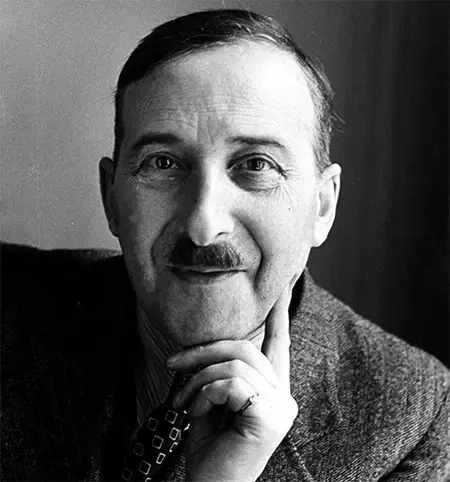
Stefan Zweig Biography: Ethnicity, Wife, Novels, Death, Awards, Children, Age, Religion, Essay
Stefan Zweig, is an Austrian writer, dramatist, essayist, and biographer, who crafted profound psychological narratives and historical portraits that captured Europe’s cultural zenith before its shattering under Nazism, achieving worldwide acclaim in the 1920s and 1930s as one of the era’s most translated authors.
He wove humanism and moral complexity into novellas like The Royal Game, novels such as Beware of Pity, and his poignant memoir The World of Yesterday, chronicling the Habsburg world’s lost elegance amid rising barbarism.
Trending Now!!:
Zweig’s early poetry and plays evolved into biographical masterpieces on figures from Balzac to Dostoevsky, reflecting his pacifist turn post-World War I and travels that fueled cosmopolitan insight.
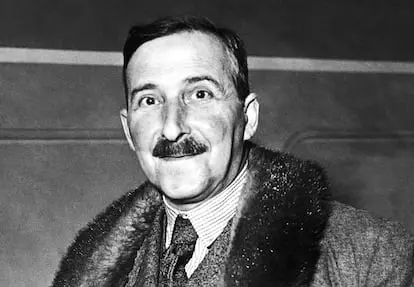
Quick Facts
- Full Name: Stefan Zweig
- Stage Name: Stefan Zweig
- Born: 28 November, 1881
- Died: 22 February, 1942
- Age: 60 years old
- Birthplace: Vienna, Austro-Hungarian Empire (now Austria)
- Nationality: Austrian
- Occupation: Novelist, Short-story writer, Biographer, Essayist, Dramatist, Translator, Journalist, Historian
- Height: Unknown
- Parents: Moritz Zweig and Ida Brettauer
- Siblings: Unknown
- Spouse: Friederike von Winternitz (m. 1915-1938), Charlotte Elisabeth Altmann (m. 1940)
- Children: None
- Relationship: Married
- Net Worth: $500,000
Early Life and Education
Stefan Zweig was born on November 28, 1881, in Vienna, Austro-Hungarian Empire, to Moritz Zweig, a thriving textile manufacturer, and Ida Brettauer from a prominent banking family.
He matured in a wealthy Jewish household brimming with intellectual fervor and artistic exposure. Zweig earned his doctorate from the University of Vienna in 1904 with a thesis on Hippolyte Taine’s philosophy.
He is of cosmopolitan heritage. Jewish by birth yet culturally assimilated, he embraced humanism over orthodoxy.
Career
Stefan Zweig unveiled his literary voice early, releasing poetry in 1901 and dramas like Thersites in 1907 while freelancing as a journalist and translator amid Vienna’s vibrant scene.
World War I sharpened his pacifism, yielding short stories such as Amok and Twenty-Four Hours in the Life of a Woman that probed human extremes with psychological finesse.
By the 1920s, he settled in Salzburg, churning out biographies of Balzac, Dickens, and Dostoevsky in Drei Meister, plus historical essays in Decisive Moments in History that blended scholarship with narrative verve.
Global lectures and friendships with Rilke and Freud amplified his reach, making him a publishing phenomenon across continents. These formative years fused youthful experimentation with mature insight, catapulting him from local talent to Europe’s literary conscience through accessible yet profound prose.
Zweig dominated the interwar peak with expansive works like Beware of Pity, a 1939 novel dissecting compassion’s perils, and biographies of Erasmus and Marie Antoinette that humanized icons amid his growing anti-fascist stance. The Royal Game emerged in 1942 as a taut novella on isolation and intellect under tyranny, mirroring his exile woes.
Salzburg’s house became a writerly haven hosting Mann and Gide, while translations into over 30 languages fueled royalties and renown. Nazi book burnings in 1933 spurred his flight, yet he penned tirelessly in London and Bath before South America.
Awards like the 1932 Vienna Prize crowned his versatility across genres, cementing influence on global readers hungry for moral clarity.
Stefan Zweig channels final reflections into The World of Yesterday, a 1942 memoir evoking Vienna’s fin-de-siècle glory against barbarism’s advance. Novellas and essays ripple through adaptations and scholarly revivals.
Salzburg residences and Brazilian memorials honor his footprint. Biographies inspire portraits of turmoil’s thinkers. Pacifist pleas echo in conflict-era anthologies. His oeuvre upholds humanism’s torch amid shattered worlds.
Social Media
Stefan Zweig does not have a social media account
Personal Life
Stefan Zweig wed Friederike von Winternitz in 1915, sharing two stepsons before their 1938 divorce amid exile strains, yet they stayed close. He married secretary Charlotte Elisabeth Altmann in 1940, who joined his Brazilian refuge.
Childless by choice, Zweig poured paternal energy into mentoring youth and causes, and he has no children. He died at the age of 60 on February 22, 1942, in Petrópolis, Brazil, after committing suicide with his wife, Lotte Altmann, due to despair over World War II and the rise of Nazism.
Net Worth
Stefan Zweig has an estimated net worth of around $500,000, he amassed wealth through prolific output and translations fueling royalties across Europe. Textile inheritance from Moritz Zweig provided early security, joined by journalism fees, lecture circuits, and Salzburg house sales amid exile.
NOTICE!! NOTICE!! NOTICE!!
At TheCityCeleb, we strive to provide accurate and up-to-date biographies and entertainment news, focusing on celebrities. Our editorial team researches information from reputable sources, including interviews, official statements, and verified media.If you spot an error or have additional details, please contact us at editor@thecityceleb.com. We value your feedback and are committed to maintaining trustworthy content.