DR Congo Fan Michel Nkuka Mboladinga Revives Patrice Lumumba’s Legacy at AFCON 2025
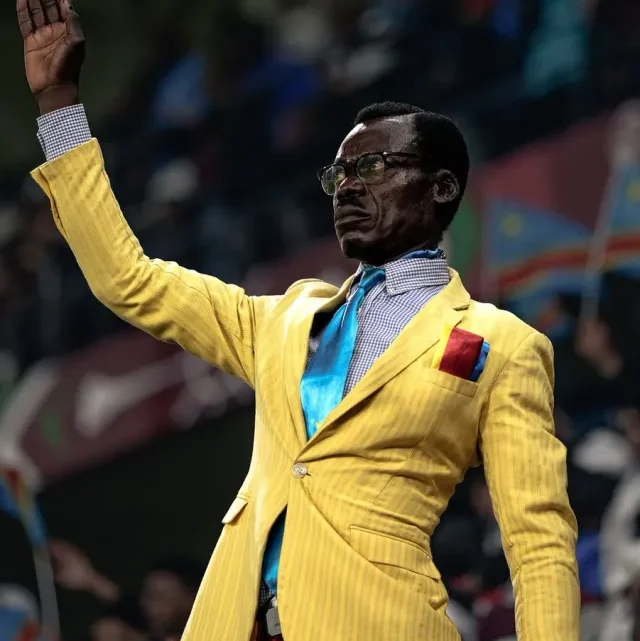
For the full duration of every Democratic Republic of Congo match at the 2025 Africa Cup of Nations in Morocco, Michel Nkuka Mboladinga— a 53-year-old father, football devotee, and self-described artist from Kinshasa—transformed himself into a living monument.
Dressed in sharp, colorful suits, he would climb onto a small platform in the stands, raise his right arm high with palm open, and freeze. Not a twitch, not a blink for 90 minutes, sometimes longer. His pose was an exact replica of the iconic statue of Patrice Lumumba that towers over the Limete interchange in Kinshasa, a gesture of defiance, unity, and unyielding hope.
Trending Now!!:
To the international viewers tuning in from living rooms in Europe, America, or Asia, it might have seemed like an eccentric fan ritual, a quirky sideshow amid the drama on the pitch. But for anyone willing to look deeper, Mboladinga‘s silent performance was a profound act of remembrance, resistance, and raw humanity—one that laid bare the complexities of Congo’s past and present in ways no commentary or highlight reel ever could.
Michel didn’t invent this tribute in Morocco. It began over a decade ago, back in the roaring terraces of Kinshasa’s Stade des Martyrs, where he supported local giants AS Vita Club. “I train every day,” he told reporters in a rare interview, his voice soft but steady. “I stand still for 45 or 50 minutes at home to prepare.”
Why? “To give strength to the team, to pass energy to the players.” But it was more than superstition. For Michel, the pose channels Lumumba‘s values: dignity, freedom, and national sovereignty. “He is like a member of the family,” Michel said of the slain leader. In a country where history feels painfully alive, this wasn’t performance art for likes—it was devotion.
Patrice Emery Lumumba‘s story still stings across the African continent and beyond, a cautionary tale of what happens when bold visions collide with powerful interests. Born in 1925 in the Belgian Congo, Lumumba evolved from a postal worker and beer salesman into a fiery orator and founder of the Mouvement National Congolais.
When independence arrived on June 30, 1960, he became the nation’s first prime minister at just 35. His speech that day was electric—and controversial. While King Baudouin of Belgium praised colonial “civilizing” efforts, Lumumba fired back: “We have known ironies, insults, blows that we endured morning, noon, and evening, because we were Negroes… We are proud of this struggle, of tears, of fire, and of blood.”
It was a declaration of true freedom, but it alarmed the wrong people. Within months, amid Cold War paranoia, mineral-rich secessionist movements in Katanga and South Kasai, and internal rivalries, Lumumba was deposed. Arrested, humiliated, and flown to Katanga, he was executed on January 17, 1961, by separatists with Belgian support—and, as later declassified documents revealed, tacit American approval, fearing his pan-Africanist leanings might tilt Congo toward the Soviet bloc.
His body was dissolved in acid to erase evidence. A 2001 Belgian inquiry admitted “moral responsibility.” To this day, Lumumba symbolizes thwarted potential: a united, prosperous Congo that never was. Fast-forward to today, and the Democratic Republic of Congo remains a land of staggering contrasts.
It’s home to some of the world’s richest deposits of cobalt, coltan, and diamonds—minerals powering your smartphones and electric cars—yet over 70% of its 100 million people live in extreme poverty. The east has been ravaged by conflict for decades, with the M23 rebel group (backed by neighboring Rwanda, according to UN reports) displacing millions in recent years.
Over 120 armed groups vie for control, fueling a cycle of violence, sexual atrocities, and child soldier recruitment that human rights organizations call one of the world’s worst humanitarian crises. Football, for many Congolese, is escape and pride intertwined—the Leopards’ last AFCON title came in 1974, a distant memory in a nation hungry for heroes.
Enter AFCON 2025. DR Congo arrived with quiet optimism under coach Sébastien Desabre. Unbeaten in the group stage—wins over Benin and Botswana, a draw with Senegal—they advanced to the round of 16. And in the stands, Michel became the unintended star.
Cameras panned to him repeatedly; social media exploded with videos. Fans nicknamed him “Lumumba Vea” (Lumumba‘s grandson). Congolese supporters formed protective circles around him to fend off selfie-seekers. Even CAF president Patrice Motsepe posed with him. For a fleeting moment, amid the drums and dances, Michel’s stillness spoke volumes about resilience.
Then came January 6, 2026, in Rabat’s Prince Moulay El Hassan Stadium: DR Congo versus Algeria. A tense, scoreless affair dragged into extra time. Michel held his pose through it all—nearly 120 minutes of immobility. In the 119th minute, Algerian substitute Adil Boulbina unleashed a stunning strike. 1-0.
Algeria advanced; Congo’s tournament ended. As green-clad Algerians erupted, the cameras found Michel again. His arm lowered slowly. His face crumpled. Tears streamed down as he covered his eyes, shoulders shaking. The unbreakable statue had broken.
That image—pride giving way to heartbreak—went viral instantly, capturing something universal: the weight of national hope crashing down.
The aftermath wasn’t all grace. Algerian forward Mohamed Amoura, in the heat of celebration, mimicked Michel’s pose before dramatically collapsing to the ground, implying Congo’s “fall.” It sparked outrage online, seen by many as mocking not just a fan, but Lumumba‘s legacy and Congo’s pain.
Amoura quickly apologized: “I simply wanted to banter… I respect Congo and its team.” The Algerian federation went further, gifting Michel a personalized jersey emblazoned with “Lumumba.” Morocco, the host, extended his stay with VIP treatment until the final.
In the end, DR Congo went home without silverware, but Michel Nkuka Mboladinga gave the world something rarer: a glimpse into a nation’s soul. His tears weren’t just for a lost match—they echoed Lumumba’s unfulfilled dreams, the ongoing struggles in the east, the pride that persists despite everything.