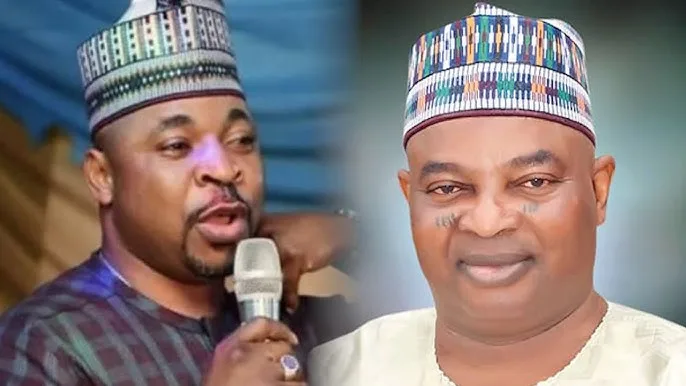
Gunshots Erupt as NURTW’s Court-Backed Chairman Baruwa Takes Over Abuja Secretariat, Ousting MC Oluomo
Armed with two court judgments and years of patience, Tajudeen Baruwa marched into the union’s national headquarters on Monday morning. What followed was chaos: a supporter shot, teargas fired, and Baruwa himself arrested by the same police force he had invited to witness the lawful handover.
Tajudeen Baruwa had come prepared. He had the court papers. He had the supporters. He had notified the police in writing, attached the certified copies of the judgments, and given every assurance that the morning’s events would be orderly and peaceful.
When he stood before journalists at the national secretariat of the National Union of Road Transport Workers in Abuja on Monday and began to speak, calmly, methodically, with the quiet confidence of a man who had waited years for this moment, everything appeared to be going according to plan. Then the shots rang out.
Trending Now!!:
What was meant to be a routine press briefing to announce the lawful reclamation of one of Nigeria’s most powerful and contentious trade union headquarters became something else entirely. One person was reportedly shot during the chaos that erupted outside the secretariat, teargas was fired to disperse the crowd, and Baruwa himself was subsequently arrested by police officers, the same force he had formally notified ahead of the takeover.
By mid-morning, the headquarters of an organisation that controls transport operations across the entire country had become a scene of sirens, smoke, and confusion, a vivid illustration of just how deep and dangerous the fault lines running through the NURTW’s leadership crisis have become.
To understand what happened on Monday, one has to go back much further than this morning. The NURTW, the National Union of Road Transport Workers, is not merely a trade union in the conventional sense. It is one of the most politically entangled labour organizations in Nigeria, a body whose reach into the daily mechanics of commerce, commuting, and electoral mobilization has made its leadership a prize worth fighting for with a ferocity that has, on more than one occasion, turned violent.
At the center of its current storm are two men whose paths through Nigerian public life could not be more different, and whose contest for the union’s national presidency has now spilled into the streets of the capital.
Musiliu Ayinde Akinsanya, popularly known as MC Oluomo, was born on March 14, 1975, in Oshodi, Lagos, and dropped out of school after his father’s death. He ran away from home at the age of 13, started working as a bus driver, became the head of a motor park in Oshodi, and rose to become the most influential agbero in the area before eventually ascending to the chairmanship of the NURTW’s Lagos State chapter.
The new NURTW chairman Baruwa was addressing the press on what happened this morning with MC Oluomo being sacked and how he won at the court and then he started hearing sounds that feels like g•nsh•t 😭💔 pic.twitter.com/39xYoaDPlz
— Oyindamola🙄 (@dammiedammie35) March 23, 2026
His rise was spectacular by any measure: from a fatherless boy navigating Oshodi’s motor parks as a teenager to a man who regularly dines with governors and senators, who counts President Bola Tinubu among his closest political patrons, and whose influence over Lagos’s transport infrastructure makes him a figure that no serious political actor in the state can afford to ignore.
In October 2024, Akinsanya was inaugurated as the national president of the NURTW, a move that represented the apex of an ascent that had taken him from conductor to chairman over more than two decades.
But that inauguration, his supporters would soon discover, had a legal problem. Two court judgments stood in the way: first from the National Industrial Court, delivered by Justice O.O. Oyewumi, which affirmed Tajudeen Baruwa as the duly elected president of the union, and second from the Court of Appeal in Abuja, which in November 2024 upheld that earlier ruling, dismissed the appeal filed by Akinsanya’s loyalists as lacking merit, and awarded costs against the appellants.
The appellate panel, comprised of three justices, was unambiguous. There was no legal vacancy in the NURTW presidency. Baruwa was the president. Akinsanya’s inauguration was, in the court’s view, a nullity.
Baruwa’s faction had argued, among other things, that Akinsanya had voluntarily exited the union in March 2021, during which he publicly tore his membership card, and therefore had no standing to contest or assume its presidency. That argument had found sympathy with two courts. Yet for over two years, despite the rulings and despite repeated notices to the police, Baruwa remained outside the secretariat while the MC Oluomo faction continued to occupy it. The courts had spoken. The building had not listened.
Monday morning was Baruwa’s declaration that the waiting was over. He arrived at the NURTW headquarters flanked by supporters from across the country and immediately addressed journalists, maintaining that his actions were backed by two court judgments and that the union had formally notified the police, attaching copies of the judgments to facilitate the recovery of the secretariat.
He was precise and measured in his language, careful to frame the morning’s events not as a seizure but as compliance. He told reporters that while the police’s body language had not been encouraging despite repeated assurances, they were taking over in a peaceful manner and simply carrying out the court’s orders after waiting for two years. He said they were open to reconciliation. He said they were a lawful organization. He said no one was above the law.
He was still speaking when the sounds reached him.
Despite the court order affirming him as the authentic NURTW chairman, police officers deployed to the secretariat by the FCT Command reportedly resisted Baruwa and his supporters, allegedly assaulting some of them, firing teargas, and shooting at least one individual whose condition could not be immediately confirmed. The same law enforcement agency that Baruwa had invited to witness a peaceful transition became, in the accounts of his supporters, the instrument of its disruption. Baruwa was arrested. His whereabouts remained unclear for a period following the confrontation.
The scene encapsulated a crisis that has been building for years, a leadership dispute that has wound through election halls, courtrooms, police stations, and now, once again, into open confrontation. At its core is a question that Nigerian institutions have repeatedly struggled to resolve: what happens when a court issues a clear order and the powerful simply choose not to obey it? Baruwa had done everything the law required. He had filed suits, won at the lower court, won at the appellate court, notified the relevant authorities, and announced his intentions publicly. The reward for that diligence was teargas and handcuffs.
MC Oluomo had not issued a public statement on Monday’s events as of the time of this report. Neither had the FCT Police Command offered an explanation for the reported assault on Baruwa’s supporters or the circumstances of his arrest. The NURTW, as an institution, now finds itself split between the authority of two courts and the reality of who physically controls the building in Abuja, a distinction that, in Nigeria, has historically mattered more than any judgment ever written on paper.
The FCT Police Command did not respond to a request for comment. MC Oluomo’s office had not issued a statement as of the time of filing this report.