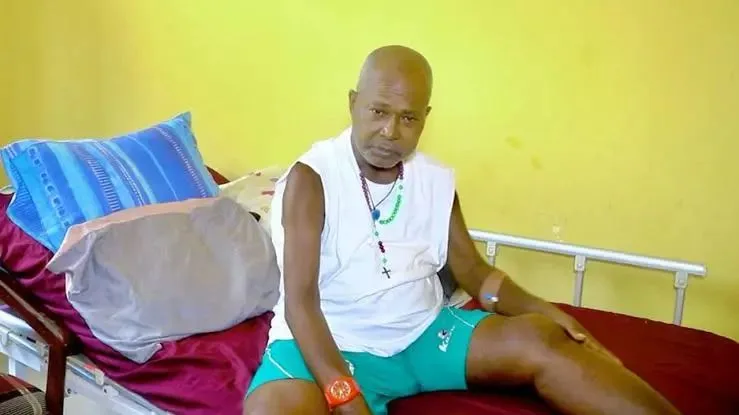
Henry Nwosu, Nigerian Football Hero of the 1980 AFCON, Dies at 62 – Segun Odegbami Posts
Henry Onyemanze Nwosu, the gifted midfielder who became the youngest player to wear Nigeria’s green jersey to continental glory, died in the early hours of Saturday at the Lagos State University Teaching Hospital in Ikeja, Lagos. He was 62 years old.
His death was confirmed by fellow former international Segun Odegbami in an emotional Facebook post, who revealed that the man he fondly called the “Youngest Millionaire” passed away at 4:00 a.m. after being in intensive care since Wednesday.
Trending Now!!:
The news spread across Nigeria with the force that only the death of a true national symbol can produce. In the language of grief that only former teammates truly know, Odegbami wrote: “It is with deep pain in my heart that I have to be the conveyor of the news of the death of Henry Nwosu MON, the youngest of the victorious 1980 AFCON squad. May he rest peacefully with our Creator in Heaven.”
Within minutes, the tribute had traveled from Lagos to London, then back to Lagos, to diaspora communities across three continents, finding in every corner a Nigerian who remembered what Nwosu represented, not just a player, but proof of what a young nation could achieve.
Nwosu’s death comes just days after Nigerian football lost another towering figure, former Super Eagles coach Adegboye Onigbinde, who led Nigeria to the 2002 FIFA World Cup in Japan and South Korea, and who died on March 9 at the age of 88. The two losses, arriving within the same week, struck the Nigerian football fraternity as a cruelty too concentrated to absorb. Both Nwosu and Onigbinde had walked the same corridors of Nigerian football’s most celebrated era, and both have now departed within the span of five days.
Born on June 14, 1963, in Imo State, Nwosu played for Nigeria between 1980 and 1991, earning approximately 60 caps and scoring eight goals. But statistics alone cannot contain what he was. He arrived on the national stage not as a seasoned veteran but as a teenager, raw, audacious, and possessed of a footballing intelligence that made older defenders look slow and older coaches look wise for picking him. He was, in the most literal sense, a boy who played among men and made the men look ordinary.
The tournament that defined him was hosted on home soil, in Lagos, in the heat of the first year of the new decade. The Green Eagles, as the Super Eagles were then known, had twice finished third at the Africa Cup of Nations, in 1976 and 1978, and the pressure to finally win on home ground was enormous. It was Coach Otto Gloria who enlisted Odegbami and a group of formidable players, including Christian Chukwu, Adokie Amasieamka, Muda Lawal, and Felix Owolabi, to win the country’s first African Cup of Nations. Nwosu was the youngest of that constellation, barely 16 years old, and already indispensable.
The final, against Algeria, ended in a 3-0 triumph that sent Lagos into a delirium of celebration that the city has not fully recovered from in the 46 years since. Odegbami scored two goals in the final against Algeria in that 3-0 victory, and Nwosu, the teenager everyone called the Youngest Millionaire, was on the pitch for every extraordinary minute of it. The members of that triumphant squad were invested with the national honor of Member of the Order of the Niger (MON), and Nwosu carried those three letters after his name, Henry Nwosu, MON, for the rest of his life. They were not merely an award. They were an inscription of national gratitude, permanent and deserved.
Born in Imo State, Nwosu rose to prominence in the 1980s as one of Nigeria’s most talented midfielders, known for his creativity, dribbling ability, and tactical intelligence. After the triumph of 1980, he did not rest on the achievement of a single tournament. He went back. He kept going back. He featured in the Africa Cup of Nations tournaments of 1980, 1982, 1984, and 1988, with Nigeria finishing as runners-up in both the 1984 and 1988 editions. For more than a decade, the man they called the Youngest Millionaire was a constant, a midfielder whose presence on the team sheet was both a comfort and an expectation.
At club level, Nwosu enjoyed a distinguished career, playing for New Nigeria Bank FC of Benin City and ACB Lagos, as well as stints abroad with ASEC Mimosas of Côte d’Ivoire and Racing FC Bafoussam of Cameroon. His willingness to venture beyond Nigeria’s borders at a time when such moves were rare for Nigerian footballers spoke to the ambition that had always defined him. He had been the youngest in a room of champions at 16. Crossing borders as a professional was, by comparison, a small risk.
He also represented Nigeria at the 1980 Summer Olympics in Moscow, where he scored the country’s only goal of the tournament. It was a goal scored on the grandest stage in international sport, and it remains one of the quietly extraordinary facts of his career, the sort of achievement that deserves louder telling.
When his playing days ended in the early 1990s, Nwosu did not walk away from the game. He walked deeper into it. After retiring, he served as an assistant coach with Nigeria’s national teams, including the side that won a silver medal at the 2008 Summer Olympics in Beijing, and also worked with Union Bank FC and Gateway United FC. The silver medal in Beijing was one of the proudest moments in the history of Nigerian Olympic football, and Nwosu’s fingerprints were on the technical staff that helped produce it. He was also appointed coach of the Nigerian Under-17 side in 2008, entrusted with shaping the nation’s next generation.
In recent years, he battled health challenges, including a stroke that required ongoing medical care and support from members of the football community. Those who had once cheered for him from the stands were now rallying around him in hospital corridors — a reminder, painful and persistent, of the inadequacy of support structures for Nigeria’s retired footballers who had given so much of themselves to the country’s joy.
The man who announced his passing to the world is himself one of Nigeria’s most storied and beloved figures. Patrick Olusegun Odegbami, born August 27, 1952, won 46 caps and scored 23 goals for the Nigeria national team, guiding the country to its first Africa Cup of Nations title at the 1980 tournament.
Nicknamed “Mathematical,” he was famous for his skill on the ball, speed, and the precision of his crosses from the right wing. The nickname was coined by the legendary broadcaster Ernest Okonkwo, inspired by Odegbami’s penetrating passes and his background as an engineering graduate from The Polytechnic, Ibadan. Odegbami was the joint top scorer of the 1980 tournament alongside Morocco’s Khalid Labied, with three goals, including the brace he scored against Algeria in the final.
In the decades after his boots were hung up, Odegbami became a respected sports journalist, writer, and broadcaster, and went on to found the Segun Odegbami International College and Sports Academy (SOCA) in Wasimi, Ogun State. He also briefly declared an ambition to run for the FIFA presidency in 2015, and in 2022 launched Eagles 7 Sports Radio 103.7 FM. He is a man of several distinguished acts, but on this Saturday morning, the act that will be remembered is the one he performed in grief: the act of bearing witness to the end of a brother.
That Odegbami chose to personally carry the news of Nwosu’s death, and did so in language raw with sorrow, reflects something deeper than social media habit. It reflects the irreplaceable intimacy of that 1980 squad. They were not merely teammates. They were young men who had done something together that no group of Nigerians had done before, and the bond forged in that achievement outlasted careers, outlasted decades, and outlasted health. It endures now, apparently, even past death itself.
Henry Nwosu is survived by his family. Information on funeral arrangements has not yet been announced. He was born on June 14, 1963. He died on March 14, 2026, exactly three months to the day before what would have been his 63rd birthday. Nigeria’s football community is mourning. The continent is mourning. And somewhere in Lagos, the man who called him the Youngest Millionaire is doing what old teammates do when the last whistle blows, sitting in silence, and remembering.