67 Lives Lost in the DC Midair Collision: Revisiting the Potomac River Tragedy
The American Airlines Flight 5342 crash over the Potomac River was not a mystery. The warnings were documented, the risks were known, and 67 people still died. Here is what the investigation uncovered, and why it is not over.
The water was cold and dark, and the Potomac River was keeping its secrets. Somewhere beneath its surface, twisted metal and shattered lives were settling into the silt.
Families at Reagan National Airport had been waiting at the arrivals gate, checking their phones, watching the boards. And then the boards stopped updating.
Trending Now!!:
That was January 29, 2025, at 8:47 p.m. Eastern time, the moment American Airlines Flight 5342 and a United States Army Black Hawk helicopter collided in the night sky above Washington, D.C., ending the lives of all 67 people aboard both aircraft.
It was, in an instant, the deadliest aviation disaster on American soil since November 2001. And as the months that followed would brutally reveal, it was also one of the most preventable.
What Happened Over the Potomac That Night
The collision involved a Bombardier CRJ700 regional jet operating as American Airlines Flight 5342, flown by PSA Airlines under the American Eagle brand, and a United States Army Sikorsky UH-60 Black Hawk helicopter operating as Priority Air Transport 25. The aircraft struck each other at an altitude of roughly 300 feet, approximately half a mile from the threshold of Runway 33 at Ronald Reagan Washington National Airport.
The jet had originated in Wichita, Kansas, and was carrying passengers home from the U.S. Figure Skating Championships and a national development camp that followed the competition. It was a routine regional hop, the kind of flight that tens of thousands of Americans board each week without a second thought. The plane was minutes from touchdown.
The collision was captured on a webcam at the John F. Kennedy Center for the Performing Arts. Witnesses reported the airliner split in half upon impact, while the helicopter crashed upside down nearby. Within three hours, authorities confirmed fatalities. By 2:50 a.m. the following morning, no survivors had been reported.
First responders who arrived at the scene that night have described what they found in terms that are impossible to dress up. When a direct line to Reagan National Airport rang that Wednesday night, Local 36 union members expected a routine report of a flight in distress.
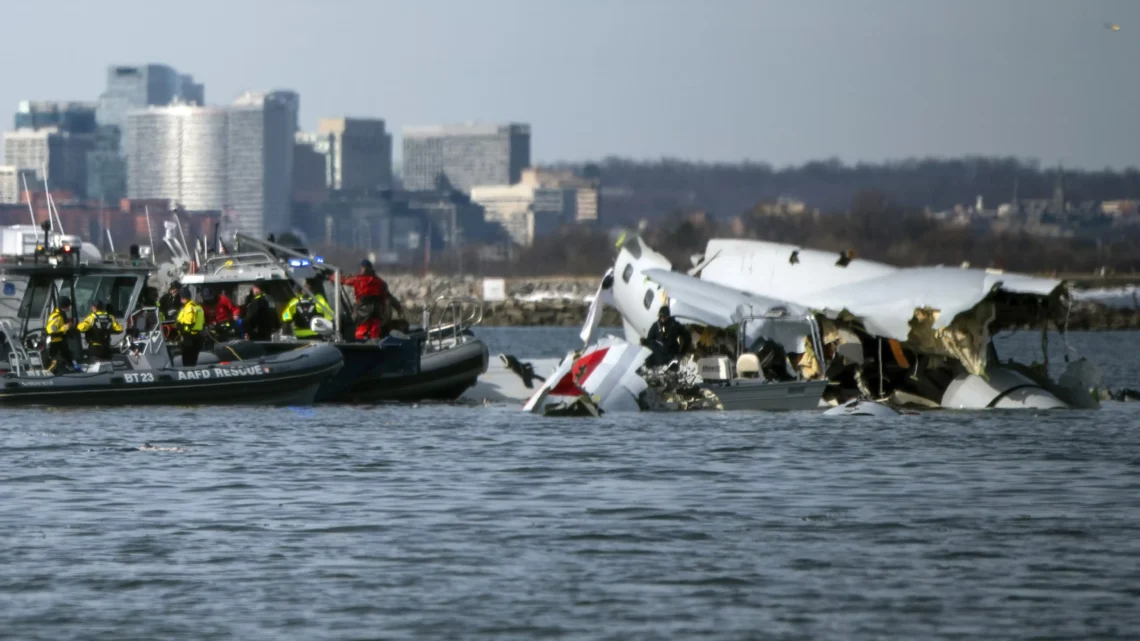
Instead, they heard: “Crash! Crash! Crash!” As they rushed to a fireboat pier, burning debris rained down on the Potomac. First responders arrived to find wreckage submerged in shallow water and almost immediately started finding victims. Some passengers were still strapped to their seats.
That image has stayed with those responders. The seat belts, fastened for landing. The passengers who had no idea what was coming.
The People on Board
Understanding the DC plane crash requires understanding who was on that flight, because the passenger manifest reads not like a list but like a portrait of American life at its most hopeful and most ordinary, all at once.
The plane carried 60 passengers and four crew members. The Black Hawk helicopter was carrying three soldiers when they collided over the Potomac River.
The plane’s passengers included 28 people connected to the sport of figure skating, many of them returning from a training camp following the 2025 U.S. Figure Skating Championships in Wichita. These were families who spent their weekends at ice rinks, parents who drove hours in the predawn cold so their children could practice jumps and spins before school. Their dreams were large, their routines demanding, and their bond to the sport total.
The 67 Victims of Flight 5342 and the Potomac Collision
The following are the confirmed victims of the January 29, 2025, collision. Ages and professions are included where publicly confirmed. Some families requested privacy, and details were not released.
Flight Crew, American Eagle Flight 5342
- Captain Jonathan Campos, 34, Commercial Airline Pilot
- First Officer Samuel Lilley, 28, Commercial Airline Pilot
- Danasia Brown Elder, Flight Attendant
- Ian Epstein, Flight Attendant
U.S. Army Black Hawk Helicopter Crew
- Captain Rebecca Lobach, 28, Army Pilot
- Chief Warrant Officer 2 Andrew Loyd Eaves, 39, Army Evaluator Pilot
- Staff Sergeant Ryan Austin O’Hara, 29, Army Crew Chief
Passengers
- Spencer Lane, 16, Competitive Figure Skater
- Christine Lane, Spencer’s mother
- Jinna Han, Competitive Figure Skater (teen)
- Jin Han, Jinna’s mother
- Everly Livingston, 14, Competitive Figure Skater
- Alydia Livingston, 11, Competitive Figure Skater
- Peter Livingston, 48, Realtor and skating parent
- Donna Livingston, 48, Marketing Executive, Comcast
- Edward Zhou, Competitive Figure Skater
- Evgenia Shishkova, Figure Skating Coach, 1994 World Champion
- Vadim Naumov, Figure Skating Coach, 1994 World Champion
- Inna Volyanskaya, Former Professional Figure Skater and Coach
- Alexandr Kirsanov, Figure Skating Coach
- Brian Ellis, Lieutenant Colonel, U.S. Naval Academy; Senior Manager, Deloitte
- Kiah Duggins, Civil Rights Attorney; Incoming Law Professor, Howard University
- Lindsey Fields, Biology Professor and Department Chair, Butler Community College; President-elect, National Association of Biology Teachers
- Chris Collins, Financial Professional, Moody’s
- Melissa Nicandri, Financial Professional, Moody’s
- Grace Maxwell, College Student, Cedarville University
- Elizabeth Keys, Attorney, Wilkinson Stekloff
- Michael Stovall, 40
- Jesse Pitcher, 30
- Dustin Miller, IT Professional
- James “Tommy” Clagett, Soccer Coach
- Bob Schrock, Farmer and Co-founder, Premium Grain Inc.
- Lori Schrock, Farmer and Co-founder, Premium Grain Inc.
- Wendy Jo Shaffer
- Casey Crafton
Additional victims whose families requested privacy or whose details were not publicly confirmed at the time of publication
Among those killed were teenage skaters Jinna Han and Spencer Lane, both traveling with their mothers, Jin Han and Christine Lane. The young skaters were affiliated with the Skating Club of Boston and had been returning from the national championships.
Spencer Lane, at 16, was the kind of talent that makes coaches reconsider the rules they thought were immovable. He had taken up skating in earnest after watching Nathan Chen and Vincent Zhou at the 2022 Beijing Olympic Games.
His coaches at the Skating Club of Boston marveled that a kid who started skating at 12 or 13 might actually have been on track for the Olympics. His father, Doug Lane, speaking from the wreckage of his grief to a Rhode Island television station, called Spencer a force of nature. He described his wife, Christine Lane, as someone who could plug into any room or community and build real human bonds within minutes.
Among the coaches killed were Evgenia Shishkova and Vadim Naumov, a married couple who had won gold medals in pair skating at the 1994 World Figure Skating Championships, along with fellow coaches Inna Volyanskaya and Alexandr Kirsanov.
Shishkova and Naumov had been living in the United States since 1998, shaping the next generation of American skaters, including their own son Maxim. One of Maxim Naumov’s final conversations with his parents had involved his chances for making the 2026 Olympic team. He would go on to earn that spot, carrying his parents’ memory onto the ice in Milan.
Peter Livingston and Donna Livingston, both 48, died alongside their daughters, Everly Livingston, 14, and Alydia Livingston, 11, who had been skating all their lives. Peter had built an ice rink in their backyard annually so the girls could learn to skate. They passed away, their family said, together.
College student Grace Maxwell was traveling back to campus after a trip home, according to Cedarville University, the Christian school she attended. Two Moody’s colleagues, Chris Collins and Melissa Nicandri, died side by side, their employer noting they had embodied the firm’s values and enriched the lives of everyone around them.
The three Army soldiers aboard the Black Hawk helicopter were conducting a required annual evaluation using night-vision goggles. The crew chief, accounts noted, was a new father with a smile for everyone, especially for his infant son.
Sixty-seven people. Sixty-seven stories. Every one of them was mid-sentence when that story ended.
The Airspace That Was Always an Accident Waiting to Happen
Anyone who has flown into Reagan National Airport knows the feeling. The approach to the airport is unlike almost anything else in commercial aviation. The Potomac curves. The monuments rise.
The restricted airspace presses in from multiple directions because you are essentially threading a needle between some of the most sensitive real estate on earth. Pilots who work those approaches regularly describe them, privately, as humbling at best and unnerving at worst.
The airspace around Reagan National Airport is among the world’s most complex and closely monitored, with restrictions on both sides of the Potomac River to protect government buildings in Washington. Military helicopter operations further complicate the picture, including a helicopter corridor that passes within 15 feet vertically of the approach to Runway 33.
Read that again. Fifteen feet. Vertical separation of fifteen feet between a military helicopter route and the final approach path of a commercial airliner.
The FAA had collected reports of more than 80 serious close calls between helicopters and passenger aircraft near Reagan National in recent years. That data was in their own systems. The NTSB was the first to draw attention to those conflicts.
Air traffic controllers at the local tower had been raising flags for years. They told the FAA, in writing, that the proximity between helicopter traffic along the Potomac and the approach to Runway 33 was dangerous. Nothing meaningful was done.
In 2024, Congress had approved additional flights at the airport, further compressing an already strained system. More planes, same inadequate airspace design, same unresolved helicopter route conflicts.
The Final Two Minutes
The sequence of events in the minutes before the American Airlines Reagan National Airport collision tells a story of compounding failures and missed moments.
At 8:43 p.m., as Flight 5342 was flying a visual approach to Runway 1, it made initial contact with the Reagan National control tower. The controller asked if the crew could switch to Runway 33. The crew accepted and was cleared to land on Runway 33.
At 8:46 p.m., around two minutes before the collision, the controller called the helicopter crew, advising them of the CRJ700. The helicopter crew reported twice that they had visual contact with the airliner and would maintain separation, although it is unknown whether they were actually monitoring the correct aircraft.
The crew of the Black Hawk may not have heard parts of the tower communication due to a mic press. The two aircraft communicated on different radio frequencies, meaning the pilots of Flight 5342 and the helicopter crews could not hear each other’s transmissions to the controller, only the controller’s responses.
In those final moments, a commercial jet and a military helicopter were converging at night, at low altitude, over the Potomac, each crew operating on incomplete information about the other’s precise location. The controller, who was simultaneously managing both helicopter and local air traffic, had complained of being overwhelmed earlier in the shift. The supervisor on duty had not separated the responsibilities.
The NTSB found that the supervisor should have separated the helicopter and landing responsibilities after the controller complained about being overwhelmed. The controller should also have issued a safety alert in the moments before the helicopter and regional jet approached each other.
Neither action happened.
What the NTSB Found: A System That Failed at Every Level
The National Transportation Safety Board’s final findings, released in January 2026, described systemic failures in airspace design, safety oversight, and risk management by the FAA and the U.S. Army. The nearly 400-page report is, in many ways, a forensic autopsy of institutional negligence.
The NTSB’s final report describes a chain of errors in which the policies and procedures in place to protect the public failed that cold winter night. NTSB Chair Jennifer Homendy described the causes as deep, underlying systemic failures, system flaws that aligned to create the conditions for the tragedy.
The findings were specific and damning:
The FAA’s helicopter route design in the Washington area failed to provide procedural separation between helicopters and fixed-wing aircraft on approach and departure paths at Reagan National. The route structure allowed helicopters to fly directly beneath an active approach corridor for commercial airliners without sufficient mitigations to manage the risk of collision.
Aeronautical charts for fixed-wing pilots did not depict nearby helicopter routes that intersected approach paths, limiting shared situational awareness. The pilots of Flight 5342 had no way to see on their charts that they were on a convergence course with a military corridor.
The U.S. Army’s safety management processes also failed. The Army lacked a flight data monitoring program for helicopters operating near major airports and had limited participation in safety reporting systems.
NTSB investigators formally made 50 safety recommendations in the final report, including 33 directed to the FAA, calling for time limitations on air traffic control supervisors, improved training, limits on some commercial air traffic at busy airports, and improved collision avoidance technology.
One moment crystallized the cost of inaction more than any other. Investigators noted that had the pilots been warned of each other’s exact position nearly one minute before impact, 67 people would still be alive today.
The Government Admits What Families Already Knew
In December 2025, the United States government admitted some failures and accepted liability for its role in the collision, according to a filing in a civil suit brought by the family of one of the 67 people killed. The filing served as the master complaint on behalf of all deceased passengers.
The government admitted it owed a duty of care to the plaintiffs, which it breached, thereby proximately causing the January 29, 2025, accident. It acknowledged that the air traffic controller had violated procedures about when to rely on pilots to maintain visual separation, and that the Army helicopter pilots’ failure to maintain vigilance was a proximate cause of the accident.
Doug Lane, who lost his wife Christine and son Spencer in the crash, spoke plainly about what the families are fighting for. He said the goal was to take the 67 people who were lost and use the strength and love left behind to keep the sky safer for others.
Eighteen family members of those killed released a joint statement declaring that serious, systemic failures in air travel safety cost their loved ones their lives and continue to threaten public safety. It was not a statement full of legal language. It was written by people who had been waiting at an arrivals gate.
What Has Changed, and What Has Not
Since the crash, the FAA has reduced hourly arrival rates at Reagan National, restricted helicopter operations near the airport’s airspace, required helicopters to broadcast their locations, and increased staffing at the air traffic control tower.
Those are meaningful steps, taken in the immediate aftermath of a catastrophe that should have been prevented by steps taken years earlier. But the larger legislative response remains incomplete.
Virginia lawmakers have expressed frustration that the ROTOR Act, which requires aircraft to be equipped with technology that transmits their positions to others operating in the same airspace, appears stalled in Congress.
The NTSB has issued hundreds of safety recommendations over the decades it has investigated crashes. Many go unimplemented. Homendy closed the final report on this collision by revisiting that history, noting that too many recommendations from previous deadly accidents had gone unheeded. Her closing words were a promise: the NTSB will never give up until there are zero grieving families and a safe transportation system for all.
A Community Still Grieving, Still Moving
On March 2, 2025, a benefit ice show called Legacy on Ice was held at Capital One Arena in Washington, D.C., co-hosted by Olympic champions Brian Boitano and Kristi Yamaguchi, in honor of the victims of the collision.
All proceeds were distributed equally between the U.S. Figure Skating Family Support Fund, the Greater Washington Community Foundation’s DCA Together Relief Fund, and the DC Fire and EMS Foundation.
The arena, which holds 20,000 people, filled up. Every seat taken for 67 people who would never know it happened.
Maxim Naumov, who lost both of his parents in the crash, went on to earn a berth on the U.S. Olympic figure skating team. Reflecting on how he pushed through the grief, he said that in times of really difficult emotional stress, if you can push yourself and ask what if I can still do it despite everything, that is where you find strength.
His parents, world champions who dedicated their later years to building other people’s children into champions, would have recognized that.
What This Crash Is Really About
Every major aviation disaster in history carries the same underlying lesson, and the aviation safety community has been saying it for decades. Crashes are almost never about one thing. They are about what happens when systems designed to catch failures at multiple points all fail at once, usually because the warnings were there, but nobody acted on them.
The DC midair collision over the Potomac River was not an unpredictable tragedy. It was a predictable one. The data was in the FAA’s own systems. The controllers had raised concerns. The proximity of helicopter routes to final approach paths was known and flagged. The airspace around Reagan National had been acknowledged as among the most complex in the world. The fixes required were not technologically impossible.
What was lacking was urgency. What was lacking was accountability. And what was ultimately lacking was the willingness to accept that “no incidents yet” is not the same as “safe.”
Sixty-seven people paid for that distinction with their lives.
The investigation is complete. The report is published. The recommendations are on the table. What happens next is not a question of aviation science or air traffic control procedure. It is a question of political will and institutional courage.
The families of Flight 5342 are watching. And they have made it very clear that they are not finished.