How to Sharpen Kitchen Knives The Right Way
In the kitchen, a sharp knife isn’t a luxury—it’s a necessity. After more than a decade spent prepping in professional kitchens and teaching home cooks, I’ve seen the same pattern repeat: someone buys a beautiful chef’s knife, uses it for a few months, then complains it’s “gone dull.”
The truth is, the knife hasn’t gone dull; the edge has rolled or worn from daily use. The real issue is that most people never learn how to sharpen kitchen knives properly and instead resort to quick fixes that do more harm than good.
Trending Now!!:
I’ve ruined edges early on by rushing, and I’ve watched students chip expensive Japanese blades by pressing too hard. Sharpening isn’t about speed or brute force—it’s about patience, consistency, and understanding your tool.
Done correctly, it extends your knife’s life and makes cooking feel effortless. Here’s the approach that has served me best over the years, blending the precision pros demand with the practicality home cooks need.
First, Know When Your Knife Actually Needs Sharpening
Don’t wait until the blade won’t slice a tomato without squashing it. A better test: hold a piece of paper upright and try to slice it. If it tears instead of gliding through, the edge needs attention.
Another telltale sign is when your knife starts slipping on onions or herbs, rather than cutting cleanly. Most home cooks confuse honing with sharpening.
Honing realigns the microscopic teeth along the edge that bend with use—think of it as daily maintenance. Sharpening actually removes metal to create a new edge. I hone my knives almost every time I use them, but I only sharpen every few months, depending on how heavily I cook.
The Best Tools: Whetstones for Serious Results
After trying pull-through sharpeners, electric gadgets, and everything in between, nothing beats a quality whetstone for control and edge quality.
The gold standard is a combination stone—say, 1000 grit on one side for shaping the edge and 6000 grit on the other for polishing. Soak it in water for 10-15 minutes until bubbles stop rising (a mistake I made early was using dry stones, which gouged blades).
For Western-style knives (like most German or American chef’s knives), aim for a 20-degree angle per side. Japanese knives often use 15 degrees for a sharper, but more delicate, edge.
If you’re unsure, match the factory bevel—use a permanent marker to color the edge, then sharpen until the marker disappears evenly.
Step-by-Step: Sharpening on a Whetstone
- Set up stably: Place a damp towel under the stone to prevent slipping. Work on a counter at waist height so your arms stay relaxed.
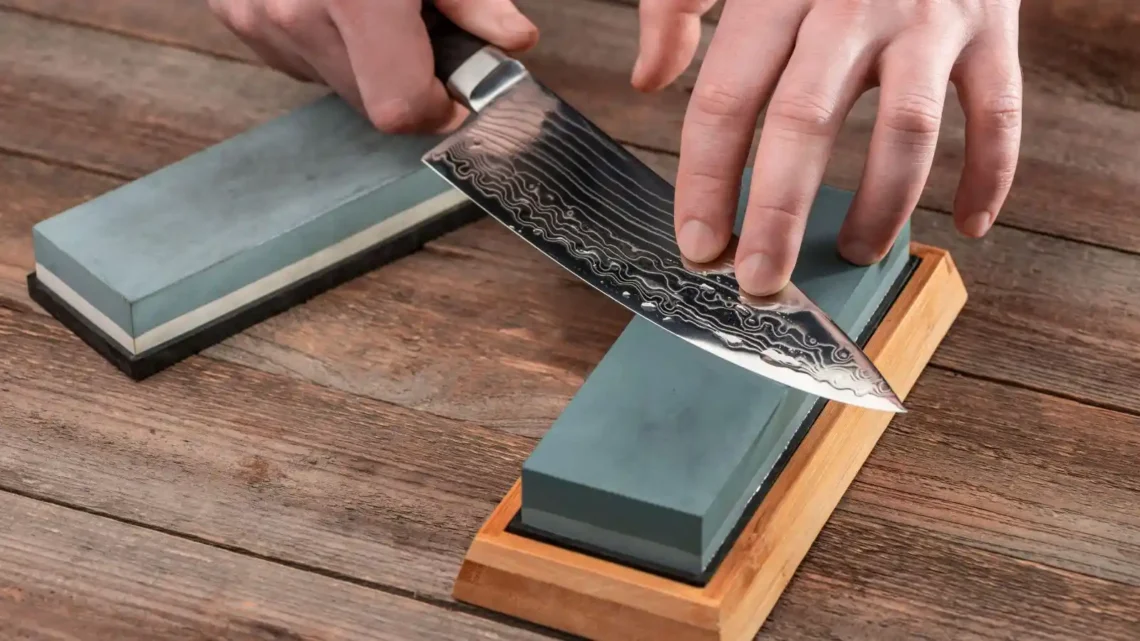
- Find your angle: Hold the knife with your dominant hand on the handle, and use the fingers of your other hand to press lightly on the blade near the edge for control. Tilt until the spine is about the width of two stacked quarters off the stone—that’s roughly 20 degrees. Practice without sharpening first; consistency trumps everything.
- Create the burr: Start on the coarser side. Push the knife forward (edge leading) across the stone, as if slicing a thin layer off the top. Use light, even pressure—too much, and you’ll create uneven bevels or heat that warps the edge. I do 10-15 strokes per side, alternating, until I feel a slight “burr” (a raised wire edge) along the entire length when I run my thumb perpendicular to the blade (never along it—safety first). Early on, I pushed too hard and ended up with a wavy edge that cut like a saw. Light pressure lets the stone do the work.
- Flip and repeat: Switch sides frequently to keep the bevels even. When the burr forms consistently, move to the finer grit. Fewer strokes here—maybe 5-10 per side—to refine and remove the burr.
- Remove the burr and polish: Lightly strop on the stone or a leather belt with compound. The edge should feel sticky-sharp, catching on a fingernail.
Honing: Your Daily Ritual
Use a ceramic or steel honing rod (ceramic is gentler and actually micro-sharps). Hold it vertically and tip it down on a cutting board. Swipe the knife at 15-20 degrees, heel to tip, alternating sides—5-10 passes total.
Do this before each big prep session. It keeps the edge aligned for weeks longer between full sharpenings.
Common Pitfalls I’ve Learned the Hard Way
- Inconsistent angle: This creates rounded or faceted edges. Go slow; speed comes with muscle memory.
- Over-sharpening: Grinding away too much metal shortens blade life. Sharpen only when needed.
- Skipping the burr check: Without it, you’re just polishing a dull edge.
- Using pull-through sharpeners as a crutch: They work in a pinch, but often create micro-serrations or remove too much metal unevenly. I’ve rescued many knives from them by going back to stones.
- Neglecting maintenance: A dull knife forces harder cuts, increasing slips and accidents.
Final Touches and Storage
After sharpening, test on paper or a tomato. Clean the blade, dry it immediately (rust loves moisture), and store it in a block, magnetic strip, or sheath—never loose in a drawer. A sharp knife is safer because it requires less force.
Sharpening becomes meditative once you get it right. The whisper of steel on stone, the satisfaction of a blade that glides through produce—it’s one of the quiet joys of cooking. Invest the time, and your knives will reward you for years to come.
If you’re starting, practice on an old beater knife first. You’ll get there, and when you do, you’ll wonder how you ever cooked without a truly sharp edge.