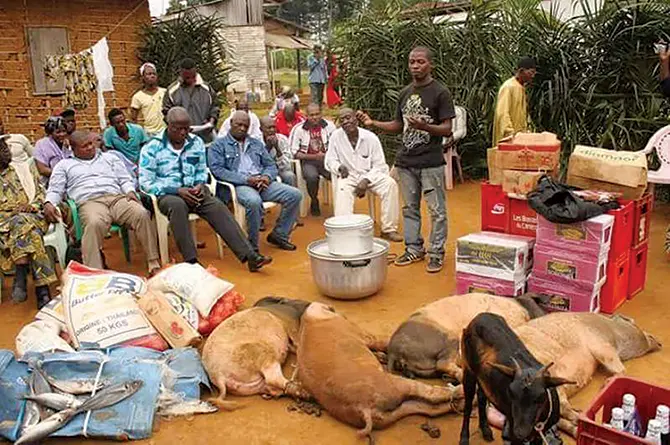
Why Are We Still Selling Our Daughters? The Rotting Core of Bride Price Culture
Across Nigeria and much of Africa, millions of families continue to place a monetary tag on their daughters’ worth. Dressed in tradition, bride price has become one of the continent’s most enduring — and most damaging — myths.
In a compound in Anambra State, a young woman with a master’s degree in biochemistry sat in silence as the men in her family negotiated her future with the family of her intended.
Her academic certificates, her years of sacrifice, her ambitions — none of it was on the table. What was on the table, quite literally, were bottles of schnapps, a list of items, and a sum of money. She was, in the language of her own culture, being priced.
Trending Now!!:
This is not a scene from a history book. It happened last year. It happens every weekend across Nigeria, Ghana, Kenya, Zimbabwe, and dozens of other African nations. It is normalized in film, celebrated in social media reels, and defended in church halls and community forums with the same tired refrain: “It is our culture.”
But culture is not a shield. And tradition is not a synonym for justice. The practice of bride price — the payment of money, livestock, or goods by a groom’s family to the family of a bride — is, at its functional core, a commercial transaction in which women are the commodity. No amount of festivity, no volume of highlife music, and no quantity of palm wine can perfume that fact away.
The History They Don’t Tell You at the Ceremony
Proponents of bride price often argue that the practice is a gesture of gratitude — a way for the groom’s family to honour the woman’s family for raising her. It is, they say, a beautiful exchange of goodwill, a bridge between families, a celebration of union.
That argument is historically dishonest. Pre-colonial African bride price was largely symbolic and communal — an affirmation of alliance between families, often involving modest, negotiable tokens. What exists today in much of Nigeria and sub-Saharan Africa is something far more transactional, far more inflated, and far more damaging.
In states like Imo, Rivers, Cross River, and among many Igbo and Yoruba communities, the modern bride price list reads less like a symbol of love and more like an invoice. Researchers at the African Population and Health Research Centre have documented how commercialised bride price has become, with families openly admitting they view daughters as financial assets to be recovered.
When a father tells his daughter’s suitor that the price is higher because the girl is educated, what is he communicating? Is she more valuable as a human being? No. He is communicating that the return on his investment is higher. The language of the market has swallowed the language of love.
The Violence Hidden in Plain Sight
The consequences of bride price are not abstract. They are written on the bodies and spirits of African women every single day.
A 2021 study published in the journal BMC Women’s Health found a significant association between bride price payment and intimate partner violence in sub-Saharan Africa.
Women whose marriages involved financial bride price transactions reported higher rates of physical and psychological abuse — the logic being brutally simple: a man who has paid for something believes he owns it. When a husband has handed over cattle, cash, or cartons of malt drinks to acquire his wife, the psychological contract he has entered is one of ownership, not partnership.
In Uganda, where bride price — known locally as lobola — has been litigated all the way to the courts, women’s rights organizations have long argued that the practice makes it nearly impossible for women to leave abusive marriages. If she leaves, her family may be obligated to return the price paid.
Across Nigeria, this silent economic trap plays out in countless households where women endure abuse rather than force their families into debt or shame. The bride price is not merely a cultural ritual. For millions of women, it is a financial cage.
“A man who has paid for something believes he owns it. When a husband has handed over cash or cattle to acquire his wife, the psychological contract he has entered is one of ownership, not partnership.”
What It Does to Our Daughters’ Minds
Consider the girl who grows up knowing that her family expects to be compensated for her. What does that do to her sense of self-worth, independent of any man’s willingness to pay? What does it say to her about her own autonomy — that she is, from birth, a future asset on a family balance sheet?
Nigerian psychologist Dr. Amara Osei-Bonsu has written about the internalized objectification that accompanies bride price cultures, noting that many young women arrive at adulthood having absorbed the message that their primary social function is to be chosen and paid for.
This shapes career decisions — some families actively discourage daughters from pursuing higher education because it raises the bride price and risks making their daughters “unmarriageable.” It shapes the way women negotiate within marriages. And it shapes the quiet, devastating way millions of African women have learned to measure their own worth: in someone else’s currency.
The ‘Culture’ Argument Has No Clothes
Every generation of African intellectuals, religious leaders, and political voices has, at some point, weaponized “culture” to justify what is simply the oppression of women. Colonialism was wrong.
Female genital mutilation is wrong. Child marriage is wrong — and the Nigerian Child Rights Act of 2003 codifies exactly this, setting 18 as the minimum age of marriage. Bride price, in its modern commercialised form, belongs in the same conversation.
Culture is not static. Nigeria’s own history illustrates this. The practice of killing twins, once culturally sanctioned in parts of the South-East, was abandoned. Osu caste discrimination, though stubborn, is increasingly condemned by a newer generation. Cultures evolve when people demand evolution. The question is never whether change is possible. The question is whether we have the moral courage to pursue it.
Defenders of bride price also like to contrast it with the Western practice of dowry, as if one form of women-as-transaction makes the other acceptable. It does not. The question to ask is not: “Does the West do it too?” The question is: “Does this practice diminish the humanity of women?” The answer, clearly, is yes.
The Legal Dimension: What Nigerian Law Actually Says
Nigeria’s Constitution, specifically Section 42, prohibits discrimination on the basis of sex. The Violence Against Persons Prohibition (VAPP) Act of 2015, considered one of the most progressive pieces of gender legislation in West Africa, criminalizes emotional, psychological, and economic abuse in intimate relationships.
The African Charter on Human and Peoples’ Rights — to which Nigeria is a signatory — and its Maputo Protocol on the Rights of Women in Africa explicitly guarantees women the right to dignity, equality, and freedom from discrimination.
None of these frameworks explicitly bans bride price. But they create a powerful legal and moral architecture that is fundamentally incompatible with a practice that assigns women a commercial value.
Advocacy organizations such as Women’s Aid Collective (WACOL) and Alliances for Africa have long argued that bride price, particularly in its coercive and commercialized forms, conflicts with these human rights obligations. Nigerian courts have yet to grapple directly with this tension. They will need to.
The Voices of African Women — Who Are Rarely Asked
The most striking feature of public defences of bride price is who is usually doing the defending: men. Elderly men. Men whose families have collected bride prices, or will. Men for whom the ritual carries economic or social benefit.
When African women are asked — truly asked, in spaces where they can answer freely — the picture is far more complex. A 2019 survey by the Centre for Gender Studies at the University of Lagos found that while 61 percent of female respondents said they would not personally abolish bride price entirely, nearly 80 percent said the practice made them feel “like a purchased object” at some point during or after their wedding. These are not the testimonies of women who have been corrupted by foreign ideology. These are the testimonies of women who have lived inside the system.
Chimamanda Ngozi Adichie, Nigeria’s most decorated living writer, has described how the language of bride price subtly frames marriage as a transfer of ownership. “The language we use matters,” she wrote in her seminal essay We Should All Be Feminists. She is right. The language of bride price says: this woman had a price. That language does not disappear after the wedding. It lives in the marriage.
What Reform — Not Abolition — Could Look Like
This argument is not a call for cultural erasure. African traditions are rich, layered, and worthy of pride. The beauty of the traditional wedding ceremony — the colours, the dances, the gathering of families — is not what is being indicted here. What is being indicted is the monetization of women within it.
A reformist path is possible — and it is already being walked in some communities. In parts of Kenya, community elders have adopted voluntary caps on bride price amounts. Several progressive Igbo families in Nigeria have replaced monetary negotiations with symbolic exchanges — kola nut, wine, and mutual gifts — stripping out the transactional core while preserving the celebratory spirit.
The Kenyan government has invested in community dialogues to transform the practice. Ethiopia’s National Action Plan on harmful traditional practices explicitly targets the commercialisation of bride price.
Nigerian state governments, traditional rulers, and the National Council for Women Societies have the platform and the mandate to lead this conversation at scale. They have not done so with anything approaching adequate urgency. That silence is itself a statement about whose dignity is considered negotiable.
A Continent That Deserves Better
Africa is the youngest continent on earth. More than 60 percent of its population is under 25. These young people — the daughters sitting in those negotiation rooms, the sons being taught that love is a bill to be settled — are watching how their elders choose to define womanhood. They are taking notes.
Nigeria’s gender gap in education, economic participation, and political representation is not unrelated to a culture that, at its most foundational social ritual, reminds women of their transactional role. The World Economic Forum’s 2023 Global Gender Gap Report ranked Nigeria 123rd out of 146 countries. That number does not exist in a vacuum. It exists in a context, and bride price is part of that context.
We are a people capable of extraordinary things. We produced Wole Soyinka, Chinua Achebe, and Ngozi Okonjo-Iweala. We built empires — Oyo, Benin, Songhai — that commanded the respect of the world. We are not people who lack the intellectual or moral capacity to examine our traditions honestly.
What we lack — what we must urgently cultivate — is the willingness to look our daughters in the eye and tell them the truth: that they are not goods. That they do not have a price. That their worth is not a figure written on a list by men who will never have to pay it.
The most radical thing a Nigerian father can do today is sit down with his daughter, look her in the eye, and say: “Your love is not for sale.”