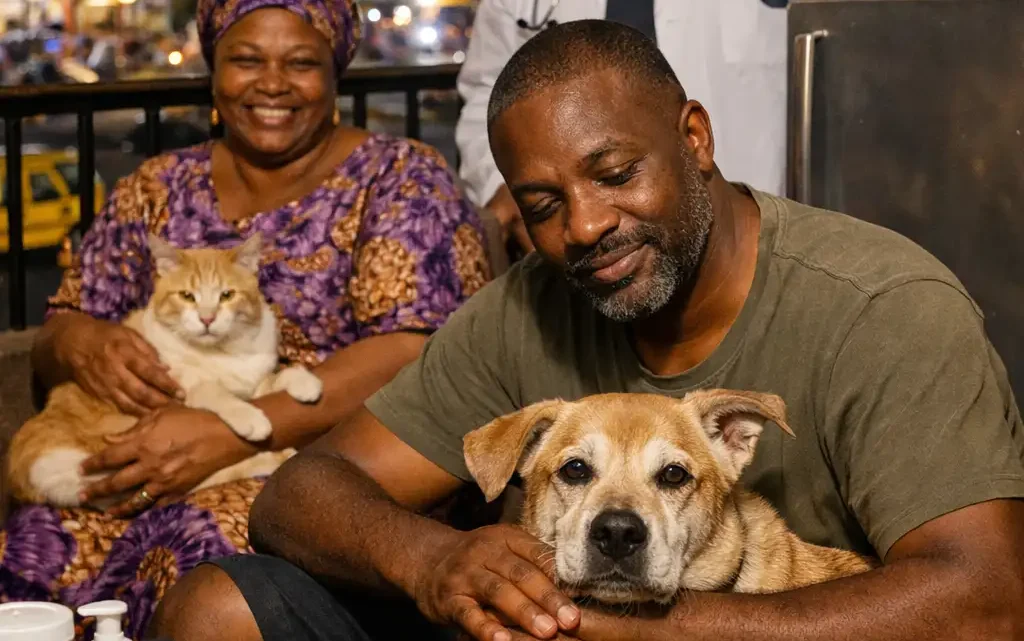
13 Years of Dog Ownership: Everything I Wish Someone Had Told Me First
I never planned to become a pet person.
Thirteen years ago, I was the guy who crossed the street when he saw a dog coming. The type who thought pet insurance was something only oyinbo people paid for, and that “premium dog food” was just a fancy excuse to waste money on an animal that would eat anything.
Trending Now!!:
I had zero interest in grooming appointments, flea treatments, or any of that. I was focused, unbothered, and completely dog-free.
Then Biscuit happened.
It was a Tuesday evening, around 6pm, and I was coming back from the market near my house in Surulere with two bags of groceries. I was almost at my gate when I heard it, this tiny, embarrassing sound, somewhere between a sneeze and a cry. I ignored it. Lagos is loud. Everything makes noise here.
But then it happened again.
I looked down and there, wedged between the gutter wall and an old car tyre, was the smallest, most pitiful dog I had ever seen in my life. A puppy, maybe eight weeks old, sandy brown with one ear flopped sideways and one standing straight. His ribs were visible. His coat was dull and patchy, which I later learned was a classic sign of mange. He was shivering in 28-degree weather, which made no sense, but puppies with low blood sugar and parasite overload do that. I know that now. I didn’t know anything then.
I stood there for a full three minutes arguing with myself.
“Don’t touch it. You don’t know anything about dogs. You have a one-bedroom flat. You travel for work.”
He looked up at me with these enormous brown eyes and sneezed directly onto my shoe.
I picked him up.
The first thing I did was call my neighbor, Aunty Remi, who had two dogs of her own, a Boerboel named Thunder and a fat, indifferent cat called Senator. She came out, looked at the puppy in my arms, then looked at me, and started laughing so hard she had to hold the wall.
“You? Dog owner? God is funny,” she said.
“I’m not keeping him. I’m just making sure he doesn’t die tonight,” I told her.
“That’s what every dog owner says on day one,” she replied. “Come, let me give you some things.”
She handed me a small bag with an old feeding bowl, a tiny dog blanket, and a tin of puppy wet food. “Don’t give him adult dog food. His stomach can’t handle it. And don’t give him milk, I know you’re going to try,” she warned.
I was literally about to try.
That first night was chaos.
I laid out the blanket in the corner of my living room. I put down the puppy wet food and a bowl of clean water. He ate for approximately forty-five seconds, then walked directly onto my couch and fell asleep on my favorite throw pillow.
I sat on the floor eating my own dinner, staring at him.
At 2am, he started crying. Not barking, crying, this soft, continuous whimper that somehow carried through every wall in my flat. I tried everything. I moved his blanket closer to the couch. I gave him a small piece of cloth with my scent on it, which I read about online at 1:45am in a desperate Google spiral. I even put a warm water bottle wrapped in a towel next to him because some forum said it mimics the warmth of his mother.
He stopped crying at 3am and fell asleep on my chest.
I did not sleep.
By morning, I had already convinced myself I was keeping him. I named him Biscuit because of the color of his coat, and because at the time, that was the most sophisticated thought I could produce on two hours of sleep.
The real education began that week.
I took him to a veterinary clinic on the mainland, a small but serious practice run by a doctor named Dr. Chukwuemeka, who had this calm energy that made you feel like everything was going to be fine even before he said a word. He examined Biscuit on the table, pressed gently along his spine, checked his gums, looked in his ears, and then turned to me with a clipboard.
“How long have you had him?” he asked.
“One day,” I said.
He nodded without judgment. “Okay. He has mange, mild dehydration, and a moderate worm load. Nothing life-threatening if we treat it now. But I want to be honest, if you had waited another week, this would have been a harder conversation.”
That hit me somewhere uncomfortable.
“What do I need to do?”
He handed me a treatment sheet. Deworming medication. A medicated shampoo for the mange, one with chlorhexidine. A puppy-specific vitamin supplement for immune support. A recommendation to switch to a high-protein puppy dry food formulated for small to medium breeds once his stomach stabilized. He also talked to me about the importance of age-appropriate vaccines and gave me a schedule, distemper, parvovirus, hepatitis, and eventually rabies. He explained that skipping early vaccinations is one of the most dangerous and expensive mistakes new dog owners make.
“Most people only come to me when the dog is already sick,” he said, scribbling notes. “Prevention is always cheaper than treatment. In every way.”
I wrote everything down like I was studying for an exam.
The mange treatment was not glamorous.
Twice a week for three weeks, I bathed Biscuit with that medicated shampoo in my bathroom while he looked at me with the betrayed eyes of someone who expected better. The chlorhexidine had to sit on his coat for ten minutes before rinsing. Ten minutes with a wet, unhappy puppy who wanted to shake and run and chew the shower curtain.
I bought a non-slip bath mat for the tub. I bought a proper dog grooming brush with soft bristles to work the shampoo through his coat without damaging his skin. I started using a grooming routine that Dr. Chukwuemeka gave me, brush before bath, check ears and paws after, dry thoroughly to avoid secondary skin infections.
By week three, Biscuit’s coat was transforming. The patchiness faded. The dullness gave way to this warm, biscuit-brown shine, and his one floppy ear finally stood up properly. He looked like a completely different dog.
I sent Dr. Chukwuemeka a photo.
He replied, “Good work. This is what proper puppy care looks like.”
I printed that message and stuck it on my fridge. I am not ashamed.
The food journey was its own lesson.
In those first months, I made every mistake in the book. I once bought a cheap generic dry dog food because it was the largest bag for the lowest price, big bag energy, and Biscuit had loose stools for four days straight. I panicked, called Aunty Remi, who said, without even pausing from whatever she was doing, “Throw that food away. You get what you pay for with dog food.”
She was right.
I switched to a quality puppy kibble with real chicken as the first ingredient, no artificial preservatives, balanced omega fatty acids for coat health, and appropriate calcium levels for bone development. It was not the cheapest option. It was also not the most expensive. But within two weeks, I noticed the difference, better digestion, more energy, and a coat that practically glowed.
That experience taught me something I now tell every new pet owner I meet: the first ingredient on any pet food label tells you everything. If it says “chicken meal” or “beef” before anything else, you are starting in the right place. If it says “corn syrup” or some derivative you cannot pronounce, walk away.
I also started adding a small amount of omega-3 fish oil supplement to his food twice a week, something Dr. Chukwuemeka recommended for long-term coat and joint health. That single addition, years later, is something I genuinely credit for how healthy and mobile Biscuit is today at age thirteen.
When Biscuit was about four months old, I made the decision to enroll him in a basic dog training program. Not because he was badly behaved, though he had absolutely chewed through one phone charger, half a TV remote, and my favorite pair of Adidas slides, but because I had read enough by then to understand that proper dog training is a form of pet care, not optional, and it is also how you build an actual relationship with your dog.
The trainer was a young woman named Amara, who ran sessions on Saturday mornings from a compound in Yaba. She had this no-nonsense approach that I respected immediately.
The first day, I walked in confident. I had watched YouTube videos. I had the treats. I had the clicker.
Biscuit sat for exactly one minute, then flopped onto his back and demanded belly rubs from three strangers.
Amara looked at me. “He’s very social. That’s good. But he needs to understand boundaries before he can learn commands. The issue isn’t intelligence, it’s that nobody has taught him what ‘no’ means yet.”
“He’s been through a lot,” I said, feeling protective.
She smiled. “Kindness and boundaries are not opposites. You can love him completely and still teach him how to behave. That’s actually what love looks like with dogs.”
That sentence rearranged something in my thinking.
Over the next eight weeks, Biscuit learned sit, stay, come, down, and leave it. That last one was the most useful. He once tried to eat a cockroach in the kitchen, and that single command saved us both from a very dark moment.
The flea situation arrived when Biscuit was about six months old.
I noticed him scratching more than usual one afternoon, behind his left ear, along his lower back. I checked his coat and found them, tiny, fast, impossible-to-catch fleas. My immediate reaction was embarrassment, like somehow I had failed him. I had been doing everything right.
Aunty Remi, veteran that she was, did not let me spiral.
“Fleas don’t mean you’re a bad owner,” she said, sitting on my balcony with Senator draped across her lap like a fur stole. “They mean your dog went outside. Which dogs do. It happens to everyone.”
The treatment required attacking the problem on two fronts, the dog and the environment. For Biscuit, Dr. Chukwuemeka recommended a monthly topical flea treatment applied to the back of the neck, a spot-on solution that works within 24 hours and lasts a full month. For the flat, I vacuumed every surface thoroughly, washed all his bedding and blankets in hot water, and used a pet-safe environmental flea spray on the carpets and corners.
Within a week, the scratching stopped.
The lesson I took from that: flea prevention is a year-round commitment, not a reaction. I have been on a monthly flea treatment schedule ever since, and I have not dealt with another infestation in twelve years. Consistency is everything in pet health.
Around year two with Biscuit, I started taking pet insurance seriously.
Before Biscuit, I thought pet insurance was the kind of thing people bought to feel good about themselves. Then Biscuit swallowed a chicken bone at a neighbor’s house during a small party, the kind of situation you cannot plan for, and I found myself at an emergency veterinary clinic at 10pm on a Saturday watching them do an X-ray and prepare for a possible endoscopic procedure.
The total bill was significant.
He was fine. The bone passed without intervention. But I sat in that waiting room doing quiet math and realized that one more incident like that, one surgery, one extended illness, could be genuinely disruptive without a safety net.
I got him enrolled in a pet insurance plan the following week. I researched what the policy actually covered, emergency care, diagnostics, surgery, specialist referrals. I read the exclusions carefully. A lot of people buy pet insurance without reading the fine print and then feel blindsided later. Do not be that person.
Since then, I have used the insurance twice. Once for a dental cleaning that revealed a cracked premolar requiring extraction, and once for a cruciate ligament assessment after Biscuit landed badly jumping off the bed at age nine. Both times, knowing I had coverage meant I made the medically correct decision without hesitation, not the financially convenient one.
That matters more than people realize.
Year five brought the question of dog dental care, which I had somehow managed to mostly ignore.
Dr. Chukwuemeka raised it during a routine check. He opened Biscuit’s mouth, looked around for a moment longer than usual, then said, quite gently, “He has some tartar buildup developing on his upper molars. At this stage it’s manageable, but in another year without intervention, we would be talking about periodontal disease.”
“He’s been eating well,” I said, as if that covered everything.
“Dental health is separate from nutrition,” he said. “About 80 percent of dogs over three years old have some degree of dental disease. It’s one of the most underestimated aspects of pet care. And it connects to organ health, because the bacteria from dental infections can travel.”
He recommended a combination approach: dental chews formulated to reduce plaque, a pet-safe enzymatic toothpaste with a finger brush for at-home use, and professional dental cleaning under anesthesia every 12 to 18 months.
The first time I tried to brush Biscuit’s teeth, he looked at me like I had suggested something deeply offensive. He turned his head away twice. He pawed at my hand. He made a sound that was less bark and more editorial comment.
It took about three weeks of daily practice, using chicken-flavored enzymatic toothpaste because apparently dogs prefer that, before he stopped resisting. Now it is part of his evening routine and he waits for it, which is an image I genuinely did not expect to be normal in my life.
Today, Biscuit is thirteen years old.
He moves a little slower now. His muzzle has gone white, and his eyes have this softness that older dogs get, like they have decided to stop rushing anything. He still gets excited about walks, though he prefers a slower pace now along routes he knows. He still sleeps at the foot of my bed, which was never the plan. The plan was the blanket in the corner of the living room. That lasted four days.
I still cook rice and chicken for him twice a week as a supplement alongside his senior formula kibble, which is lower in calories and higher in joint-supporting nutrients like glucosamine and chondroitin. His annual vet visits now include a senior wellness panel, bloodwork, kidney and liver function checks, because at thirteen, early detection is the whole game. Dr. Chukwuemeka, who is also thirteen years older now, always checks on Biscuit the same way, slowly and completely, like the dog is a friend he has known a long time. Because he is.
Aunty Remi asks about him every time I see her. Thunder passed away three years ago, and Senator is somewhere around sixteen now, still indifferent, still magnificent.
I get asked a lot by people who are thinking about getting a dog for the first time. They usually want to know what products to buy, what food to choose, whether to go for a puppy or an adult rescue, whether the cost is really as high as people say.
My honest answer is always the same.
The products matter. The food matters enormously. Grooming, flea prevention, dental care, quality accessories, these things are not extras, they are the baseline. A proper dog bed, a well-fitted leash and harness, interactive toys that prevent boredom and destructive behavior, a crate for training, a reliable thermometer for those moments when you are not sure if something is wrong, these are investments, not indulgences.
But the most important thing nobody tells you before you get a pet is this: the products are just tools. What actually keeps an animal healthy and happy is consistency and attention. It is showing up for the boring maintenance tasks. It is learning to read your pet’s behavior well enough to catch something early. It is building a relationship with a vet you trust before you ever need one urgently. It is understanding that pet ownership is not an aesthetic, it is a long-term commitment to a creature that has no choice but to trust you completely.
Biscuit trusted me when I picked him up from that gutter wall in Surulere with zero experience and two bags of groceries.
I have spent thirteen years trying to be worth that.
Some nights I sit with him on the balcony, his old chin resting on my knee, the Lagos night doing its usual loud things around us, and I think about that Tuesday evening when I almost kept walking.
I almost kept walking.
Thank God I didn’t.