How Getting Fired Was the Best Productivity Hack I Never Asked For
I used to think productive people were born different.
Like somewhere in their DNA, there was a gene that made them wake up at 5 a.m., journal with a matcha latte in hand, and still find time to read twelve books a year.
Trending Now!!:
Meanwhile, I was hitting snooze four times, scrolling through Twitter before my eyes fully opened, and telling myself, “Today will be different,” knowing fully well it would not be.
This went on for three years.
Three years of buying planners, I never filled past day two. Three years of watching productivity YouTube videos as a substitute for actually being productive. Three years of bookmarking articles titled “How to Get Your Life Together” while my life sat in pieces on the floor, unbothered.
Then one Tuesday in November, something happened that changed all of it, and it did not come from a TED Talk.
It came from a man named Chukwuemeka.
I had just been fired.
Not dramatically. No shouting, no scene, no storming out with a box of desk belongings like in the movies. My manager, a quiet, measured woman named Mrs. Adaeze, simply called me into her office, offered me a seat, and said the words with the same energy someone uses to discuss the weather.
“We’re letting you go, Rotimi. Your output has been inconsistent, and honestly, we need someone who shows up fully. Not just physically.”
I nodded. Said thank you, weirdly. Walked out, took the elevator down, sat in my car in the parking lot for forty-five minutes, and stared at the steering wheel like it owed me an explanation.
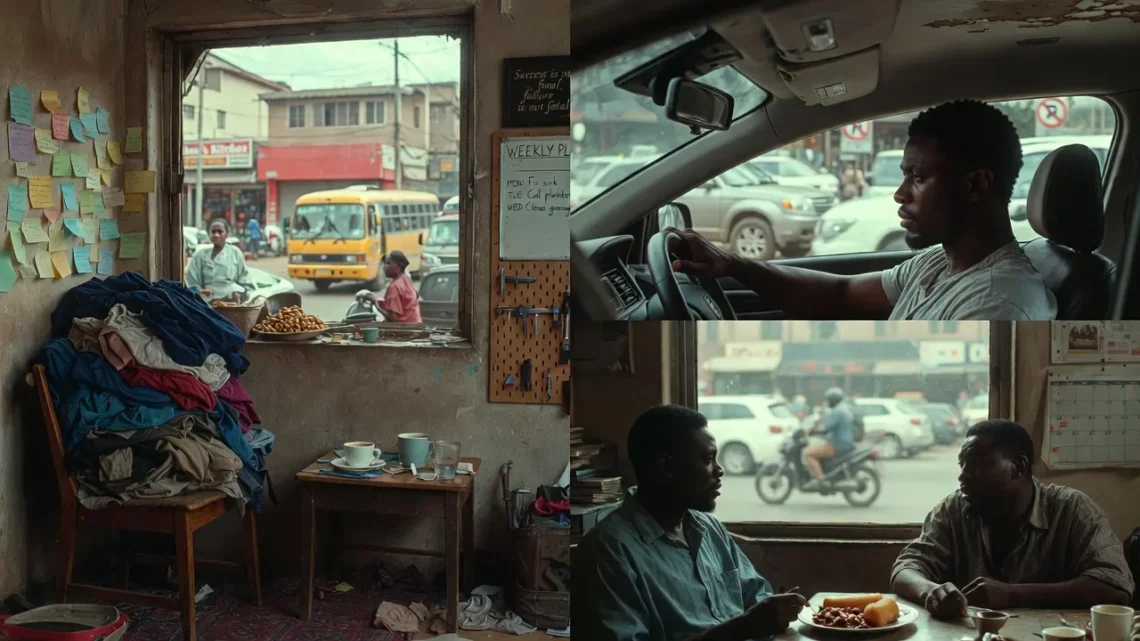
Outside, Lagos continued its chaos. Buses honked. A man argued with a keke driver over twenty naira. A woman sold groundnuts with the confidence of someone running a Fortune 500 company. Life was moving. Mine had stopped.
I drove home on autopilot.
My apartment was the physical representation of my mental state. Clothes on the chair that had not been moved in two weeks. Three cups on the table, each with a different stage of abandoned tea. Post-it notes on the wall with goals I had written in a burst of motivation and never touched again.
“Launch the blog by March.”
March was eight months ago.
I sat on my bed, opened my laptop, and typed into Google, “how to be productive when your life is falling apart.”
Six million results. Zero comfort.
I closed the laptop. Lay back. Stared at the ceiling like it had answers coded into the paint. Then my phone rang. It was Chukwuemeka, my neighbor from the flat downstairs, a man in his early sixties who repaired electronics for a living and occasionally knocked on my door to borrow pepper.
“Rotimi, I can hear you walking heavily. You okay?”
I almost lied. Then I did not.
“I got fired today, Uncle Emeka.”
Silence. Then, “Come downstairs. I have yam on the fire.”
Chukwuemeka’s flat was the opposite of mine. Small, yes, but everything in it had a place. Tools arranged on a pegboard with outlines drawn around each one so he always knew what was missing. A whiteboard on the wall with the week mapped out in his handwriting. A single motivational quote, handwritten on a piece of paper taped near the door.
It read, “A man who does not plan his day has already planned to fail someone else’s.”
I sat on the bench near his worktable while he served yam and stew with the calm of a man unbothered by urgency.
“You know why you got fired?” he asked, not looking up from the pot.
“Because my output was inconsistent,” I repeated Mrs. Adaeze’s words like a student reciting something I did not fully understand.
“No,” he said, setting the plate in front of me. “You got fired because you never decided what kind of man you wanted to be. Everything else is just a symptom.”
I stared at him.
“Eat first,” he added. “Philosophy is better on a full stomach.”
We talked for three hours that evening.
Chukwuemeka had not always repaired electronics in a small flat in Surulere. In his forties, he had run a mid-sized electrical supply company with twelve staff members, two vehicles, and a contract with a government agency. Then he lost it all, in the kind of slow collapse that does not announce itself until it is too late. A partner who stole. A flood that wiped out his warehouse. A loan he could not repay.
“I spent two years being angry,” he said, turning a broken radio over in his hands the way a doctor examines a patient. “Angry at the partner, angry at the rain, angry at the bank. You know what being angry produced for me?”
“Nothing?” I guessed.
“Exactly nothing,” he said. “Then one morning I woke up and I said, okay. Today I fix one thing. Just one. Not everything. One.”
He pointed at the whiteboard. “That is still my rule. Every day, one thing that cannot be moved. One thing I will finish no matter what happens around it. Everything else is bonus.”
I looked at the board. Monday had three items. Two were crossed out. The third said, “Call Mrs. Funmi about the generator.”
“And the days you don’t feel like it?” I asked.
He laughed, the kind of laugh that holds real lived experience in it. “Rotimi, feelings are the most unreliable employees you will ever have. You cannot wait for motivation to show up before you start. Motivation is a shy visitor. It comes after you have already begun.”
I went back upstairs that night and did something small.
I opened a new note on my phone and wrote one sentence.
“Tomorrow I will wake up at 6 a.m. and write for thirty minutes before I touch my phone.”
That was it. No five-year plan. No vision board. No seventeen-step morning routine I copied from a productivity influencer who wakes up at 4 a.m. and meditates for an hour. Just one sentence. One decision.
I set the alarm. I slept.
At 5:58 a.m., I was already awake, staring at the ceiling again, but this time something was different. I got up before the alarm went off. I did not know why. Some part of me had made a quiet decision overnight that I was not even fully conscious of.
I made tea. I sat at my table, which still had the three abandoned cups on it, and I opened a blank document. I wrote badly for thirty minutes. Messy, unstructured, no direction. But I wrote. And when the thirty minutes ended, something small but real settled in my chest.
I had done the thing.
Weeks passed. Then months.
The one-thing rule became my anchor. I started consulting, then freelancing, then building the blog I had post-it noted into shame for eight months. The work was slow. There were mornings the motivation was completely absent, mornings I sat at my table and typed one sentence and stopped, mornings I called Chukwuemeka downstairs just to hear him say, “Did you do your one thing?”
“Not yet,” I would say.
“Then why are you on the phone?” he would reply, and hang up.
He was the most effective accountability partner I ever had, and he charged me nothing except occasionally borrowing pepper.
Eight months after the night I sat in the parking lot staring at a steering wheel, I got an email.
It was from a company, a mid-sized tech firm in Lagos, who had found my blog and wanted to know if I offered consulting services.
I read the email three times.
Then I walked downstairs and knocked on Chukwuemeka’s door.
He opened it, looked at my face, and said, “Good news?”
“Someone wants to pay me for something I built,” I said. “Something I almost never started.”
He nodded slowly, unsurprised, the way wise people receive news they already knew was coming.
“Come in,” he said. “I have yam on the fire.”
Here is what three years of false starts and eight months of real ones taught me about self-improvement and productivity, not from a textbook, but from a parking lot, a neighbor’s whiteboard, and a lot of badly written 6 a.m. pages.
Motivation is not the starting point. Action is. You do not wait until you feel ready. You start, and readiness follows like a reluctant friend who eventually shows up once the party has already begun.
The one-thing rule is underrated. Productivity systems fail most people not because they are bad systems but because they are too heavy to carry on hard days. One non-negotiable thing per day is light enough to carry every day, and it compounds.
Accountability does not need to be formal. It just needs to be consistent. Chukwuemeka was not a life coach. He was a man who repaired radios and asked the right questions.
Your environment is either working for you or against you. I cleaned my apartment the week after that first night. Not because cleanliness is next to productivity, but because I needed to stop living inside a physical representation of a mind that had given up.
And the most important one: the plot twist in your story is rarely the dramatic fall. It is the quiet Tuesday morning when you decide, without fanfare, without an audience, without a caption for Instagram, to begin.
That is the morning everything changes.
That was my morning.
What will yours be?