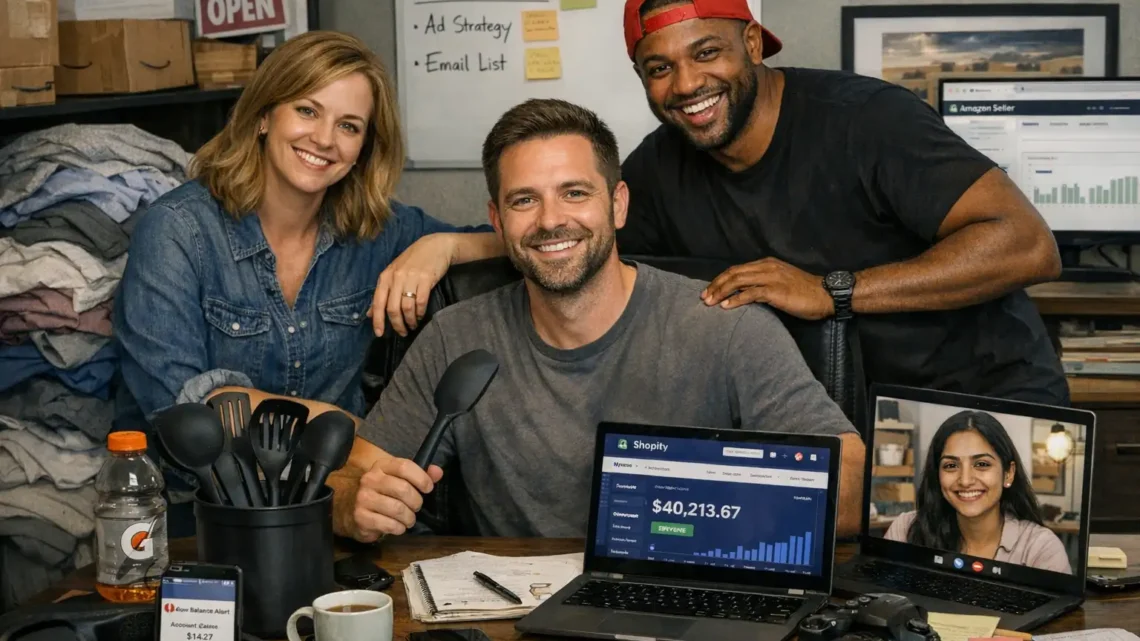
How I Built a $40,000 Shopify Store in 90 Days After Years of Getting It Wrong
I started with zero sales, a TV remote accidentally in my product photo, and a wife who just wanted the gutters fixed. Here is what three months of trial, embarrassment, and stubbornness actually taught me about building a real online business.
I still remember the exact moment I decided to start an online business.
It was a Tuesday. I was sitting in my car in the parking lot of the grocery store, engine off, too tired to go inside.
Trending Now!!:
My phone buzzed, and it was my bank sending me a “low balance” notification with the same cheerful ding it uses for good news. I sat there staring at it, and I said out loud, to nobody, “There has to be something else.”
There was nobody in the car. Just me, an empty bottle of Gatorade, and a dream I hadn’t named yet.
That was three years ago.
My name is Marcus. I am thirty-four years old, and I run a six-figure e-commerce business from a spare bedroom in my house that also doubles as an ironing room.
There is a pile of shirts on the chair next to my desk that have been waiting to be ironed since February. My wife Rachel has given up commenting on them. That pile is practically a family member now.
But before any of that, before the revenue and the product listings and the Shopify dashboard that I refresh more than my own Instagram, I was just a regular guy with a regular job and a very irregular amount of anxiety about money.
I worked in logistics coordination for nine years. Not glamorous, not terrible, just steady. I was good at it, the way you can be good at something that was never meant for you.
I knew how supply chains moved, how goods traveled from a warehouse shelf to someone’s front door. What I did not know was that I was accidentally studying e-commerce the entire time.
The idea to start an online store came from an unlikely place.
My cousin Dre called me one afternoon, laughing so hard he could barely get words out.
“Bro, I just made seven hundred dollars selling silicone spatulas.”
“What?”
“Spatulas, man. Kitchen spatulas. On Amazon. I set it up two months ago and forgot about it. I just checked and there’s money in the account.”
I was quiet for a moment. Then I said, “Are you serious right now?”
“Dead serious. Come over this weekend. I’ll show you everything.”
That weekend changed the entire direction of my life. Dre sat me down at his kitchen table, pulled up his Amazon Seller account, and walked me through the basics of private label e-commerce.
I watched him scroll through product research tools, keyword data, supplier contacts, profit margin calculators. My logistics brain was fully activated. This was a supply chain I could actually own.
I drove home that night with my head full of numbers.
Rachel looked up from her book when I walked in, reading my face the way only a spouse of eight years can.
“What happened to you?”
“I’m going to start an online business.”
She put the book down slowly. “Okay. How much is this going to cost us?”
“Two thousand dollars. Maybe three.”
She stared at me. “Marcus.”
“I know.”
“We talked about fixing the gutters.”
“The gutters can wait.”
“The gutters cannot wait, Marcus, we had a whole—”
“Rachel. Spatulas.”
“…What?”
I sat down and told her everything Dre showed me. To her credit, she listened. To her further credit, she only said “absolutely not” twice before eventually landing on “fine, but if it fails, you fix the gutters personally, no contractor.”
Deal.
The first three months of building my e-commerce store were a beautiful disaster.
I chose my niche after two weeks of product research, which is the process of sitting with seventeen browser tabs open, second-guessing yourself constantly, and eating cereal for dinner.
I landed on home organization products, specifically a collapsible storage solution that was trending in search volume but had weak competition. The keyword data was screaming opportunity. I chose to listen.
I set up my Shopify store in a weekend. I watched tutorials until my eyes felt like sandpaper. I connected my payment gateway, designed my product pages, wrote descriptions that I was genuinely proud of, and launched.
Then I waited.
Nothing happened for eleven days.
Not a single sale. Not even abandoned carts, which would at least have meant someone visited and thought about it. Just silence and a Google Analytics dashboard showing me that my primary traffic source was myself, refreshing the page repeatedly.
I called Dre.
“Nobody’s buying anything.”
“Are you running ads?”
“…No.”
Long pause.
“Marcus. How did you think people were going to find you?”
“I thought… the algorithm…”
“The algorithm doesn’t care about you, man. You have to spend money to make money. Have you done any social media marketing?”
“I made an Instagram page.”
“How many posts?”
“Three.”
Another long pause.
“Okay. We’re starting over.”
This is the part of the online business journey that most people do not post about. Not the cute “I quit my job and built a laptop lifestyle” aesthetic, but the actual grinding, confusing, humbling middle section where you realize that building an e-commerce brand is a real job with real skills required, and nobody is coming to save you.
I hired a freelance social media manager named Priya off a platform. She was twenty-two, based in a timezone six hours ahead of me, and she was relentlessly efficient in a way that made me feel personally attacked.
Our first video call:
“Your product photography is the problem,” she said, getting directly to the point without even saying hello properly.
“Good morning to you too.”
“The shadows are wrong. The background is distracting. And why is there a TV remote in this shot?”
I squinted at the image. “That’s… I thought the frame was cropped.”
“It is not cropped, Marcus. There is a remote control next to your product on what appears to be a couch.”
“Okay. So what do we do?”
“We reshoot everything. White backdrop, natural lighting, multiple angles. And you need lifestyle shots, people actually using the product. Does your wife use the product?”
“She uses it to organize my ironing pile.”
“Perfect. Film that.”
Rachel was not thrilled about becoming an unpaid e-commerce model, but she agreed after I promised dinner at her favorite restaurant. We spent a Saturday afternoon shooting content in the living room. She actually got into it by the end, rearranging the shelves with genuine enthusiasm and telling me how the product should be positioned for the shot.
“You should have angled it this way from the beginning,” she said, holding it up to the window light.
“Are you giving me product staging advice right now?”
“I’m just saying the shadows are nicer.”
Priya would have loved her.
We launched the new content alongside a small paid social media campaign. I set a two-hundred-dollar test budget and nearly had a cardiac event every time I checked the ad spend.
Then, on a Thursday morning, I woke up to my phone buzzing.
Three sales. While I slept.
I sat up in bed so fast I nearly knocked Rachel off the pillow.
“What is wrong with you?”
“We have sales.”
“…Go back to sleep, Marcus.”
“Rachel. Three sales.”
She rolled over and looked at my phone screen. Then she looked at me. Then she said, very quietly, “Okay, that’s actually kind of exciting.”
That was the beginning.
Over the next sixty days, I learned more practical lessons about running an online business than I had absorbed in nine years of logistics work.
I learned that your conversion rate will tell you everything your gut feeling won’t. I was driving traffic but losing people on the product page, so I rewrote the copy, added customer reviews that I personally reached out to early buyers to collect, and restructured the page layout. Conversions improved by thirty percent in two weeks.
I learned that email marketing is not dead, not even slightly. Building an email list felt slow and unglamorous, but that list became the most reliable revenue channel I had. Every time I sent a well-crafted email to subscribers, sales followed within hours. No algorithm involved. Direct line to real people who had already shown interest.
I learned that customer service is the silent backbone of any e-commerce business. A buyer named Greg sent me an angry message saying his order arrived with a broken piece. I refunded him immediately and shipped a replacement the same day, covering the cost myself. He left a five-star review that mentioned my customer service by name and sent two friends to the store.
Greg is now one of my favorite people I have never met.
By the end of the third month, the store had done forty thousand dollars in revenue.
I remember the night I crossed that number. I was sitting in my ironing room, the pile of shirts still watching over me from the corner chair, and I just looked at the Shopify dashboard for a long time.
Rachel came to the doorway.
“Are you okay? You’ve been quiet in here.”
“Come look at this.”
She walked over and looked at the screen. She stood there for a moment, then sat on the arm of the chair, right next to the ironing pile, and put her arm around my shoulder.
“You did it,” she said.
“We did it. You were in the lifestyle photos.”
She laughed. “I want full credit in the business bio.”
“Done.”
We sat there in the glow of the laptop screen, the shirts waiting patiently behind us, and for a few minutes, the ironing room felt like the most important room in the house.
I am still learning. That is the honest truth about running an online business, the part the highlight reels skip. SEO optimization evolves and what ranked you last year may not rank you next year. Ad costs shift. Consumer behavior changes. New competitors enter your niche with better packaging and lower prices, and you have to respond with smarter positioning rather than cheaper panic.
But the fundamentals stay the same. A real product that solves a real problem. A store built with the customer’s experience in mind. Consistent content that builds trust before anyone opens their wallet. An email list treated like a community, not a broadcast channel. Data that you actually read and act on, not just collect.
And patience. Unglamorous, unsexy, absolutely essential patience.
Last month, Dre called me again.
“How’s the store?”
“Good. Really good.”
“See? Told you. Spatulas changed everything.”
“You know what’s funny,” I said, “I actually sell a silicone kitchen set now. It’s one of my top products.”
He burst out laughing. “You’re joking.”
“Full circle, man.”
There was a pause, and then he said, more seriously, “Proud of you, bro. Real talk.”
I looked over at the ironing pile in the corner. Still there. Growing, honestly.
Some things don’t change.
But some things do, and you just have to be stubborn enough to sit in a parking lot, stare at a low balance notification, and decide that “there has to be something else” is not a thought you’re going to let pass without doing something about it.
The gutters, for the record, still need fixing. But now I can afford to hire someone.