
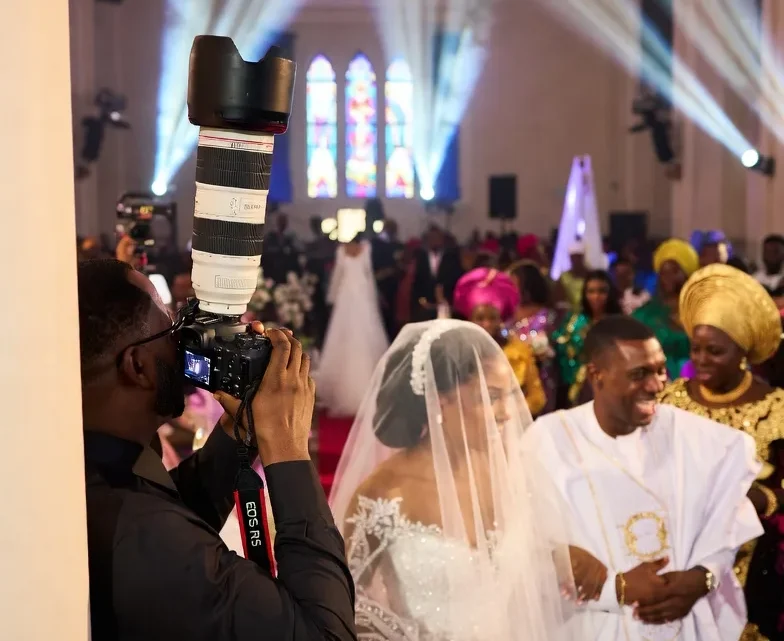
I Left My Memory Cards at Home on the Biggest Shoot of My Life
I still remember the exact smell of that moment. Burnt rubber from the Lagos traffic outside, cheap air freshener in the car, and the faint metallic anxiety sitting in my chest as I drove to what should have been the biggest shoot of my career.
My camera bag was in the back seat. Two Canon EOS R5 bodies, a 24-70mm f/2.8 lens, a 50mm prime, three speedlites, and a portable LED panel I had saved six months to buy. Everything a professional photographer is supposed to carry to a luxury wedding shoot in Eko Hotels.
Trending Now!!:
Everything, except the memory cards.
Let me back up.
My name is Kelechi, and I have been shooting professionally for eleven years now, covering everything from editorial portrait photography and commercial product videography to documentary wedding films and corporate headshots. I started with a borrowed Nikon D3100 in my uncle’s living room in Enugu, shooting passport photos for N200 each and thinking I had made it.
I had not made it.
But that day I drove toward Eko Hotels in a sweaty Toyota Camry, I genuinely believed I had. The client was Mrs. Adaora Chukwuemeka, the bride, and she had paid a deposit of N3.5 million for full-day wedding photography and a cinematic wedding videography package. The brief included a bridal boudoir session at sunrise, ceremony coverage, aerial drone footage, same-day edit highlights, and a full feature-length wedding film. Her planner, a sharp woman named Temi, had sent me a seventeen-page shot list.
Seventeen pages.
I had been preparing for three weeks.
And I left the memory cards on my kitchen counter next to a half-eaten plate of jollof rice.
I was already on Third Mainland Bridge when I reached into my bag for a routine check and my fingers found nothing but an empty card slot in my first body. I checked the second. Empty. My stomach dropped through the floor of the car and probably landed somewhere in the Lagos Lagoon below me.
I called my assistant, Emeka.
“Guy, where you dey?”
“I dey Lekki Phase 1. Why?”
“The cards. I left them. All of them. On the kitchen counter.”
Silence.
“Kelechi.”
“Don’t.”
“All of them?”
“Emeka, I said don’t.”
More silence. Then, “Okay. Okay. How much time do we have before the bridal session?”
I checked the clock. Forty-two minutes.
Emeka exhaled slowly, the kind of exhale that carries the weight of every stupid mistake a human being has ever witnessed. “I’m going to Slot on Admiralty Way right now. I’ll meet you at the lobby in thirty-five minutes.”
“They won’t open this early.”
“I know the security guy. His name is Femi. I buy him Gala every morning. Today Femi will open the shop for us.”
I have never loved anyone more than I loved Emeka in that moment.
He made it. With four minutes to spare, he walked into the Eko Hotels lobby holding a small paper bag like a man delivering organ transplants. Inside were three 128GB CFexpress cards and two standard SD cards, still in their packaging.
I could have cried. I almost did.
Temi, the wedding planner, was already standing near the elevator looking at her clipboard and her watch alternately, like she was conducting a very stressful orchestra. She looked up at us and said, “You are four minutes early. I respect that.”
She never knew what almost happened.
That is one of the first things nobody tells you about professional photography. The technical stuff, aperture settings, ISO control, shutter speed, understanding natural light versus artificial lighting, mastering off-camera flash techniques, building a cinematic color grading workflow in DaVinci Resolve, all of that matters enormously. But the work that actually protects your career happens before you ever touch the shutter button. It happens in checklists, in redundancy systems, in the unglamorous habit of packing your bag the night before and checking it twice.
I learned that lesson the almost-catastrophic way.
The bridal session began at 6:47 a.m. in the presidential suite on the fourteenth floor, and the light coming through those floor-to-ceiling windows was the kind of light photographers spend years trying to recreate in studio setups. Soft, warm, directional, and absolutely free. Golden hour light, photographers call it, and it is genuinely one of the most powerful natural lighting conditions you can use for portrait photography.
Mrs. Adaora was sitting at the vanity mirror while her makeup artist, a quiet focused woman named Blessing, worked around her eyes with a tiny brush. The bridesmaids were scattered across the suite in various stages of getting ready, laughing about something I could not quite hear. Champagne flutes caught the window light. A white gown hung on the back of the bathroom door like a sculpture.
I stood at the doorway for a moment before I started shooting. I always do this. I just watch.
A lot of photographers rush into the room and start clicking immediately. I understand the impulse. You are nervous, the client is watching, you want to look busy and capable. But the photographers who produce consistently compelling imagery are the ones who read the room first. You are looking for the real moments, the unposed interactions, the genuine expressions that no posing guide in the world can manufacture.
Blessing said something softly to Adaora and she laughed, a full, real, surprised laugh that crinkled the corners of her eyes. I lifted the camera and shot six frames in that half second.
Those six frames ended up being the ones Adaora cried over when we delivered the gallery.
Emeka was working the video side of the room, running a Sony FX6 on a shoulder rig for the cinematic wedding videography coverage. We had a whole silent communication system for moments like these: hand signals, eye contact, small nods. He saw me move toward the window and immediately repositioned to get the complementary angle. Good videography and good photography on the same shoot require almost choreographic coordination. If you do not plan it properly, you end up blocking each other constantly and the client notices.
Around 8:30 a.m., I stepped out to grab coffee from the corridor and ran into the groom, Chukwuemeka Obi, a tall man in a sharp agbada who was pacing slightly outside the room where his groomsmen were getting ready.
“You’re the photographer?” he asked.
“Yes sir. Kelechi.”
He nodded slowly, then said, “Please. Whatever happens today, make sure you get my mother dancing. She hates cameras but she dances when she thinks nobody is watching. If you catch that, I will add something for you.”
I smiled. “Consider it done.”
That is the other thing nobody tells you. People do not just hire you for photography skills or videography production quality. They hire you to see what they cannot see themselves. The mother who hates cameras but dances freely. The father whose eyes fill up during the processional. The small child at the reception who falls asleep on the speaker box and somehow looks perfectly peaceful despite the music. These are the images that make a wedding photography portfolio extraordinary rather than merely competent.
You cannot find those shots with a shot list. You find them by staying alert and caring enough to pay attention.
The ceremony itself was everything Lagos weddings promise and then deliver tenfold. Two hundred and eighty guests, a live band playing Afrobeats and highlife seamlessly, a church that had been decorated so elaborately that I spent ten minutes just photographing the floral installations before the bride arrived. Natural light was flooding through the stained glass in colored shafts, and I made a mental note to use those for creative wedding photography compositions whenever possible.
Adaora entered the church to a song I did not recognize, but the effect it had on the room was immediate and total. People stood. Some started crying before she even reached the aisle. Her father, a broad-shouldered man with a completely impassive face, was holding her arm, and I watched his jaw tighten the way jaws tighten when someone is trying very hard not to show emotion in public.
I moved to the side aisle without being asked. Every movement I made during the ceremony was slow, low, and deliberate. One of the most common mistakes I see from newer photographers at ceremonies is the constant repositioning, walking across sightlines, crouching dramatically in the middle of the aisle like they are the main character. Your job is to be invisible. The moment guests start watching you instead of the couple, you have failed at the most fundamental part of event photography.
I stayed near the columns. I used the 70-200mm f/2.8 telephoto lens from a distance. I let the ceremony breathe.
When Chukwuemeka saw Adaora approaching and his face changed completely, I was already in position. I got the frame. Forty meters away, long lens, fast burst. Perfect focus, genuine emotion, nobody looking at the camera.
That shot became the cover of their wedding album.
The reception was louder, freer, and honestly more fun to shoot. This is where I finally spotted Mama Obi, the groom’s mother. A stout, elegant woman in a gold gele who spent the first hour sitting very properly at the high table, smiling politely whenever someone pointed a phone at her.
I watched her from across the room for almost forty minutes, drinking my cold Chapman and pretending to review shots on my camera screen. Patient observation is one of the most underrated skills in documentary photography.
Then the band shifted into something old, something I recognized vaguely as classic highlife from the seventies, and Mama Obi stood up.
She did not announce it. She did not look around. She simply stood, found the beat, and started dancing with her whole body, shoulders, hips, feet, arms. Pure and completely unselfconscious.
I raised the camera.
I shot for about ninety seconds without stopping.
When I reviewed the images later that night in my hotel room, there were forty-three frames from those ninety seconds, and I genuinely could not stop smiling at them. She was magnificent. Alive in a way that formal portraits almost never capture.
Chukwuemeka came to find me near the exit at the end of the night. He shook my hand for a long time without saying anything, which told me Emeka must have shown him a clip from the video footage. Then he said, “My mother will frame that. I know it already. Thank you.”
I said, “She saved the whole night.”
He laughed. “She doesn’t know you caught her.”
“Better that way,” I said.
The same-day edit we delivered at 11 p.m. that night was a three-minute cinematic highlight reel that Temi played on the reception screens to close the event. Emeka had been editing continuously in a back room since 6 p.m., syncing audio, cutting to the music, doing basic color correction on the fly in Premiere Pro. It is brutal, exhausting work, and it requires a very specific kind of videographer, one who can think editorially in real time.
When the reel played on the screens, the room went quiet. Then, when it ended, the applause started. Not polite applause. Real applause. The kind where people are clapping for something that actually moved them.
Adaora was crying again. Chukwuemeka had his arm around her. Mama Obi was somewhere in the crowd, probably not crying, probably dancing.
Emeka appeared next to me at that moment, smelling like stress and too much coffee, and said quietly, “We didn’t die.”
I said, “We almost did.”
“But we didn’t.”
“But we didn’t,” I agreed.
Eleven years in photography and videography teaches you things no workshop, no YouTube tutorial, and no expensive online course can fully prepare you for. It teaches you that the best camera equipment in the world means nothing if you leave your memory cards at home. It teaches you that technical mastery of things like exposure triangle, color temperature, focal length compression, and dynamic range is only the foundation, and the building you construct on top of that foundation is made of human understanding, emotional intelligence, and the patience to wait for the real moment.
It teaches you that Emeka and his relationship with a security guard named Femi and a bag of Gala can save your entire professional reputation on a Tuesday morning in June.
It teaches you that the shot you planned is rarely the shot that matters. The shot that matters is usually the one you were not expecting, the one that required you to put down your shot list and just watch.
And it teaches you that when a groom tells you at 8:30 in the morning, “Catch my mother dancing and I’ll add something for you,” you do not ask how much. You just say yes, you find a good corner, and you wait.
Because that is what professional photography actually is.
Not the camera. Not the lens. Not the editing software or the color grading preset or the drone footage or the cinematic slow motion.
It is the waiting. And knowing, when the moment finally arrives, exactly where to stand.