I Paid ₦180,000 for an Online Course That Almost Ruined Me
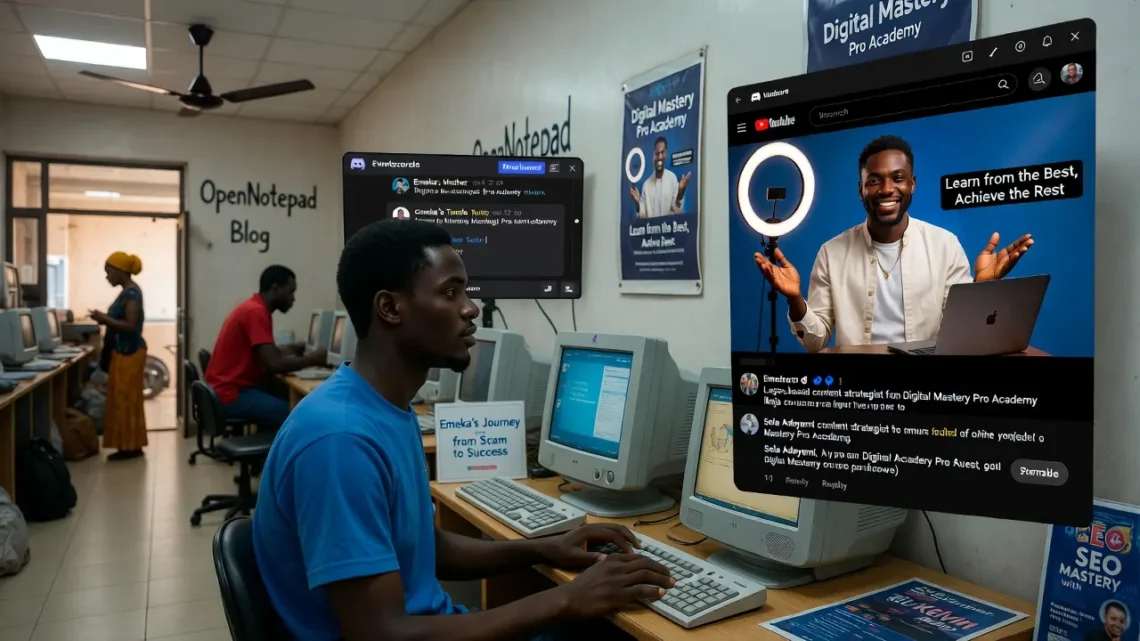
Two years ago, I was sitting in a cybercafe on Allen Avenue, Ikeja, staring at a YouTube ad that kept playing every three minutes.
The guy in the ad had a ring light, a MacBook, and the kind of calm confidence that made you want to trust him immediately. He was saying, “You don’t need a university degree to earn six figures online. You just need the right digital skills and the right online learning platform.”
Trending Now!!:
I watched the full ad. Twice. Then I clicked.
That one click changed my life. Not in the way I expected, though.
My name is Chukwuemeka, but everyone calls me Emeka. At the time, I was twenty-six, freshly unemployed after the logistics startup I worked for quietly folded. My rent was due in six weeks. My savings were bleeding. And every job application I sent into the internet felt like dropping a stone into a dark well, no sound, no response, nothing.
I had heard people talk about e-learning and online courses like they were the holy grail. My cousin Tunde, who moved to Canada in 2021, was always raving about it.
“Bro, I did a three-month UX design bootcamp online,” he had told me on a video call, his background suspiciously cleaner than mine. “Now I bill in dollars. Just enroll in something. Anything. Stop waiting.”
I thought about that conversation as I sat in that cybercafe, sweating under a ceiling fan that was working against me. The course the YouTube guy was selling promised to teach freelancing, content creation, and SEO skills, all in one package. It was called something like “Digital Mastery Pro Academy.” Very motivational. Very suspicious in hindsight.
The price? ₦180,000.
I called my mother.
“Mama, I want to use part of the house money to buy an online course.”
Silence.
“Emeka.”
“Yes, ma.”
“Which kind course costs one-eighty thousand naira and you cannot touch it? Is it made of gold?”
“Mama, it’s e-learning. You study from home, you learn digital skills, and you get certified. It’s the future.”
Another silence. Then she said, “Is this one of those Yahoo boys teaching people how to do Yahoo?”
“No, Mama.”
“Because your father’s cousin did something like this in 2017 and—”
“Mama. I’m twenty-six. I know what I’m doing.”
She exhaled the way only Nigerian mothers can, like the breath carried a full sermon she had decided not to preach. Then she said, “Do whatever you want. But if this course does not put food on your table in three months, I will personally come and remove that laptop from your hand.”
I enrolled the next morning.
The platform looked good. Clean interface, structured curriculum, a certificate at the end. The kind of online course website that made you feel like you were already successful just by logging in.
Week one was exciting. The instructor, a man called Coach Dayo, had a voice like a motivational audiobook. He talked about keyword research, search engine optimization, content marketing, and how to build passive income through digital skills. I was taking notes like a final year student.
“The internet is the largest open university in the world,” Coach Dayo said in one of the early video lessons. “But only those who are intentional about their online education will monetize it.”
I wrote that down. I put it on a sticky note above my desk.
I was locked in.
By week three, things started feeling off.
The course modules were getting thinner. Lessons that were supposed to go deep into SEO strategies and content writing were just… surface level. Stuff I could have Googled for free. The online community forum attached to the platform had barely thirty active members, most of them asking questions that nobody answered.
I posted a question about affiliate marketing strategy. It sat there for eleven days. No response.
I sent an email to the support team. An automated reply came back: “Your message has been received. Our team will respond within 5-7 business days.”
They never did.
I started researching. Turns out Coach Dayo had three other “academies” running simultaneously under different brand names. Same videos, different packaging, different prices. The course I paid ₦180,000 for was being sold elsewhere as a ₦45,000 beginner package.
I felt sick.
I opened WhatsApp and typed a long message to Tunde.
“Bros. I think I just got scammed by an online course.”
He replied immediately. “Lmao. Which one?”
I sent him the link.
“Emeka.” Long pause. “I know this guy. Everyone in the digital marketing community knows him. He’s been called out three times. Why didn’t you research first?”
I closed WhatsApp and stared at my ceiling for a very long time.
Here is where the story should have ended badly. And for about two weeks, it looked like it would.
I was angry, broke, and embarrassed. I had argued with my mother, used rent money, and had nothing to show for it except a half-finished course and a PDF certificate that I was almost sure nobody would recognize.
But something strange happened on a random Tuesday afternoon.
While scrolling through one of the course’s weak video lessons on YouTube (because I had started finding better, free versions of the same content), the algorithm recommended a channel run by a woman named Sola Adeyemi.
She was a Nigerian content strategist based in Lagos, and she was talking directly to the camera, no ring light, no MacBook aesthetic, just honest.
“Stop buying expensive online courses before you understand what you actually want to learn,” she said. “The best online learning happens when you combine structured courses with real practice. Read, write, apply, fail, repeat. That is the actual curriculum.”
I subscribed.
I binge-watched everything on her channel. Then I found her free email newsletter. Then I found the community she ran on Discord, a free group of over four thousand people learning digital skills together, sharing resources, giving feedback, holding each other accountable.
I joined.
Inside that community, I met a guy called Kelvin, a thirty-year-old from Port Harcourt who had been freelancing as an SEO writer for two years. He was not rich, but he was stable, and more importantly, he was generous with information.
“Emeka, what specifically do you want to do?” he asked me in a DM one evening.
“I want to write. Content writing, SEO, blogs, all of that.”
“Okay. Have you written anything yet?”
“I wrote in my old job a bit. Press releases, social media.”
“Good. So here’s what you do. Forget the certificate for now. Start a blog. Write three articles a week. Practice keyword research on free tools like Ubersuggest. Then come back to me in thirty days.”
I almost argued. I almost said, “But I need a proper course first.”
Instead, I said, “Okay.”
I started the blog. I called it OpenNotepad, a simple WordPress site where I wrote about things I was learning, productivity, freelancing, online education. Nothing fancy. Just honest writing.
The first three articles got a total of eleven views. Nine of them were me.
I kept writing.
By the end of month two, I had published twenty-six articles. One of them, a piece titled “How to spot fake online courses before you pay,” started getting shared in Facebook groups. I woke up one morning to find it had 3,000 views overnight.
My phone buzzed. It was a DM from a woman called Priscilla, a Lagos-based small business owner.
“Hi, did you write this article? It saved me from making a huge mistake. I was about to pay for a ₦250,000 course.”
“Yes, I wrote it,” I replied, still half asleep.
“Do you do this professionally? I need someone to write content for my skincare brand’s blog.”
I sat up straight.
“Yes,” I typed. “I do.”
That was my first paid content writing client. Priscilla paid me ₦35,000 for four articles. Not life-changing money, but it was more than I had made in three months.
I went back to Kelvin and told him.
“See?” he said. “Now you have proof of concept. Go find five more clients. Then raise your rates.”
“But should I do a proper certification now? Like a Google or HubSpot course?”
“Yes, but the free ones first. HubSpot Academy is free. Google Digital Garage is free. Coursera has free audits. Use those. Get the certified credentials. They actually carry weight with international clients.”
I enrolled in three free e-learning platforms that same week. HubSpot, Google Digital Garage, and a Coursera content marketing course I audited without paying. I completed all three within six weeks, fitting them in between client work.
Now here is the plot twist, and I promise I am not making this up.
Eight months after the ₦180,000 disaster, I got an email. It was from a digital marketing agency looking for a content strategist to train a team of junior writers. They had found my blog through Google search. Specifically, through the article about fake online courses.
The job was remote. The pay was quoted in dollars.
I did the interview over Google Meet. Three rounds. The last round was with the agency’s head of content, a South African woman called Amara.
She asked me, “What’s your formal training in content and SEO?”
I was honest. “I started with a course that turned out to be a scam. Then I self-taught through free platforms, a community, and real client work.”
She laughed. Not rudely. Genuinely.
“Honestly, that’s the best answer I’ve heard in two months of interviewing people with fancy certificates,” she said. “Most of them can talk about SEO, but they can’t write. You write well.”
I got the job.
I called my mother the day the offer letter hit my inbox.
“Mama.”
“What happened?”
“You know that ₦180,000 online course I bought?”
Long pause. “The gold one?”
“Yes. It actually worked.”
She laughed. I could hear her calling my father in the background.
Technically, I left out the part where the course itself was useless and everything good came from a free YouTube channel, a Discord community, and sheer stubbornness. But I did not feel like that detail was necessary at that moment.
If I could go back and tell the twenty-six-year-old version of myself sitting in that cybercafe on Allen Avenue anything, it would be this:
The best online education is not always the most expensive one. It is the one you actually apply.
Before you pay for any online course, spend two weeks on free platforms first, YouTube, Google Digital Garage, HubSpot Academy, Coursera free audits, Khan Academy. Understand whether the subject even excites you enough to go deeper.
When you do pay, research the instructor. Look them up on LinkedIn. Search their name plus the word “review.” Check if their community is active. A course with a ghost forum is a red flag.
And find your Kelvin. Find someone a few steps ahead of you who is willing to talk. Online learning communities are full of them.
The internet is genuinely the largest free university in the world. The scammers exist, yes. But so do the Solas, the Kelvins, the Discord groups, and the ₦0 certifications that will show up on your resume right next to the expensive ones, with no asterisk.
I learned that lesson the hard way. You don’t have to.
P.S. I still have the sticky note above my desk. The one with Coach Dayo’s quote about intentional online learning. I kept it, not because I respect him, but because the quote was accidentally correct.
Sometimes the scam teaches the lesson.