I Tried to Live Sustainably for One Year. Here’s What Actually Happened.
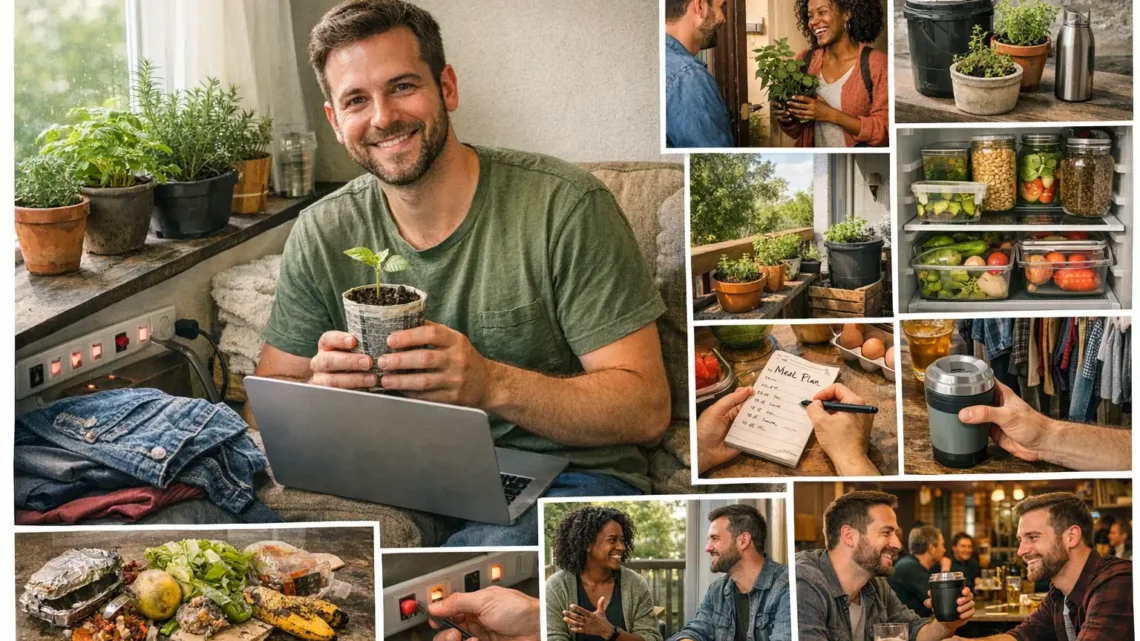
I did not start this journey because I was some kind of eco-warrior. I started because my electricity bill was choking me, my kitchen smelled like something was always rotting, and my neighbour, Clara, knocked on my door one Tuesday morning holding a dying houseplant and said, “I think we’re killing the planet one takeout box at a time.”
I laughed. She did not.
Trending Now!!:
That was the beginning of the strangest, most frustrating, most genuinely rewarding year of my life.
I had been working in environmental consulting for about four years at that point, advising companies on carbon footprint reduction and sustainable supply chains. I knew the theory cold. I could recite stats about greenhouse gas emissions, explain the lifecycle of single-use plastics, and draw a diagram of a circular economy on a whiteboard without blinking.
But my own apartment? A disaster.
Fast fashion piling up in a corner. Food waste I refused to measure because the number scared me. A refrigerator running so inefficiently it sounded like a helicopter preparing for takeoff. Three plastic bags of plastic bags under my kitchen sink, because I kept forgetting my reusable tote bags and felt guilty throwing the new ones away.
Clara was not a professional. She was a primary school teacher who had started composting in a bucket on her balcony after watching a documentary on ocean plastic pollution. She did not know what “net zero” meant. She just knew she was tired of feeling helpless.
“Come see what I’m doing,” she said that morning, still holding the dying plant, which I later found out was not dying at all, just underwatered.
I followed her across the hall.
Her apartment smelled like soil and lemon. There were glass jars on her counter, filled with dried lentils and oats and chickpeas. Her windows had sheer curtains, not blackout blinds, so natural light came flooding in and reduced her need for electric lighting. There was a small compost bin on the balcony next to a tray of herbs, basil and rosemary and mint, all thriving in recycled yogurt containers.
“I spend about forty percent less on groceries now,” she said, casually, like she was telling me the weather.
I stared at her for a long moment. “And this works?”
She smiled and said, “Ask my electricity bill.”
I went home, sat on my couch, and opened my laptop. I typed “how to start green living” and got immediately buried in articles about solar panels, electric vehicles, and zero-waste lifestyles that required purchasing seventeen different bamboo products before breakfast. That was the first mistake most people make, and I almost made it too. Sustainable living is not about buying new eco-friendly stuff to replace perfectly functional old stuff. That is just green consumerism wearing a tote bag.
I closed the laptop and called my colleague Adaeze, who had been living sustainably for about six years and always brought lunch in a stainless steel container that she had owned since graduate school.
“Where do I start?” I asked.
She did not hesitate. “Your food. Start there. Everything else is noise until you sort out your food habits.”
“Why food?”
“Because food production accounts for about a third of global greenhouse gas emissions,” she said, “and also because you clearly have a rotting problem in your kitchen. I smelled it at the last office meeting when you opened your bag.”
I was mortified. But she was right.
I started tracking what I threw away. Just tracking. No changes yet, just honesty. By Friday of the first week I had thrown out half a head of wilted lettuce, three bananas that had gone black, a container of leftovers I had forgotten existed, one lemon that had turned soft, and something in a foil wrap I could not identify and chose not to investigate further.
It was embarrassing. Not in an abstract, environmental guilt way. Embarrassing in the way you feel when you realize you have been losing money quietly for years and just never looked at the receipts.
Sustainable food habits are one of the most impactful personal choices you can make for reducing your carbon footprint. But nobody tells you the emotional weight of actually seeing your waste laid out in front of you.
I texted Clara: “I threw out food worth probably twenty dollars this week.”
She replied: “Welcome. Now don’t do it again.”
Simple. Zero sympathy. Exactly what I needed.
I started meal planning. Not the gorgeous Pinterest kind with color-coded spreadsheets and mason jars arranged by hue. The ugly, practical kind where I wrote five meals on a sticky note, bought only what I needed for those meals, and cooked on Sunday and Wednesday. I started a small kitchen compost bin for scraps, the kind with a charcoal filter so it does not smell, which I would empty into Clara’s balcony composter since I had no outdoor space of my own.
By week four, my grocery bill had dropped noticeably. My kitchen smelled clean. And I had not thrown out a single piece of fruit.
The refrigerator was next. I had always set it to the coldest possible temperature because I thought colder meant safer. Turns out that is not only wrong but it is wasting significant energy every single day. The recommended temperature for a refrigerator is between 35 and 38 degrees Fahrenheit, or 1.6 to 3.3 degrees Celsius. Mine was set to what I can only describe as “Arctic expedition.”
I adjusted it.
I also started unplugging electronics I was not using. Standby power, sometimes called phantom load or vampire energy, accounts for roughly five to ten percent of a household’s electricity use. My phone charger, my television, my microwave clock, all of them drawing quiet, invisible power all day, every day, even when I was at work.
I bought a power strip with individual switches. Not a new eco-friendly one, just a regular one from a hardware store that cost almost nothing. I started switching off the strip when I left the room.
My flatmate at the time, Jonah, thought I was losing my mind. He would come into the living room and find the television off, the strip switched down, the curtains open for natural light.
“Did the power go out again?” he asked, the first time.
“No,” I said. “I’m just not using it.”
He stared at me with genuine concern.
“Are you okay? Do you need me to call someone?”
I laughed. He slowly started doing the same things two months later, without ever admitting it.
I had always known fast fashion was a problem. I knew about the water usage, the synthetic microfibers polluting waterways, the labor conditions in production facilities, the sheer volume of textile waste going into landfill every single year. I knew all of it.
I also had thirty-seven t-shirts.
I counted them. Thirty-seven. Most barely worn. Several still had tags on them because I bought them on sale with such enthusiasm that I never stopped to ask whether I needed another grey t-shirt. I did not. I had six grey t-shirts. Seven, if you counted the one I was currently wearing.
I spent a Saturday afternoon going through everything. I sorted into three piles: keep, donate, repurpose for cleaning rags. I kept seventeen items, all things I genuinely wore and loved. I donated what was in good condition to a local thrift store. I cut up the rest.
Then I made a rule for myself. Before I bought any new clothing item, I had to ask three questions. Do I already own something that does the same job? Will I wear this at least thirty times? And can I buy this secondhand first?
That third question changed my shopping completely. I discovered thrift stores I had walked past for years without entering. I found a vintage denim jacket that had clearly lived a full life before it met me. I bought it for almost nothing and wore it until people started asking where I got it.
Sustainable fashion is not about looking like you shop at a farmer’s market. It is about breaking the psychological loop that says “new” always means “better.”
By the halfway point of the year, people had started noticing. Colleagues at work asked questions. Friends at dinner became curious when I declined single-use cutlery or quietly declined the plastic straw. Some were genuinely interested. Some were what I can only call performatively skeptical, the type who say, “But what difference does one person make?” in a tone that sounds philosophical but is really just tired.
I had one of those conversations with Marcus, an old friend from university, over dinner.
“You know this is all a bit much, right?” he said, poking at his pasta. “Individual action doesn’t change systemic problems. The top companies produce most of the emissions.”
I had heard this argument before. It is true, actually. Systemic change is essential. Corporate accountability matters enormously. But I had learned something in six months of living differently that I had not learned in years of professional environmental work.
“You’re right,” I said. “But this year changed how I vote, what I buy, which companies I give money to, what conversations I have, and apparently, what conversations I force you to have over dinner. Individual action is also civic action. It’s not either-or.”
Marcus was quiet for a moment.
Then he said, “Okay but can we talk about something else now because I feel judged by your reusable water bottle.”
I laughed so hard the table next to us looked over.
I want to be honest about this part, because every sustainable living guide I ever read made it sound like once you start, the habit just locks in permanently and you become a glowing person who never struggles.
That is a lie.
Month ten, I was exhausted from a heavy work project, emotionally depleted, and I ordered takeout seven times in two weeks, all in plastic containers, from a place that used styrofoam lids, and I did not compost a single thing. I bought a shirt I did not need because the dopamine hit felt good in the moment. I left my laptop charging all night three times.
I texted Clara: “I think I failed.”
She called me immediately.
“Listen,” she said, and I could hear her balcony herbs rustling in the background. “Sustainable living is not a diet. You didn’t fall off a wagon. You had a hard few weeks. Just start again. That’s the whole thing. You just start again.”
That was the most useful thing anyone said to me that year.
I did not become zero-waste. I did not install solar panels. I do not own an electric vehicle. By most Instagram-green-living-influencer standards, my year was modest and unimpressive.
But here is what actually happened.
My electricity bill dropped by about thirty percent. My grocery spending dropped by a similar amount with zero reduction in the quality of what I was eating, actually an improvement, because I was cooking more and wasting less. I own roughly half the clothing I used to own and feel no sense of loss about it. My apartment is quieter, less cluttered, and smells significantly better than it used to.
I started a small herb garden on my windowsill, thyme, parsley, and the same rosemary Clara gave me a cutting from. I cook with it almost every day.
And Marcus, who told me individual action did not matter, sent me a photo three months after that dinner. It was his new reusable coffee cup. The caption was: “Don’t say anything.”
I said nothing.
I just sent back a single green leaf emoji.
Clara saw me in the hallway last week. She was carrying a new batch of seedlings, tiny green shoots in recycled newspaper pots.
“How’s the year feeling?” she asked.
I looked at the seedlings, then back at her.
“Like I finally stopped pretending I didn’t know better,” I said.
She nodded, like that was exactly the right answer, handed me one of the seedlings, and walked back to her apartment.
I put it on my windowsill, next to the rosemary.
It is doing very well.