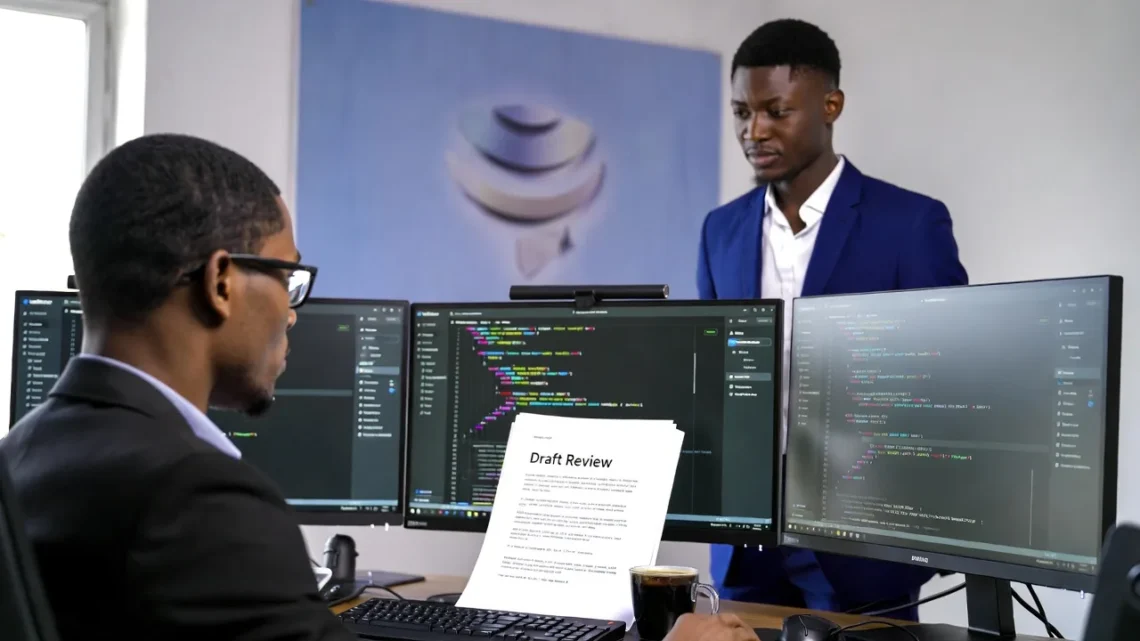
I’ve Reviewed Over 400 SaaS Tools. Nothing Prepared Me for This Midnight DM
I have been writing software reviews for over ten years now. Ten years of trial accounts, free demos, biased landing pages, and founders who swear their project management tool is “the Notion killer.”
Ten years of testing CRM software, comparing cloud-based solutions, evaluating user experience, and telling the truth even when the truth made someone’s investor cry.
Trending Now!!:
I thought I had seen everything.
I had not seen Emeka.
It started on a random Tuesday night in November. I was sitting in my home office, three monitors glowing, a cold cup of coffee beside my keyboard, and my review draft for a popular email marketing software open on my screen.
The review was brutal. Honest, but brutal. Their automation workflow was clunky, their customer support response time was embarrassing, and their pricing tiers made absolutely no sense for small business owners.
I was about to hit publish.
That is when my phone buzzed.
A DM on LinkedIn. Unknown sender. The profile picture showed a young man in a sharp navy blazer, startup logo on the wall behind him.
The message read, “Hi, I know it’s late. I’m Emeka, co-founder of TaskBridge. I heard you’re the most trusted SaaS reviewer in West Africa. I need to talk to you. Please.”
I stared at it.
Most trusted SaaS reviewer in West Africa. I will not pretend that did not flatter me a little. I typed back, “It’s past midnight. What’s this about?”
He replied instantly, like he had been holding his phone.
“My startup just launched. We built a B2B SaaS platform for remote team collaboration. We’ve been live for three weeks. Techcrunch Africa is writing about us next month. But tonight, someone published a fake one-star review of our tool on G2, calling it malware. It’s spreading. Investors are seeing it. I need a credible voice. Please.”
I exhaled slowly.
This was not my first rodeo with reputation management crises in the SaaS space. I had seen competitors use review bombing, fake ratings, and coordinated negative campaigns to take down rival products. It was a real problem in the software review ecosystem, and it was genuinely dirty.
But I had rules. I never rushed a review. I always tested the product myself. I never let urgency replace due diligence.
I typed, “Send me access to the platform. I’ll take a look. But I don’t publish what I don’t personally verify.”
“Thank you. Sending you admin access now. Please, just look at it tonight if you can.”
I poured myself a fresh cup of coffee.
The onboarding flow opened in my browser. Clean interface. Navy and white color scheme. Task management dashboard on the left, a real-time collaboration panel on the right. I clicked through the features slowly, the way I always do, like a mechanic lifting the hood of a car before agreeing to fix it.
I have reviewed over 400 software products in my career. Everything from enterprise resource planning tools to no-code app builders to customer data platforms. I know what good SaaS architecture feels like. I know the difference between a product that was built to solve a real problem and one that was built to raise funding.
TaskBridge felt real.
The task dependencies worked cleanly. The Kanban view was responsive. The API integration with Slack and Google Workspace was smoother than tools I had seen from companies with fifty times the funding. There was even a built-in time tracking feature that synced with invoice generation. Small teams would love this.
I ran a performance test. Page load speed was excellent. I checked the SSL certificate, reviewed the privacy policy, tested the mobile responsiveness. I even tried to break the file upload feature by sending a corrupted document. It handled it gracefully and gave a clear error message.
This was genuinely good software.
I called Emeka.
He picked up on the first ring.
“Hello?” His voice was tired but alert.
“Your product is solid,” I said. “Whoever wrote that fake review either never opened the platform or was paid to lie.”
I heard him exhale. Long, heavy, like someone who had been holding their breath for hours.
“Thank you. That means everything right now.”
“Who do you think did it?” I asked.
He paused.
“I have a theory,” he said quietly.
“Tell me.”
Another pause. Then, “Our main competitor is CloudCollab. They raised two million dollars last year. We launched with bootstrapped funding. We’ve been growing faster than them in the SME segment. I think they felt threatened.”
That was a serious accusation. I had reviewed CloudCollab eighteen months ago. Decent product. Aggressive marketing team. I had given them a 3.8 out of 5, which their PR person had emailed me about three times asking me to revise upward. I had declined each time.
“Can you prove it?” I asked.
“Not yet,” he admitted. “But I can show you something interesting.”
Emeka screenshared his laptop with me over a video call. He pulled up the G2 review that was causing the damage. It had been posted by a user called “TechTester_NG.” The account was three weeks old. No profile photo. No other reviews. The language in the review used very specific technical-sounding phrases.
“Look at this phrase here,” Emeka said, highlighting a line in the review. “‘Unsecured data handling protocols and unverified third-party integrations.’ Nobody talks like that unless they work in enterprise SaaS sales.”
I leaned closer to my monitor.
He was right. That kind of phrasing was not user language. That was competitor sales collateral language. I had read enough software comparison pages and battle cards to recognize it.
“Okay,” I said, “I’m going to write an honest, detailed review tonight. Not because you asked me to, but because bad actors in the software review industry make my job harder for everyone. A good product deserves an accurate record.”
I heard real relief in his voice.
“I don’t know how to thank you.”
“Let me finish the review first,” I said. “If I find anything genuinely wrong, I’m writing that too. Fair warning.”
“Fair enough,” he said. “That’s all I’m asking.”
I spent the next two hours going deep. I tested the software review checklist I have used for a decade, covering everything from data security features and user access controls to integration ecosystem and customer support quality. I submitted a test support ticket and documented the response time. I analyzed the pricing model against competitors in the project management software category.
By 4 AM, my draft was ready.
It was a strong review. Honest and detailed. I gave TaskBridge a 4.4 out of 5. I noted the areas that needed improvement, specifically the mobile app, which still had some UI inconsistencies, and the lack of a dedicated help center documentation library. But I called the core product what it was: an impressive, well-built remote work platform from an underdog team.
I published it.
Then I went to bed.
When I woke up six hours later, my phone had forty-seven notifications.
The review had been shared across three SaaS communities on Reddit. It had been reposted on Product Hunt. Two startup newsletters had linked to it. My own following had grown by 300 overnight.
Emeka sent me a voice note.
“Bro. The fake review is being flagged for removal on G2 now. Three investors who went quiet last week just came back. One of them said they saw your review and it restored their confidence. I genuinely don’t know what to say. You changed the trajectory of this thing.”
I smiled, made myself a proper breakfast, and sat back down at my desk.
But here is where the story gets interesting.
Later that afternoon, I got an email.
It was from CloudCollab’s marketing director, a woman named Adaeze.
The subject line read: “Regarding your recent TaskBridge review.”
I opened it expecting a complaint, maybe even a legal threat. Companies had tried that before when my reviews were unfavorable. Instead, the email said this:
“Hi, I read your TaskBridge review this morning. I want to be transparent with you. The fake G2 review was not posted by us. I understand why you might suspect otherwise given our competitive position, but we had nothing to do with it. The person behind that account is actually a former employee of TaskBridge itself. His name is Chidi. He was fired six weeks ago for code theft allegations. He has a personal grievance. I thought you should know.”
I read it three times.
A former employee. Not a rival company. Someone internal.
I called Emeka immediately.
The phone rang five times before he answered.
“Hey, did you fire someone named Chidi recently?” I asked.
Silence.
Long, uncomfortable silence.
“How do you know about Chidi?” he finally said.
“Answer the question.”
Another pause. Then, slowly, “Yes. He was our lead backend developer. We caught him copying proprietary code and trying to sell it to another company. We had to let him go. It got messy. There were threats.”
I sat back in my chair.
“Emeka,” I said carefully, “the person who attacked your reputation online was not your competitor. It was someone inside your own story.”
He was quiet for a long moment.
Then he said, softly, “I accused CloudCollab to you last night.”
“You did.”
“I need to apologize to Adaeze.”
“You do,” I agreed.
What followed was something I genuinely did not expect. Emeka reached out to CloudCollab, admitted the misdirection, and the two companies actually began a conversation that led, three months later, to a formal API partnership, a technical integration between both platforms, and a co-authored blog post about competing with integrity in the African SaaS market.
Chidi, for his part, was eventually reported to G2 for review manipulation and his account was permanently removed. G2 also used the incident to update their review verification protocols for African market accounts.
I think about that night often.
Not because of the drama, but because of what it reminded me about software reviews and the SaaS ecosystem in general.
A review is not just content. It is not just SEO copy or a keyword-optimized article designed to rank for “best project management software” or “top SaaS tools for remote teams.” It is a record. Someone out there, a small business owner, a first-time founder, a remote team lead, is going to read that review and make a decision that affects their business, their budget, and their people.
When I get that wrong, whether through laziness, bias, or rushing, I do not just lose credibility. I become part of someone’s bad decision.
That responsibility is something I carry into every single review I write, whether it is a cloud-based CRM comparison, an honest breakdown of subscription management software, or a deep dive into AI-powered analytics tools.
I have turned down payments to inflate scores. I have re-reviewed products after major updates and changed my ratings, both upward and downward. I have lost brand deals because I refused to remove a negative but accurate critique.
And I would do it all again.
Because TaskBridge is now used by over 1,200 teams across Nigeria, Ghana, and Kenya. Emeka sends me a message every quarter with the updated numbers. He always ends with the same line.
“The review changed everything.”
I always reply the same way.
“The product did the work. I just told the truth.”
And that, honestly, is the whole job.