My Insurance Claim Was Denied After My House Burned Down
I have spent over ten years in the legal and insurance space. I have reviewed thousands of policies, sat across from hundreds of panicking clients, and walked into courtrooms that smelled like burnt coffee and quiet desperation.
I have seen insurance fraud, denied claims, wrongful settlements, bad-faith insurance practices, and every type of legal disaster you can imagine.
Trending Now!!:
But nothing, and I mean absolutely nothing, prepared me for the Tuesday afternoon Mrs. Adaeze walked into my office.
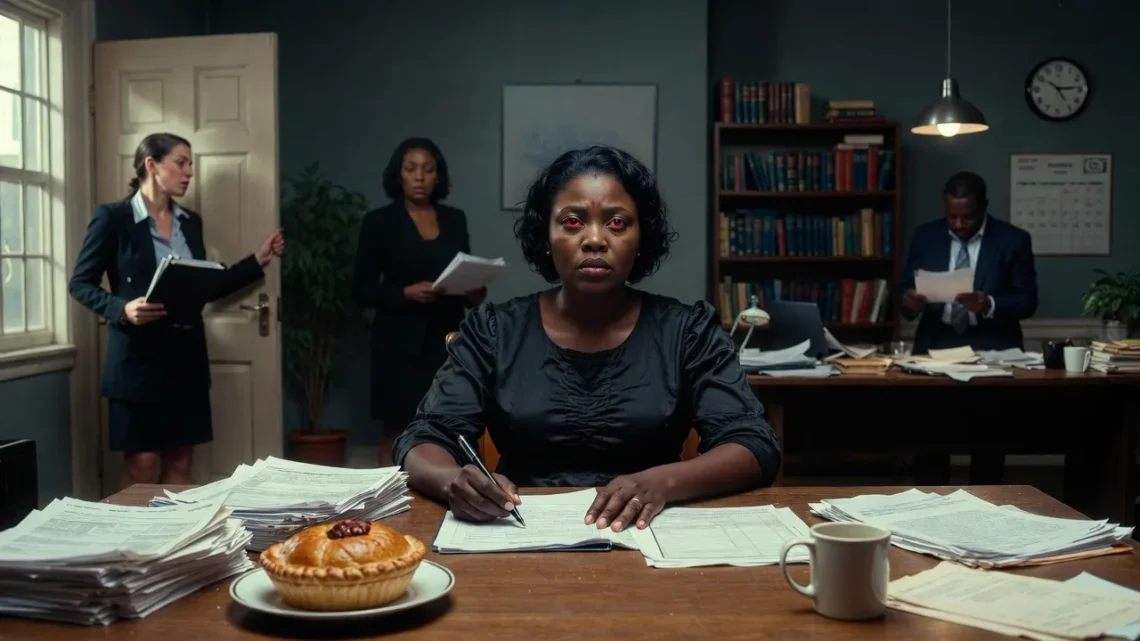
It was a regular day. My desk looked like a crime scene of its own. Policy documents, liability coverage reports, a half-eaten meat pie, and three tabs open on my browser, all on different insurance settlement case laws. My assistant, Chuka, knocked twice before poking his head in.
“Boss, there’s a woman outside. She said she doesn’t have an appointment, but she also said she will not leave until she sees you.”
I sighed. I had heard that before.
“Send her in,” I said.
Mrs. Adaeze walked in wearing a black dress that looked like it had been ironed in a hurry and then sat in for a long bus ride. She was maybe fifty-five, maybe older. Her eyes were red, not from crying exactly, but from the specific kind of exhaustion that comes from not sleeping for several nights because your brain will not stop calculating your losses.
She sat down without being invited to.
“They rejected my claim,” she said, before I could even offer her water.
I leaned forward. “Who did?”
“The insurance company. My house burned down three weeks ago. Everything gone. The furniture, my certificates, my late husband’s photographs, everything. And now they are telling me my homeowners insurance policy is not valid.”
I looked at her carefully. In my years of handling insurance claims and property damage cases, I had learned one thing. When someone says their claim was denied, there are always two sides. The insurance company’s side, and the truth.
“Do you have the rejection letter?” I asked.
She opened her bag and pulled out a crumpled envelope. She had clearly been holding it so tightly for so many days that it had absorbed some of her frustration. I took it, smoothed it out on my desk, and started reading.
The language was the usual insurance company corporate gymnastics. Terms like “lapse in premium payment,” “failure to notify of material change in property structure,” and my personal favorite, “exclusion clause 14(b).” That last one. I had seen that clause used to deny legitimate claims so many times that I could practically recite it in my sleep.
I asked, “When did your husband pass away?”
“Four years ago,” she said quietly.
“And who was the main policyholder on the homeowners insurance?”
She paused. Then looked at her hands. “He was. But I continued paying. I have all the bank statements.”
I nodded slowly. This was already complicated. When a policyholder dies and the surviving spouse continues paying premiums without formally transferring the policy into their name, insurance companies often use that gap as a reason to deny claims. It is technically within their rights. It is also, in my personal and professional opinion, one of the most predatory practices in the entire industry.
I told her plainly, “They may be using the lapse in policyholder name transfer as a grounds for denial. It doesn’t mean you have no options. It means we have to fight.”
She looked at me like I had said something in a language she was hearing for the first time.
“Fight? I am sixty-one years old. I am tired. I just want my money.”
“Then let me do the fighting,” I said.
What happened next is the part I tell every client who comes into my office thinking an insurance denial letter is the final word.
It is not.
I filed a formal claim dispute with the insurance company’s internal review board. I gathered her premium payment records, all four years of them, which legally established what courts call “continued interest in the policy.” I attached an affidavit explaining that she had maintained the property, paid all premiums, and that the insurance company had accepted those payments without flagging the policyholder name issue until she filed a claim, which is a classic bad-faith insurance tactic.
Meanwhile, my paralegal, Emeka, had been digging through the original policy documents. On day four of our investigation, he came into my office and dropped a folder on my desk with an expression on his face I had not seen since we won a complicated personal injury lawsuit against a logistics company two years prior.
“Boss,” he said, “you need to see this.”
I opened the folder.
There it was. Buried in the fine print of the original policy, under a subsection titled “Spousal Continuance Clause,” was a provision that stated, in plain language, that in the event of the death of the primary policyholder, a legally married spouse who continued premium payments would automatically be recognized as the successor policyholder for a period of up to seven years, provided that the insurer had accepted at least twelve consecutive premium payments post-death.
Mrs. Adaeze had paid for four years. That was forty-eight consecutive payments.
The insurance company had not only accepted those payments. They had sent her annual policy renewal notices addressed to her name.
I sat back in my chair and exhaled slowly.
They knew. They had been treating her as the policyholder for correspondence and premium collection, and then the moment a major claim came in, they quietly pretended that clause did not exist.
I called the company’s legal department directly. I spoke to their senior counsel, a man named Mr. Babatunde, who had the kind of confident voice that comes from spending too many years winning cases against people who do not know their rights.
“Counselor,” he said smoothly, “your client’s claim was reviewed thoroughly. The denial stands on solid legal ground.”
“Does it?” I replied. “Because I am looking at your own policy document right now. Page thirty-one, subsection nine, paragraph four. Would you like me to read it to you, or do you want to call your client and suggest they revisit this matter before I file for bad-faith damages in addition to the original claim?”
There was a long pause on the line. The kind of pause I have learned to enjoy after ten years in this field.
“I will need to consult internally and get back to you,” Mr. Babatunde said. His voice had lost some of its confidence.
“You have forty-eight hours,” I told him, “after which I will be filing in court.”
Here is where the plot twists in a way I genuinely did not see coming.
Thirty-six hours later, Mr. Babatunde called back. But it was not to negotiate the settlement.
He said, “Counselor, I owe you a candid conversation.”
I sat up straighter.
“The reason this claim was flagged internally was not actually the policyholder name issue,” he said. “Someone at this company flagged your client’s property as a suspected insurance fraud case. There was an anonymous tip suggesting the fire was deliberately set.”
I nearly dropped the phone.
I kept my voice level. “On what basis?”
“The tip came with photographs of your client allegedly purchasing accelerant from a market three days before the fire.”
I was quiet for three full seconds. Then I said, “Send me the photographs.”
He did.
I looked at them carefully. A woman in a blue wrapper buying what appeared to be kerosene. The image was grainy. The face was partially obscured.
I sent the photographs to Mrs. Adaeze immediately. She called me within two minutes.
“That is not me,” she said, and her voice was not defensive. It was confused. “That wrapper, I don’t own anything like that. And that market, I have not been to that area in years. My knee has been bad.”
I believed her. Not just because she said it, but because in ten years of doing this work, I have developed a sense for when someone is lying to me and when someone is genuinely bewildered. She was bewildered.
I hired a forensic image analyst within the day. His name was Mr. Dike, a quiet man who billed by the hour and communicated mostly in technical reports that read like poetry if you understood insurance law.
Mr. Dike came back with his findings in four days.
The photographs had been digitally altered. The metadata on the image files showed they had been edited using software on a specific device, and the timestamp of the original photographs predated the date of the fire by nearly six months.
Someone had fabricated evidence to trigger a fraud investigation and kill Mrs. Adaeze’s claim before it could be settled.
I sat with that for a moment. This was no longer just an insurance claim dispute. This was witness tampering, evidence fabrication, and potentially a criminal matter.
Emeka looked at me from across the office. “Who would do this?”
I had one theory, but I needed more before I said it out loud.
I requested the full claims history on the policy. It turned out there had been a previous minor claim three years earlier, a burst pipe that caused partial flooding in the kitchen. That claim had been processed and paid without issue. But attached to that old claim file was a notation from an internal insurance assessor, a man whose name kept appearing in the paperwork, a man named Mr. Okonkwo.
I pulled up his profile. He was a freelance insurance assessor who contracted with multiple companies. He had assessed Mrs. Adaeze’s property twice. Once after the burst pipe and once after the fire.
But here is what caught my eye. In the period between those two assessments, Mr. Okonkwo had also submitted a proposal to purchase Mrs. Adaeze’s property, through a shell real estate company, at roughly forty percent below market value. She had declined.
There it was.
I put together a dossier so complete that when I walked into the insurance company’s head office with it, Mr. Babatunde read it and visibly paled.
Mr. Okonkwo had fabricated the fraud tip to kill the claim, hoping that without insurance payout, financial pressure would eventually force Mrs. Adaeze to sell the land.
He had not counted on a sixty-one-year-old woman who refused to leave my waiting room.
The insurance company settled within three weeks of that meeting. Full property damage claim paid, plus a bad-faith damages payment, plus legal costs. Mr. Okonkwo was reported to the regulatory authority, his assessor license was under review, and a criminal complaint had been filed.
When I called Mrs. Adaeze to tell her the settlement had cleared, she was quiet for a long moment.
Then she said, “You know what my husband always told me? He said, always read the fine print. Always keep your documents. And always find someone who knows more than you about the things that are trying to hurt you.”
I smiled. “Smart man.”
“He was,” she said. “He also took out a life insurance policy in my name before he passed. I forgot about it for two years because I was grieving. His lawyer called me about it eventually. That money is what kept me going when everything else fell apart.”
I went quiet for a second.
“A life insurance policy?” I said.
“Yes. He was always the careful one. I didn’t even know what half the documents meant when I signed them. I just trusted him.”
I thought about that for a long time after we hung up.
Here is what I want you to take from this story, because after more than a decade in legal and insurance, this is what I know for certain.
Insurance companies are not always on your side. Homeowners insurance, auto insurance, liability coverage, life insurance, health insurance, every single one of these can become a battlefield the moment a significant claim is filed. The fine print is not decoration. It is either your weapon or your enemy, depending on whether you have read it.
Policyholder rights are real, but they are only useful if you know they exist. Bad-faith insurance practices happen more often than companies will admit. A claims adjuster is not your friend by default. An insurance settlement is rarely the first number they offer you. And when a claim is denied, that denial letter is not a verdict. It is the beginning of a negotiation.
Get legal representation early. Understand your liability coverage before something happens, not after. Keep records of every premium payment, every correspondence, every renewal notice. Because the day you need to file a claim is the day all of that paper becomes your lifeline.
And sometimes, the most important thing a person can do is refuse to leave the waiting room.
Mrs. Adaeze knew that instinctively.
She walked in tired, defeated, holding a crumpled rejection letter.
She walked out with a full settlement, justice against the man who tried to steal from her, and enough money to rebuild.
I have handled bigger cases. Cases with more zeros, more lawyers, more media attention.
But I have never handled a case that reminded me more clearly of why I got into this field in the first place.
Because somewhere out there, right now, someone is holding a rejection letter and thinking it is the end.
It is not.
Not if you know your rights. Not if you read the fine print. And not if you find someone willing to fight.
Have you ever had an insurance claim denied unfairly? Or discovered a policy you forgot about? Share your experience in the comments. And if you need guidance on insurance claim disputes, policyholder rights, or legal representation for a coverage denial, reach out. That is exactly what I am here for.