
My Wife Gave Me Until Sunday Dinner to Fix It. Here’s What Happened
Three years ago, I knocked down the wrong wall in my own house.
Not a load-bearing wall, thankfully. But wrong enough that my wife, Carla, stood in the doorway of what used to be our perfectly functional guest bathroom, looked at the cloud of drywall dust settling on the hallway carpet we had just paid $1,400 to install, and said, very quietly, “I need you to explain what I am looking at right now.”
Trending Now!!:
I had no good answer.
Let me back up.
I have been doing home improvement and DIY projects for over a decade. I started the way most people do, watching YouTube videos at midnight, convincing myself that a bathroom remodel, a kitchen renovation, or a full flooring installation was something any reasonably intelligent adult could handle over a long weekend. I have ripped out tile.
I have replaced subfloor. I have rewired light fixtures in ways that probably scared my electrician friend half to death when I told him about them later. I know the smell of fresh spackle the way a baker knows yeast. I have the callused palms and the paint-stained jeans to prove all of it.
But that afternoon, I had made a rookie mistake. Not a tools mistake, not a materials mistake. A planning mistake, which is the most expensive kind there is.
It started because Carla had been dropping hints for about eight months. Not subtle hints. The kind of hints that come with magazine cutouts left on the kitchen counter, and screenshots texted to you at 7 a.m. with captions like, “This is literally all I want.” She wanted the guest bathroom expanded.
She had seen a home renovation idea online, a concept where you remove the wall separating a small guest bathroom from an adjacent linen closet to create one larger, open-plan bathroom with double vanity space. It looked incredible in the photos. Clean lines, budget bathroom renovation done beautifully, the kind of interior design upgrade that adds real value to a home.
I told her I could do it.
She said, “Are you sure? Because I can just call someone.”
I said, “Carla, I have been doing this for ten years. I replaced our entire kitchen backsplash in a weekend. I installed the hardwood flooring in the living room myself. I got this.”
She gave me the look. The look that married people will understand immediately. The one that says, I love you, but I am already mentally preparing for the version of this story where something goes wrong.
I ignored the look.
The first weekend, I did everything right. I ran the stud finder along both walls, marked the studs, checked for electrical wiring with a voltage tester, confirmed there were no water lines running through the linen closet wall. I had a solid drywall repair plan.
I had the right tools: oscillating multi-tool, reciprocating saw, pry bar, shop vac, safety goggles. I had watched no fewer than six tutorials on how to remove interior non-load-bearing walls cleanly. I was, by any reasonable standard, prepared.
And then my neighbor, Pete, showed up with a six-pack of craft beer and a tremendous amount of unsolicited confidence.
Pete is the kind of man who has owned a drill since 1987 and believes this qualifies him as a structural engineer. He walked in, looked at my marked wall, tilted his head, and said, “You know what would really open this space up? If you took out that section too,” pointing at the adjacent wall that jutted slightly into the hallway.
“That’s a different wall, Pete,” I said.
“It’s attached to the same wall,” he said. “Trust me, I did something similar in my basement.”
I should have said no. I should have checked my plans again. I should have done approximately forty-seven other things before picking up that reciprocating saw. But it was a Saturday afternoon, the beer was cold, and Pete had the particular energy of a man who is absolutely certain he is right.
Forty minutes later, I had a hole in the wrong wall.
The silence when Carla walked in was genuinely cinematic. She was holding a cup of tea. She looked at the hole. She looked at me. She looked at Pete, who was suspiciously focused on the ceiling. She looked back at me.
“I need you to explain what I am looking at right now,” she said.
“So,” I began, “there was a slight deviation from the original plan.”
“A deviation,” she repeated.
“A directional pivot,” Pete offered helpfully.
Carla looked at him the way a judge looks at someone who has just interrupted court proceedings to offer an unqualified legal opinion.
“Pete,” she said, “go home.”
Pete went home.
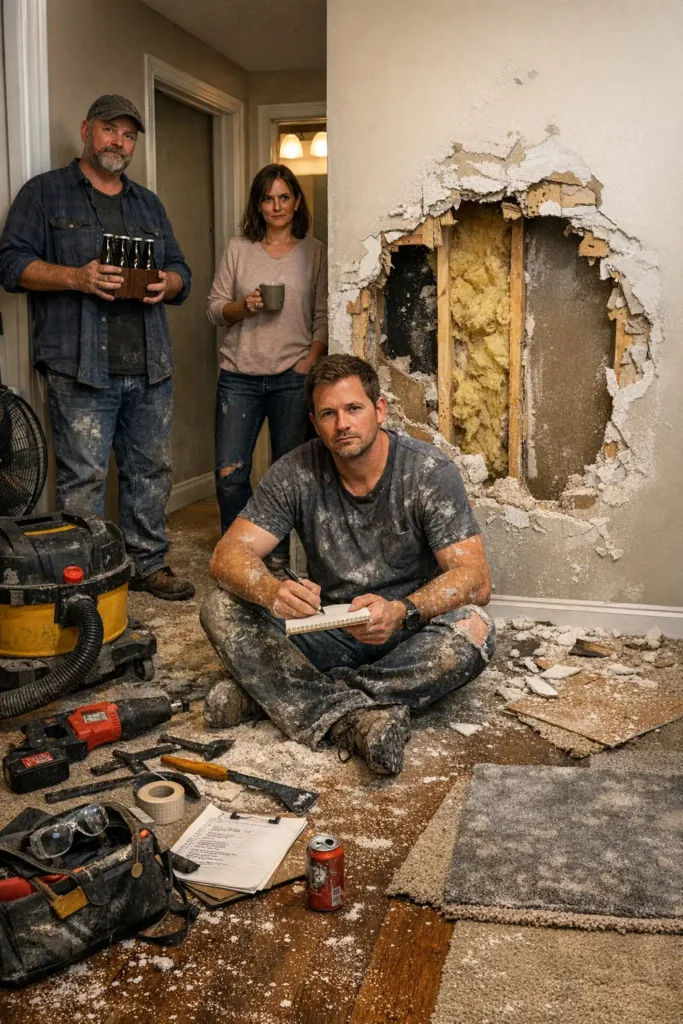
I stood alone in a hallway that now had a ragged, man-sized hole in a wall that was supposed to remain entirely intact, exposing the insulation behind it like a wound. Drywall dust on the new carpet. A shop vac humming uselessly in the corner. The bathroom project, which had been going so well, completely derailed.
Here is the thing about home improvement projects that no tutorial ever really prepares you for: the moment everything goes sideways is also the most educational moment of your DIY career, if you choose to approach it that way. I have learned more from my worst renovation mistakes than from any of my clean, successful projects. Successful projects teach you confidence. Failed projects teach you everything else.
So I sat down on the hallway floor, covered in dust, and I made a list.
The damage assessment took about twenty minutes. The good news: the wall I had accidentally opened was not structural.
No load-bearing elements, no electrical, no plumbing, no surprises hiding inside it. The bad news: I had created extra repair work that would cost me time and materials I had not budgeted for. The carpet immediately outside the hole was ruined in a two-foot radius. And Carla was now upstairs, very quiet, which in our house is a loudness all its own.
I texted her: “I’m going to fix it. All of it. Give me the weekend.”
She replied: “You have until Sunday dinner.”
I drove to the hardware store at 6 p.m. on a Friday evening. I know that store the way some people know their gym or their church. I know which aisle has the drywall screws, which corner stocks the compound, where they hide the mesh tape behind the joint tape rolls.
I pulled a cart and started building my list in my head: two sheets of half-inch drywall, joint compound, primer, interior paint matched to the existing wall color, replacement carpet remnant for the hallway patch, and everything I needed to complete the original bathroom expansion correctly.
Total materials cost: $194.
I also bought a large coffee and a sandwich, because I knew I was working through the night.
The repair process, when you strip it down, is not complicated. Drywall installation and drywall repair follow the same basic logic.
You cut your patch piece to fit the opening cleanly, you fasten it to your studs or your backer board, you tape the seams with mesh tape, you apply your joint compound in thin coats, you let each coat dry completely, you sand, you repeat until the surface is flush, you prime, you paint.
If you rush any single step, especially the drying time between coats, the entire finish will crack and bubble and you will be able to see the repair from six feet away for the rest of the time you live in that house. I have made that mistake exactly once. I did not intend to make it again.
By midnight Friday, the patch was up and the first coat of compound was on. I set a fan running low to help the drying and went to sleep on the couch, setting an alarm for 5 a.m.
Carla brought me a blanket at some point without saying anything. I chose to read that as a positive sign.
Saturday was a long, focused day. Second coat of compound in the morning, sand by early afternoon. The carpet patch was trickier. Matching carpet from a remnant is always a gamble because the remnant has been sitting in a warehouse and the existing carpet has been walked on and faded under two years of natural light. The color was close but not perfect.
I pulled the patched section to a corner near the bathroom door where it would be largely hidden by the door frame when open, and used the better-matching remnant piece in the more visible section of the hall. A small trick I learned years ago: the eye always finds the worst patch, so put your best work where the eye lands first.
By Saturday evening, I was back on the original project, the one that was actually supposed to happen. The linen closet wall came down clean. I framed the new opening properly. The space opened up exactly the way the inspiration photos had promised.
Carla came downstairs around 9 p.m. and stood in the new, larger bathroom space, looking around slowly.
“This is actually what I wanted,” she said finally.
“I know,” I said.
“You made a very large mess getting here,” she said.
“I know that too,” I said.
She picked up a paint roller from the floor, looked at me, and said, “Which color did you buy?”
I handed her the sample card. She nodded. We painted until midnight together, both of us quiet and focused, the way people who have been through something mildly stressful together get quiet and comfortable again.
Sunday morning, I finished the hallway. Third coat, final sand, paint. From six feet away, you could not see the repair at all. The carpet patch was invisible from the doorway. The bathroom had its new double vanity wall, the space properly opened up, the whole small home renovation project complete.
Carla made breakfast. She set my plate down, looked at me with a slight smile, and said, “You know Pete called this morning to check how it went.”
“What did you tell him?” I asked.
“I told him you fixed it,” she said. “And that he is not allowed back inside this house with a beer until further notice.”
I laughed so hard I nearly knocked over my coffee.
Pete did eventually come back, about three weeks later, appropriately humble, bearing a bottle of wine instead of beer. He walked through the new bathroom, looked at the hallway, and genuinely could not find where the repair had been made. He ran his hand along the wall, pressing lightly, frowning.
“You can’t even tell,” he said, almost offended.
“That’s the point, Pete,” I said.
“I’m sorry about the wall,” he said.
“Don’t point at walls anymore,” I told him.
He nodded solemnly. “Noted.”
Here is what ten years of DIY home improvement has actually taught me, past all the tutorials and tool reviews and before-and-after content:
The planning phase is worth more than the execution phase. Every hour you spend measuring, checking your structure, identifying your utility lines, and confirming your actual project scope will save you three hours of repair work and approximately four to seven years off your marriage.
I say this with full sincerity. The most expensive home renovation mistakes I have ever made were not caused by using the wrong tools or buying cheap materials. They were caused by skipping steps because I was confident and someone with a beer was pointing at a wall.
Budget bathroom remodels, kitchen renovations on a budget, DIY flooring installation projects, even full home improvement projects done on a shoestring, all of them are genuinely achievable without professional contractors. I have done all of them. But the gap between a DIY success and a DIY disaster is almost never about skill. It is almost always about patience.
Take your time. Measure everything twice. Do not listen to Pete.
And if your partner gives you that look before you start, at least have the self-awareness to pause and think about whether you have fully earned your confidence in that moment, or just borrowed some of Pete’s.
The wall cost me $194 and a very long weekend.
But the bathroom looked incredible. And Carla still brings it up at dinner parties, which means it made a good story in the end, which I have decided is the same as a win.