Parenting a Teenager Taught Me I Still Had Growing Up to Do
I have been a father for sixteen years. And for about fourteen of those years, I was absolutely, completely, embarrassingly convinced I was doing it wrong.
Not just slightly wrong. Like, “this man should not be near impressionable children” kind of wrong.
Trending Now!!:
Let me paint you the full picture. It was a Tuesday evening — the kind of Lagos evening where the traffic had already stolen two hours of your life, your generator had the audacity to run out of fuel, and your jollof rice was sitting on the cooker looking back at you like a personal insult.
That was when my daughter, Zara, walked into the sitting room, sat directly across from me, folded both arms with the calm authority of a woman who had rehearsed this moment, and said the seven words no exhausted single father ever wants to hear:
“Dad. We need to talk. Like, seriously.”
She was fifteen. Her braids were freshly done — tight cornrows with gold beads at the ends that clicked every time she moved her head. She had that face on. The one that means she has already thought through every possible response you might give and has pre-countered all of them.
I set down my overcooked rice and gave her my full, undivided, quietly terrified attention.
I need to backtrack a little, because you need to understand the weight of that moment.
I became a single father when Zara was two years old. Her mother, Adaeze, slipped away quietly in a hospital bed at Lagos Island General while I sat outside the ward eating stale chin-chin from a vending machine — too numb to cry, too young to fully understand that the real job had just begun. No manual. No co-parent. No one to look at in the middle of the night and say, “Is she breathing too fast, or is that normal?”
Just me.
Research shows that most children in single-parent households grow up to be well-adjusted adults, but that is not information you have access to at 2 a.m. when your toddler has a fever and your hands are shaking as you read the back of a Panadol syrup bottle. What you have at 2 a.m. is fear. And guilt. And a WhatsApp group called “Single Dads Who Are Trying” that nobody has posted in for three weeks.
I tried everything. I read The Whole-Brain Child. I attended three parenting workshops at St. Kevin’s Primary School when Zara was in JSS2. I watched YouTube tutorials on how to braid African hair — plural, multiple tutorials, for multiple Saturday mornings — and still managed to produce cornrows so uneven they looked like someone drew them in the dark. I tried authoritative parenting. Then positive discipline. Then natural consequences. I tried the love-and-logic approach, which Zara basically dismantled at age nine by being more logical than me.
I was trying. Lord knows I was trying. But trying and knowing what you’re doing are two entirely separate things, and I spent thirteen years confusing one for the other.
Back to the Tuesday evening.
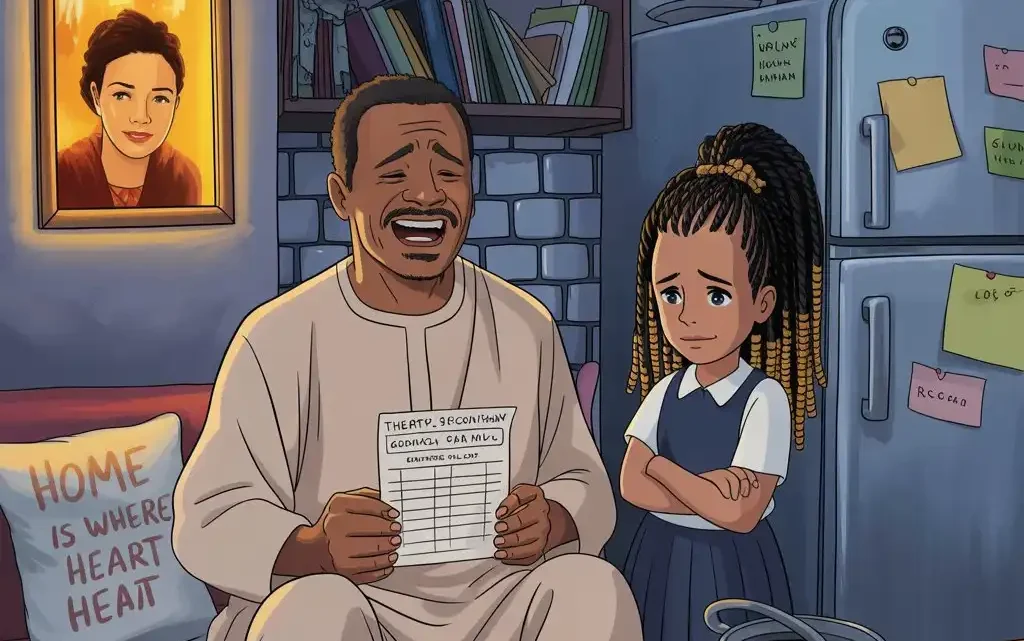
Zara cleared her throat in that deliberate teenage way that means do not interrupt me and pulled out a piece of paper. An actual, physical, handwritten piece of paper. She had made a list. She had sat down somewhere — probably her bedroom, probably while I thought she was doing homework — and written me a list.
“Number one,” she read, gold beads clicking with quiet authority. “You apologise to the microwave every time you use it wrong. That is not normal behaviour, Dad.”
I opened my mouth. Closed it.
“Number two. You cried watching the Cocomelon intro last month. You do not even have a toddler.”
“That was—”
“Number three.” She did not look up. “You still sleep with Mum’s cardigan under your pillow. It has been thirteen years.”
The room went quiet. Not ordinary quiet. The kind of quiet that has actual weight, that settles on your chest.
I looked at this girl — this fifteen-year-old with her mother’s eyes and my stubbornness — and I felt something crack open inside my chest. Not painfully. More like the way a window cracks open and lets air in after a very long time.
“Zara,” I said slowly. “When did you become this wise?”
She folded her list back into her uniform pocket like a woman closing a business meeting. “I Googled ‘how to help a grieving parent’ when I was twelve. I have been monitoring you since.”
I did not know what to do with that information. I still am not entirely sure what to do with it.
Parents who are emotionally sensitive to their children’s emotional needs tend to raise emotionally intelligent children — that is what the research says. But nobody tells you the reverse can also happen. Nobody tells you that the child you are trying to raise with emotional intelligence might quietly turn around and start applying it directly to you.
The next morning, Zara placed a printed confirmation slip on the kitchen table next to my morning tea. It was a booking for three therapy sessions with Dr. Ngozi Okafor, a grief and family counsellor whose office was on the third floor of a building on Admiralty Way in Lekki.
“Where did you get money for this?” I stared at the paper, then at her.
She shrugged the way only teenagers shrug — that full-body unbothered roll that communicates entire paragraphs. “I have been making and selling chin-chin at school for eight months. Mrs. Adeyemi lets me use her kitchen on Saturdays.”
I sat down. Not on a chair. On the floor. My legs simply gave up.
“You sold chin-chin,” I said. “To pay for my therapy.”
“I also ate some of it,” she said. “Quality control.”
I laughed. The kind of laugh that arrives at the exact same time as crying. The ugly, honest, completely undignified kind. The real kind.
Dr. Ngozi’s office was small and deliberately calm. Pale blue walls. A thriving little potted plant on the windowsill that looked genuinely smug about its life. The kind of space designed to make you feel safe while also making you realise how much work you have been avoiding.
Zara had insisted on attending the first session. She sat beside me in the waiting room reading a book called Emotional Intelligence for Teens with the seriousness of someone prepping for an exam. I wanted to laugh. I did not. I sat in my best agbada and sweated quietly.
Inside, Dr. Ngozi asked me the one question I was not remotely prepared for.
“When was the last time you told Zara you were proud of her? Not for her grades. Not for her behaviour. Just for being alive and being yours?”
Nothing came out of my mouth.
Beside me, Zara did not say a word. She just reached over and held my hand. Quietly. The way she always had, without making a production of it, without asking for anything back.
And in that moment, in that pale blue room in Lekki, with a smug plant watching from the windowsill, something that had been locked inside me for thirteen years finally broke open and began, slowly, to move toward the light.
Adolescent emotional intelligence is positively linked with the authoritative parenting style — one that balances firm guidance with warmth and genuine verbal connection. I had been so occupied performing fatherhood — the tutorials, the workshops, the parenting books I stacked on shelves — that I had missed the most important part. Just talking. Just being present enough to say the true things out loud.
Three months after the sessions ended, Zara’s school held their annual Family Day showcase. I arrived expecting a poster about the food chain or renewable energy. I was not prepared to stop dead in the middle of the school hall in front of a large mounted display board that read:
“THE BEST DAD IN THE WORLD: A Three-Year Observational Study.”
My mouth went dry.
It was a full research project. Three years of quiet, careful documentation. Photos I had no idea she had taken. Journal entries. Dated evidence of every small, imperfect, consistent thing I had done while I was busy being convinced I was failing.
The burnt Sunday jollof rice: “Because he never stopped trying to get it right.” The YouTube hair tutorials: “Dad once spent four hours learning to braid my hair. The result was terrible. He tried again the following week.” The WhatsApp screenshots of me asking other dads for parenting advice at 11 p.m.: “He is not too proud to ask for help. That is what strength looks like.” The cardigan under my pillow: “He kept Mum’s cardigan because he loved her. I don’t think that needs fixing. I think it deserves to be admired.”
I stood in that school hall and read every single word my daughter had written about me.
The final entry was dated three months earlier — the night after our first therapy session.
“Tonight, Dad sat on the kitchen floor and cried because I paid for his therapy with chin-chin money. He held my hand and told me he was proud of me — just because I exist. I have been waiting three years to hear that. I knew the therapy was working. I knew we were going to be okay.”
I found Zara nearby, pretending to be deeply interested in someone else’s project about the water cycle. She turned around and tried to look casual. She failed.
“Did you like it?” she asked. Her voice was steady. Her eyes were not.
“You documented me. For three years.”
“For science,” she said. “Also because you are my dad and I did not want to forget any of it.”
I pulled her into a hug right there in the middle of the science fair. She groaned. Said I was embarrassing her. Her gold beads clicked against my shoulder. I did not let go.
“You are the best thing I ever did,” I told her.
She was quiet for a moment. Then:
“Okay. But your jollof rice is still a crime against humanity.”
I laughed so hard the science teacher — who had clearly been crying since she first read the display — started crying all over again.
Here is what sixteen years, one grief counsellor, three chin-chin-funded sessions, and one extraordinary girl have taught me about parenting and family: you do not have to be a perfect parent. Studies indicate that children and parents develop stronger bonds in single-parent families, and children raised this way often develop a deep sense of community and resilience — not despite the difficulty, but because of the closeness that difficulty creates.
What your children need is not your perfection. They need your presence. They need you to keep burning the Sunday rice and still show up in the kitchen the next Sunday. Research consistently shows that a parent’s emotional warmth has a significantly positive effect on a child’s wellbeing — more than any method, any book, any workshop you will ever attend.
Positive parenting is not a system. It is a daily decision to stay in the room even when you are tired, to say the true things out loud even when they feel too big, to ask for help even when it costs you your pride — or three months of someone’s chin-chin profits.
And sometimes, if you are very lucky, the child you have been desperately trying to raise right will quietly turn around and raise you right back.
That is not failure.
That is family.