The Night My Stream Crashed and Changed My Life Forever
I never planned to become a game streamer. I planned to become an accountant.
Funny how life works.
Trending Now!!:
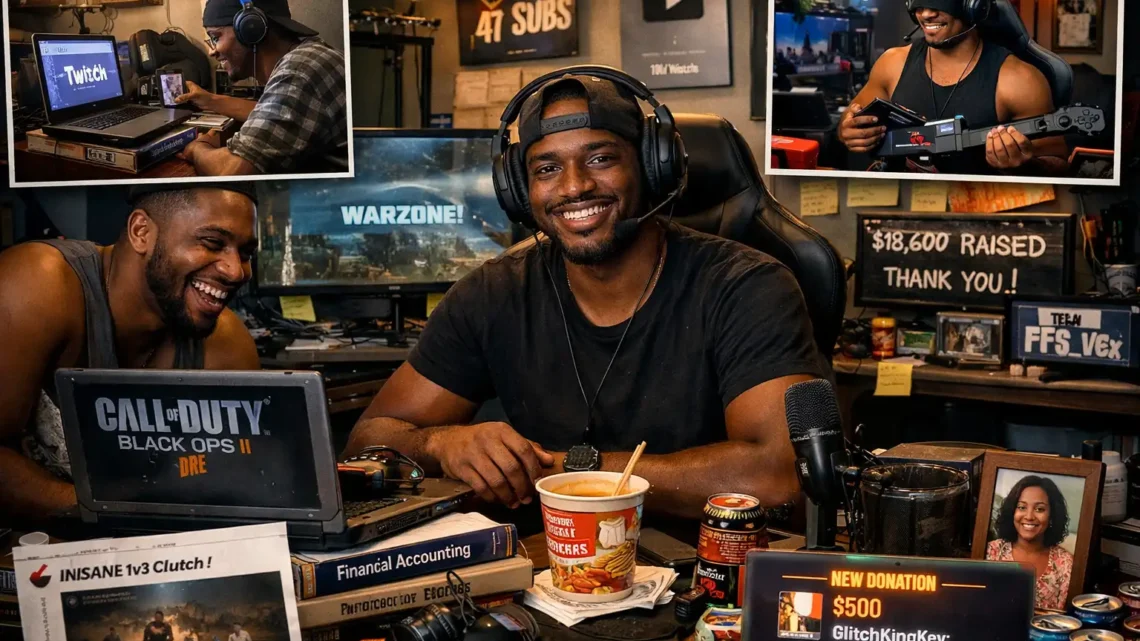
It was 2014, and I was sitting in a cramped university dorm room with a secondhand laptop, a broken headset held together by electrical tape, and a copy of Call of Duty: Black Ops II that I had borrowed, indefinitely, from my roommate Dre.
I was supposed to be studying for my financial accounting exam. Instead, I was rage-quitting multiplayer matches at 2 a.m. and eating instant noodles cold, straight from the cup, because I had forgotten they needed hot water.
That was my gaming setup. That was my life.
I had stumbled onto Twitch three weeks earlier, watching a streamer called xQc lose his mind over a missed shot and somehow have 80,000 people watching him do it.
I remember sitting there, noodles in hand, staring at the screen, genuinely confused. How is this man making money screaming at a video game? I thought. And why does it feel more entertaining than anything on television?
I decided, stupidly and impulsively, to start my own live stream that same night.
My first stream had four viewers. Three of them were bots. The fourth was my younger sister Amara, who typed “u look nervous lol” in the chat and then left to watch a reality show.
She was right. I was nervous.
I had propped my phone on a stack of textbooks as a makeshift facecam. My audio was so bad that every time I spoke, it sounded like I was broadcasting from inside a tin of biscuits. I did not have a capture card, I did not have OBS configured correctly, and my streaming PC, which was just the same sad laptop, was running at about 14 frames per second on a good day.
But I kept going.
Not because I believed I would blow up. Not because I had some grand content creator strategy or a monetization plan. I kept going because when I played, especially when I played well, something clicked inside me that nothing else in my life had ever clicked. The game was honest.
If you were bad, you lost. If you worked at it, if you studied the maps, learned the recoil patterns, adjusted your sensitivity settings, and played with people smarter than you, you got better. There were no office politics. No favoritism. Just skill, and time, and the willingness to grind.
I understood that language.
Six months in, I had 47 subscribers. I remember the exact number because Dre made fun of me for it.
“Forty-seven people, bro,” he said, leaning over my shoulder one evening as I wrapped up a stream. “That is literally less than our lecture hall.”
“Forty-seven people who chose to come,” I replied. “Our lecture hall is full of people who had no choice.”
He laughed. But I meant it.
Those 47 people taught me more about streaming than any YouTube tutorial ever did. They told me when my mic was clipping. They complained when my facecam froze. One of them, a viewer called Glitch King, stayed in my chat every single stream for four months straight and never said a word except to type “W” whenever I got a kill and “L” whenever I died. He was my first real community member. He probably does not know how much that consistency meant to me.
The first time I went viral, I was not even trying to.
It was a late-night ranked match in Warzone, Season Three, and I was solo queuing because Dre had finally gone to sleep like a responsible human being. I had about 130 concurrent viewers, which was my personal best at the time, and I was playing aggressively, pushing teams that most players would avoid.
There was one squad left. Three players, all with high kill counts, all clustered in a building on the edge of the final circle. Any rational streamer would have repositioned, played the zone, taken a safe third-party opportunity. I looked at my viewer count. I looked at the chat, which was already typing “DON’T DO IT” and “HE’S GONNA PUSH” and “STREAM SNIPERRRR.”
I pushed.
I do not fully remember the next 40 seconds. I remember the adrenaline. I remember my hands moving faster than my brain. I remember a clean headshot on the first player, a panic rotation to the second, and then a moment where everything went silent in my head and I just, somehow, knew exactly where the third player was without seeing him. I swung the corner. One shot. Done.
The chat exploded.
“WHAT WAS THAT”
“CLIP IT CLIP IT CLIP IT”
“BRO IS BUILT DIFFERENT”
Someone clipped it. Someone else posted the clip on Reddit’s r/Warzone. By morning, it had 60,000 upvotes and 1,400 comments. I woke up, looked at my phone, and thought it was a bug.
I gained 4,000 new followers overnight.
Growth after that moment was not a straight line. Nobody tells you that when they talk about going viral. The clip brought people in, but keeping them was a completely different game. I had to suddenly perform at a level that matched their expectations, every single stream, for people who had only ever seen my best 40 seconds.
I failed constantly.
There were streams where I played horribly, where the connection lagged and my ISP decided that 9 p.m. on a Friday was the perfect time to throttle my bandwidth, where I tilted badly after losing five ranked matches in a row and became genuinely unpleasant on stream. There were nights I sat in front of the camera for four hours and peaked at 60 viewers. There were sponsorship deals I chased that never responded. There was a six-week period in year two where I genuinely considered quitting and finishing the accounting degree properly.
My mother, Mrs. Adaeze, called during that period. She did not know about the streaming, not really. She knew I played games. She thought it was a hobby.
“How are your studies?” she asked.
“Fine, Mummy,” I said.
“Are you eating?”
“Yes.”
“Are you sleeping?”
I paused for a moment too long.
“What is wrong?” she said, because mothers always know.
I told her everything. The streaming. The growth. The plateau. The doubt. All of it, in one long exhale, sitting on the floor of my flat at midnight with the glow of my dual-monitor gaming setup behind me.
She was quiet for a while.
Then she said, “So you are telling me that tens of thousands of people have watched you play this game?”
“Yes.”
“And some of them pay you?”
“Some of them, yes.”
Another pause.
“Then why are you crying about it?” she said. “Finish what you started.”
I laughed for the first time in weeks.
Year three was when things genuinely shifted.
I had invested in a proper streaming setup by then. A custom-built gaming PC with a dedicated GPU that could actually handle streaming software without turning the game into a slideshow. A condenser microphone that made my voice sound like I knew what I was talking about. A ring light. A green screen. A secondary monitor dedicated entirely to reading the chat. I had learned about stream overlays, about scene transitions in OBS, about the importance of consistent streaming schedules for building an audience algorithm platforms actually reward.
I had also, critically, found my niche within a niche.
Everyone was streaming Warzone. Thousands of streamers, many of them better than me mechanically. But I noticed something that the bigger names were not doing, at least not in the way I wanted to. They were not explaining. They were performing. They were playing for highlights, for clips, for the moment that gets posted to TikTok and YouTube Shorts.
I started teaching.
Mid-game, mid-firefight, I would break down what I was thinking. Why I chose that rotation. Why I took that fight instead of the other one. Why my loadout was configured that specific way and what each attachment actually did to the weapon’s performance. I started pulling up the damage charts on stream. I brought on viewers in duo matches and coached them live, correcting their positioning, telling them when to be aggressive and when to disengage.
The gaming community responded like I had found a secret door nobody else knew about.
A streamer called Fps_Vex messaged me on Discord one afternoon: “Bro, I don’t know what you’re doing differently but your chat engagement is insane. What’s your setup?”
I told him it was not the setup. It was the conversation.
“You have to make the viewer feel like they’re in the room with you,” I said, “not just watching you through a window.”
The night that I will never forget, the night that permanently separated the person I was from the person I became, happened during a charity stream in December of my fourth year.
I was raising money for a children’s literacy program. 24 hours of continuous live streaming, solo, with donation alerts tied to in-game challenges. Every time someone donated above a certain threshold, I had to play a round blindfolded, or with an inverted mouse, or using a guitar hero controller instead of my gaming mouse and keyboard. The chat was absolutely unhinged from hour one. Pure chaos energy. Beautiful.
Around hour 19, somewhere past 3 a.m., the stream had raised just over $11,000 and I was running on cold brew coffee and the kind of sleep-deprived euphoria that makes everything feel slightly surreal. My viewer count had climbed to 9,400 concurrent viewers, which was by far the biggest audience I had ever played in front of.
And then my internet went down.
Not a brief drop. A full, complete outage. Router lights blinking red. ISP down in the whole building. Nothing.
I sat there in the sudden silence, staring at a black screen, 19 hours in, $11,000 raised, 9,400 people suddenly looking at a stream that had just gone dark.
I will be honest. I wanted to cry.
My phone buzzed. It was Dre, texting from his own place across town.
“Bro your stream just died lmao.”
“I know,” I typed back.
“What are you going to do?”
I looked at my phone. Then I looked at the dark monitors. Then I opened the Twitch app on my phone, connected to my mobile data, pointed the phone camera at my face, and went live again from my phone.
The resolution was terrible. The audio was my phone’s built-in microphone, which sounded exactly as bad as you are imagining. The frame rate was a slideshow of a man who had not slept properly in 19 hours.
But I kept going.
“Internet is down,” I told the chat. “But we’re still here. We’re finishing this. The kids need the books more than I need sleep.”
The chat went absolutely wild.
“W STREAMER”
“LET’S GOOOO”
“DONATING AGAIN FOR THE WIFI GOD”
By the time the internet came back at around hour 21, we had raised another $4,200 purely during the phone stream. People donated specifically because of the breakdown. Because I did not quit. Because the imperfection made it real.
We finished at $18,600.
I sat back in my chair at hour 24, voice completely gone, eyes burning, and watched the final donation alert come through. The name on it was GlitchKingKev.
The amount was $500.
The message said: “Been here since 47 subs. Proud of you man.”
I did not cry on stream. I tried very hard not to. But I am not going to tell you I fully succeeded.
I am writing this now as someone with a streaming career spanning over a decade, a team of three editors, a signed esports content deal, and an affiliate marketing portfolio that covers a range that would make my former accounting professors raise an eyebrow in reluctant approval. My gaming setup alone would make 2014-me faint on the spot.
But the things that actually built this, not the RGB lighting, not the high-end capture card, not the professional stream overlays, were the 47 subscribers who chose to show up, the viral clip I never planned, my mother telling me to finish what I started, and a charity stream that fell apart at 3 a.m. and somehow became the best stream I ever did.
Nobody tells you that the algorithm rewards consistency, but the audience rewards humanity. They are not the same thing. You can be consistent and hollow, posting on schedule every week with perfect production value and zero soul, and the numbers will come but they will not stay. People do not subscribe to setups. They subscribe to people. Specifically, to people who make them feel something: excitement, laughter, belonging, or even just the comfort of not being alone at 2 a.m. while you both watch some guy miss a shot and scream about it.
I was that guy. I am still that guy.
The only difference is now I have hot water for my noodles.
If you are sitting in a dorm room right now with a broken headset and a laptop that runs games at 14 frames per second, wondering whether any of this is worth it, I want to tell you something I genuinely wish someone had told me.
The setup does not make the streamer. The streamer makes the stream.
Start now. Start bad. Start anyway.
The chat will tell you when to improve. And one day, if you are lucky and you keep going, someone named GlitchKingKev will show up in your notifications with a message that makes it all make sense.