This Is What Happens When You Stop Paying Attention in the Wild
I have been doing this for over a decade. Solo camping trips, wilderness survival training, off-grid weekends, bug-out drills in the middle of nowhere with nothing but my EDC kit and whatever sense God gave me.
People call me paranoid. My wife Renee calls me “the man who packs for the apocalypse every time we go grocery shopping.” I laugh it off. But three months ago, on a ridge in the Smoky Mountains, none of them were laughing, and neither was I.
Trending Now!!:
It started as a five-day solo bug-out simulation. That is what preppers do, we test ourselves. We take our bug-out bags, our survival kits, our water purification tablets, and we go somewhere that will not be forgiving if we mess up.
I had done this exact trip four times before. Same trail, same bear canister, same emergency shelter setup. I knew that mountain like I knew my own backyard.
Which is exactly why I stopped paying full attention.
I left the trailhead at Alum Cave on a Tuesday morning, sky clean, temperature sitting around 58 degrees. My bug-out bag weighed 34 pounds, which is heavier than most preppers recommend for a 72-hour kit, but I was going five days, and I was not compromising on my water filtration system or my fire-starting redundancy.
I carry three ways to start a fire. Always. Ferro rod, waterproof matches, and a Bic lighter I tape to the inside of my kit because lighters disappear at the worst moment, like car keys.
By Thursday afternoon, everything changed.
The storm came in faster than any forecast had suggested. I had checked the weather obsessively before leaving, the way any serious prepper does, and it showed a 20% chance of light rain on Day 3.
What it did not show was the kind of sideways mountain rain that turns trails into rivers and drops visibility to about eight feet. One minute, I was moving through a familiar section of hardwood forest, watching for the orange trail blazes on the trees. The next minute, I was standing in a whiteout of fog and rain, and the blazes were gone.
I stopped.
That is the first rule of wilderness survival that most people forget when panic hits: stop moving. Every survival instructor I have ever trained under, from Colonel Dave at the mountain warfare school in Vermont to old Pops Kinsley who ran the bush craft retreat in Idaho, they all said the same thing. When you realize you are lost, your legs will want to move. Do not let them.
I stood still and said out loud, “Okay. Breathe. You have everything you need.”
Nobody heard me. The rain did not care. But I needed to hear it.
I pulled out my topographic map, the paper one I print before every trip because phones die and apps lie, and I tried to orient myself. My compass told me I had been trending northeast when I should have been northwest.
Not catastrophically off, maybe 400 meters, but in mountain terrain during a storm, 400 meters is a different world. I had two hours of gray light left at most.
The decision was simple and hard at the same time: I was not going to make it back to my planned campsite. I needed to build an emergency shelter right here, right now, and I needed to do it before the temperature dropped another ten degrees.
I found a natural debris field near a granite overhang, which is exactly what you look for in a survival shelter situation. The overhang handled about 40% of the rain load. I leaned dead branches against it in an A-frame pattern, the way I have practiced probably two hundred times in my backyard while Renee watched from the kitchen window with a look that said “I married a strange man and I am at peace with that.”
Then I layered dry leaves and debris over the frame. Then more leaves inside for ground insulation, because the ground will steal your body heat faster than the air will, and that is one of those survival truths you only really understand the first time you sleep on cold earth without proper insulation and wake up shivering at 2 a.m. with your teeth doing morse code.
By the time I had the shelter up, my hands were cold and the light was almost gone.
I was opening my fire kit when I heard something.
Footsteps. Heavy, deliberate, not animal, but human.
A voice cut through the rain: “Hey! Hey, is somebody there?”
I stepped out from behind my shelter and saw a kid, maybe 22, soaked to the bone, wearing a day pack that could not have held more than a water bottle and a sandwich. He had a cell phone in his hand with a cracked screen, flashlight on, almost dead.
His name was Marcus. He was a college student from Knoxville on what he called “a quick afternoon hike” that turned into a full disaster when the trail disappeared and his phone GPS lost signal. He had no rain gear, no emergency blanket, no fire kit, not even a proper trail map. He was wearing cotton, which preppers call “the fabric that kills” because it holds moisture against your skin and accelerates hypothermia.
He looked at my shelter and said, “You built that? Just now?”
“Just now,” I said.
He looked at me the way people look at someone who just parallel parked a semi-truck in one move. Then he said, “Are you, like, a survivalist?”
I told him, “I am just someone who does not like dying.”
I got him inside the shelter. I pulled out my emergency Mylar blanket, the compact one I always keep in the outer pocket of my bug-out bag for exactly this kind of situation, and I wrapped it around him. Then I went to work on fire.
The ferro rod is not the easiest fire-starting method when your hands are cold and shaking. Most YouTube videos about ferro rods are filmed in backyards on sunny afternoons. What they do not show you is the moment when your fingers feel like wooden pegs, and you are trying to catch a spark on the tinder you found under a granite overhang in the rain. I had to warm my hands under my armpits for two minutes first. Marcus watched me the whole time with this expression of pure terrified fascination.
First strike, no catch.
Second strike, a small ember. Gone.
Third strike, the birch bark I had tucked inside my jacket caught. I nursed it with my breath, slow and steady, the way Pops Kinsley used to say, “You are not blowing a fire, you are having a conversation with it.”
It caught. It held. It grew.
Marcus said, “Oh my God.”
I did not say anything. I was too busy feeding the fire properly, small sticks first, then medium, then larger pieces, the way you always build a fire in a survival situation, because if you put a log on too early, you smother it and you are starting over.
Once the fire was stable, I pulled out my titanium pot and my Sawyer water filter, and I started collecting rainwater from the overhang drip line. I boiled it anyway, not because I doubted the filter, but because I was also cold and hot water with the electrolyte pack I carry in my kit was exactly what both of us needed.
Marcus held the cup with both hands and said, “This might be the best thing I have ever tasted.”
I handed him a freeze-dried meal from my kit, chicken and rice, nothing fancy, but when you are wet and cold and scared, freeze-dried chicken and rice is a Michelin star experience.
He was quiet for a while, listening to the rain hit the branches above us. Then he asked, “How long have you been doing this? Like, preparing for stuff?”
I thought about it. “Since my daughter was born,” I told him. “I realized I was responsible for a person who could not protect herself. That changed how I looked at everything.”
He nodded slowly.
“I always thought preppers were, like, conspiracy guys,” he said, and he said it honestly, not mean.
“Some are,” I told him. “But most of us are just parents and regular people who understand that cell service goes down, weather turns, governments are slow, and your family is your responsibility. The rest is just gear and practice.”
He was quiet again. Then he said, “My girlfriend told me to take a proper hiking kit. I told her I was only going for two hours.”
I said, “Call her when we get down. And listen to her from now on.”
He laughed. The rain started to ease.
We made it down the next morning. Trail was still muddy and slow, but navigable once the fog cleared. I picked up the blazes again about 300 meters from where I had lost them. Marcus followed me step for step the whole way, asking questions about water purification, about bug-out bag essentials, about what the single most important survival skill was.
I told him the same thing I tell everyone who asks that question: “Situational awareness. Everything else is just tools. If you pay attention before things go wrong, you rarely end up in survival situations to begin with.”
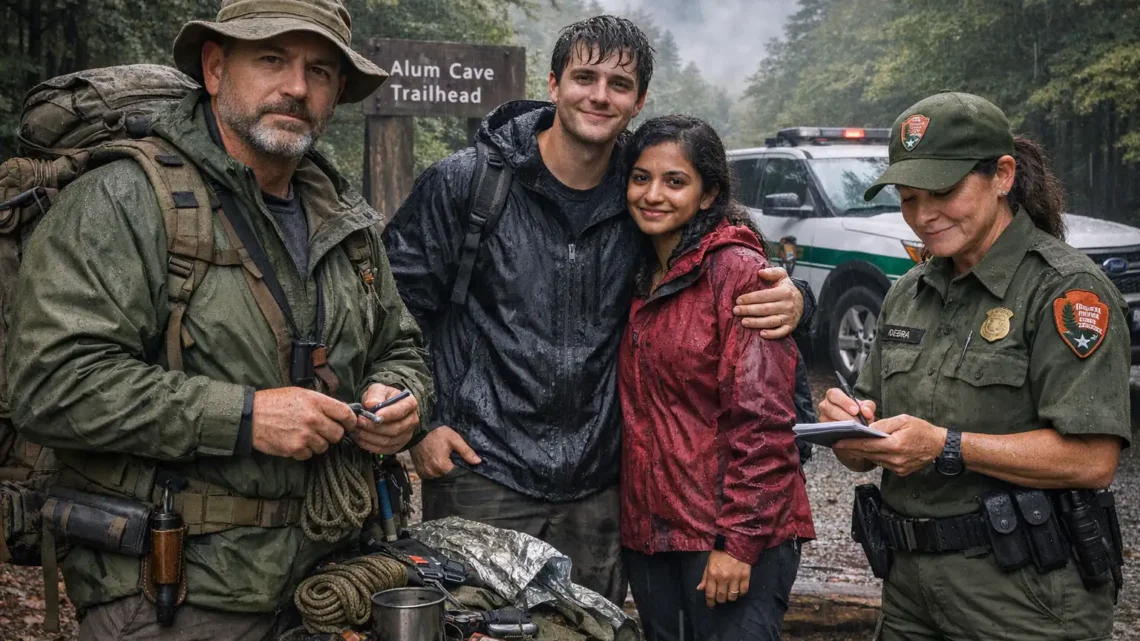
When we reached the trailhead parking lot, there was a ranger vehicle and a worried-looking woman who had to be his girlfriend, Priya, pacing beside a silver Civic. She saw him and walked toward us fast, that specific walk of a person who is relieved and furious at the same time.
She said, “Marcus, I swear to everything holy.”
He said, “You were right about the kit.”
She looked at me, then at him, then at the shelter debris still stuck to his jacket, and said, “What happened?”
Marcus pointed at me and said, “This man saved my life.”
I shook my head. “He saved his own life. I just happened to be there.”
The ranger, a compact woman named Officer Debra, took both our statements and wrote something in her notebook. Before she closed it, she looked at me and said, “Sir, what was in that bag of yours?”
I listed the basics. Bug-out bag, water filtration, fire-starting kit, emergency shelter, freeze-dried food, first aid, navigation tools, Mylar blankets, paracord, fixed-blade knife, headlamp with extra batteries, emergency whistle, and a handwritten contact card in a waterproof bag.
She looked at me for a moment and said, “You carrying all that every trip?”
“Every trip,” I said.
She nodded, slow and deliberate, the way people nod when something confirms what they already believed. Then she said, “My husband thinks I am overreacting when I make him carry an emergency kit on day hikes.”
I smiled and said, “Tell him a ranger told you it was the right call.”
She actually wrote that down.
Marcus texted me six weeks later. Said he had built his first 72-hour emergency kit, took a wilderness first aid course at the local community college, and had already gone back to the same trail with proper gear and Priya beside him. He sent a photo of them at the summit, both grinning, both wearing rain jackets, both carrying real packs.
The caption said: “We made it. No drama this time.”
I showed Renee the photo. She looked at it, then at me, then back at the photo, and said, “So basically, your paranoia saved a young man’s life.”
I said, “Preparedness. The word is preparedness.”
She kissed me on the cheek and said, “Same thing. Don’t push it.”
She was right. She usually is.
The mountain does not care about your excuses. It does not care that you only planned to be out for two hours, or that the weather app said clear skies, or that you forgot to charge your phone the night before. It just is what it is, cold, wet, steep, and completely indifferent to your schedule.
That is not a threat. That is a reminder. A reminder that the outdoors rewards the prepared and charges the careless a very steep fee.
I have been paying that fee in planning, gear, and training for over ten years, so that when the moment comes, and it always comes eventually, I do not have to pay it in anything else.
Pack right. Learn the skills. Go outside. The mountain is waiting, and it wants to know if you are ready.