What Six Years of Untreated Anxiety Actually Feels Like From the Inside
I have been lying to myself for six years.
Not small lies, not the kind where you tell your boss the report is almost ready when you have not even opened the file. I mean the deep, comfortable, well-rehearsed lie that goes: “I’m okay. I’m just tired. Everyone goes through this.”
Trending Now!!:
Six years of that script. Six years of waking up at 3 a.m. with my chest tight and my thoughts running like a generator that refused to go off. Six years of calling it “stress” when every licensed mental health professional would have immediately recognized it as generalized anxiety disorder layered over unprocessed grief.
I did not know any of that yet. I just thought I was a guy who worked too hard.
It started, honestly, with a conversation I was not supposed to overhear.
I had gone to see my older sister, Adaeze, in her apartment in Surulere on a Saturday afternoon. She is the kind of person who always has something cooking on the stove and something louder cooking in her living room. I knocked, she shouted “enter!” from inside, and I walked in to find her on a video call, laughing with someone I did not recognize.
I dropped onto her couch and scrolled my phone, half-listening.
Then I heard her say, “No, therapy genuinely changed my life. I am not even joking. My therapist helped me see patterns I had been repeating since secondary school.”
I looked up.
Adaeze, my sister who once told me that therapy was for oyinbo people who had too much time on their hands, was now sitting cross-legged on her kitchen counter, glowing like someone who had found religion, testifying about cognitive behavioral therapy like it had personally healed her knees.
I stared at her.
She caught me staring, finished her call, and jumped down from the counter with the energy of someone whose cortisol levels had clearly been regulated.
“How long have you been there?” she asked.
“Long enough,” I said. “Since when?”
She smiled, not the defensive kind but the kind that comes from genuine peace. “Eight months. I started after Daddy died and I just… I could not function. I thought I was handling it. I was not handling anything.”
I nodded slowly.
“You should try it,” she said, already walking to the kitchen.
“I’m fine,” I said.
She turned and looked at me the way only older sisters can, that specific look that communicates an entire paragraph of “I know exactly what fine means when you say it” without a single word spoken.
“Okay,” she said simply, and handed me a bowl of egusi.
Three weeks later, I had my first panic attack in public.
I was at a mall in Ikeja, standing in line at a pharmacy, buying Vitamin C of all things, when it happened. My heart rate spiked without warning. The fluorescent lights above me suddenly felt aggressive, like they were pressing down. My vision went slightly sideways. I could hear my own breathing too loudly, and I became convinced, with absolute certainty, that something was catastrophically wrong with my body.
I paid for the Vitamin C with shaking hands and walked quickly to the parking lot, sat in my car, and spent forty-five minutes telling myself I was not dying.
I was not dying. But I was also not fine.
That evening, I called Adaeze.
“I think I need the number,” I said.
She did not say “I told you so.” She just said, “I’ll send it now.”
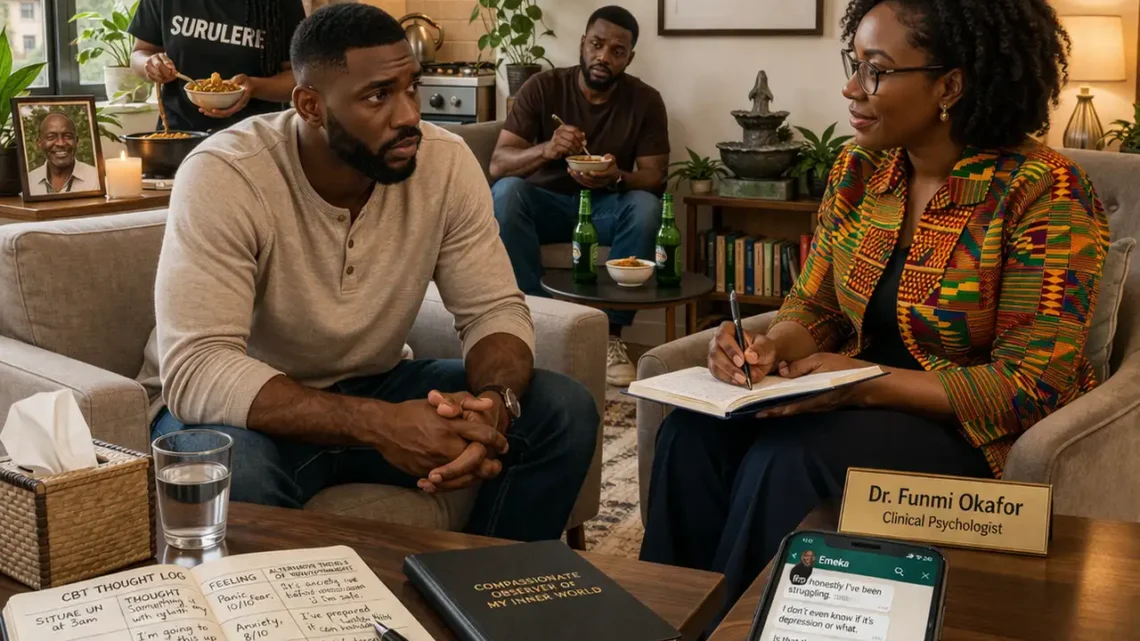
The therapist’s name was Dr. Funmi Okafor, and her office was in a quiet building in Lekki Phase 1, the kind of building that looks like it was specifically designed to make your nervous system calm down before you even knocked on the door. There were plants in the reception. Real ones. Thriving ones. I remember thinking that if she could keep plants alive in Lagos, she probably knew something about sustaining fragile living things.
I sat in the waiting area in a chair that was softer than anything I owned, reading a framed quote on the wall that said something about healing not being linear. I thought it was the kind of thing people put on walls when they have run out of ideas. I would think differently about it later.
Dr. Funmi came out personally to call me in. She was a small woman in her forties with natural hair and reading glasses pushed up on her forehead, wearing a kente-print blouse that somehow made the whole room feel less clinical.
“Welcome,” she said, shaking my hand. “Come in.”
Her office had more plants. A small fountain on the shelf made the softest sound, like it was minding its business. I sat across from her in another criminally comfortable chair and spent the first sixty seconds calculating how quickly I could leave if I needed to.
“So,” she said, clicking her pen once and setting it down, “what brings you here today?”
I had rehearsed an answer on the way. Something polished, organized, efficient. Something that would communicate that I was a reasonable, self-aware person who simply needed a minor tune-up.
What came out instead was: “I don’t actually know if anything is wrong with me. I might just be wasting your time.”
She tilted her head slightly. Not with judgment. More like a doctor who has just seen a very familiar symptom.
“What makes you think you might be wasting my time?” she asked.
“Because other people have real problems,” I said. “I have a job. I have a family. Nobody beat me. Nothing dramatic happened.”
She wrote something down. I wanted badly to see what it was.
“Trauma and emotional distress don’t require a dramatic origin,” she said. “Sometimes the wound is just quiet. That doesn’t make it less real.”
I said nothing. Something in my chest shifted slightly, the way a locked door shifts when the right key goes in but you haven’t turned it yet.
The first three sessions were, I will be honest, uncomfortable in a way I had not anticipated.
Not because Dr. Funmi was harsh. She was the opposite. She was warm and measured and patient in a way that made me feel like I was being heard possibly for the first time in my adult life. That was exactly the problem. Being truly heard, when you have spent years performing okayness, feels less like relief and more like exposure.
She asked me about my father. I told her he died two years ago and that I handled it well.
“What did handling it well look like for you?” she asked.
“I organized the burial. I made sure my mum was okay. I went back to work the following week.”
She nodded. “And where did you put your own grief?”
I blinked. “I… I grieved.”
“When?”
Long pause.
“I cried at the burial,” I said.
“Once?”
“I’m not really a crying person.”
She did not argue with me. She just said, “Grief doesn’t only come out as tears. It also comes out as irritability, emotional numbness, difficulty concentrating, disturbed sleep, and sometimes as anxiety that appears to have no clear source.”
I was quiet for a long moment.
Then I said, “I wake up at 3 a.m. almost every night.”
“I know,” she said softly. “You mentioned it when you came in. Tell me more about that.”
By session five, she had introduced me to something called CBT, cognitive behavioral therapy, which sounds like the title of a corporate training module but is actually one of the most effective, evidence-based approaches to treating anxiety disorders and depression that exists. The principle, simplified brutally, is this: your thoughts are not facts, and the stories your brain tells you, particularly the catastrophic ones, can be examined, challenged, and slowly rewired.
Dr. Funmi gave me a small notebook and asked me to write down, every time I noticed anxiety rising, exactly what thought had preceded it.
I resisted this.
“It feels like homework,” I told her.
“It is homework,” she said. “Therapy is not something that only happens in this room. The actual work is out there. In your real life, in the moments when it’s hardest.”
I grumbled about it on the drive home. Then I did it anyway.
What I discovered over the following two weeks was quietly astonishing. Almost every spike of anxiety I experienced was preceded by a specific category of thought: something is about to go wrong, and when it does, you will not be able to handle it. That thought, in various costumes, was running silently in the background of almost every hour of my day.
I showed Dr. Funmi the notebook.
She read through several pages slowly. “This is really good work,” she said.
“It’s terrifying,” I said.
“Yes,” she agreed. “But you can’t address what you can’t see. You’ve just made the invisible visible. That’s the beginning of everything.”
Month three was when something broke open, not in a dramatic way, not like the movies where the person suddenly weeps and everything resolves, but quietly, like a window being opened in a room that has been sealed for too long.
We had been talking about my relationship with control, how I managed anxiety by over-preparing, over-working, over-functioning, and how exhausting that had been as a long-term coping strategy. I made a joke about it because that is what I do when something touches a nerve. Dr. Funmi let me finish the joke and then said:
“What would happen if you let go of control for one day? If you just… allowed things to be uncertain?”
I opened my mouth to answer and found that I could not. My eyes went strange. I looked at the ceiling the way men do when they are trying to stop something from happening in their face.
“It’s okay,” she said quietly.
“I don’t know how to let go,” I said. My voice came out smaller than I expected. “If I let go, something bad will happen. Something always happens when I’m not watching.”
“When did you first learn that?” she asked.
And then we were back to my father again, but this time we went further back, to before he died, to the years when he was sick and I, the first son, had become the unofficial manager of everyone’s panic. Coordinating doctors, coordinating finances, coordinating my mother’s emotions, being the one who held the shape of everything so that it did not collapse.
I was twenty-four when that started.
Nobody had told me it was okay to also be afraid.
I sat in Dr. Funmi’s chair with its criminal softness and, for the first time in a long time, I let something be true without managing it.
It was not elegant. It was not cathartic the way people describe catharsis. It was more like releasing air from a tyre that has been overinflated for so long the rubber had started to forget its original shape.
Dr. Funmi handed me a tissue and said nothing for a while. Then she said, “You have been carrying a lot. For a very long time. And you have done it remarkably well. But you were never supposed to do it alone.”
I am not going to tell you therapy fixed everything. That is not how mental health support works, and anyone who tells you otherwise is selling something.
What I will tell you is this: nine months in, I sleep through the night more often than not. The 3 a.m. chest tightness has not disappeared entirely, but I know what it is now, I know what thought triggered it, and I have actual tools, not just willpower, to respond to it. I have become, in Dr. Funmi’s words, a more compassionate observer of my own inner world.
I have also, slowly, started talking to other people in my life with more honesty. My friend Emeka, who I have known since university, told me recently over pepper soup at a joint in Yaba that he had been struggling with what sounded very much like depression for over a year and had told no one.
I looked at him and said, “I have a number for you.”
He looked skeptical. “Is it that therapy thing?”
“Yes.”
“I’m not sure I need that. I think I’m just—”
“Fine?” I said.
He paused.
“Yeah.”
I smiled. “I know exactly what fine means.”
He took the number.
The mental health stigma in our world, especially among men, especially in Nigerian and African communities, is real and it is loud and it has cost people years of their lives. It has cost some people their entire lives. The idea that seeking emotional wellness is weakness, that going to a therapist means something is broken beyond repair, that you should pray harder or hustle harder or just be stronger, has kept too many people in rooms with no windows, breathing recycled air and calling it survival.
I was one of those people.
I am not anymore.
If you are waking up at 3 a.m. with a chest that feels like a closed fist, if you are exhausted in a way that sleep does not fix, if you are performing fine so consistently that you have started to believe your own performance, I want you to hear this from someone who has been exactly where you are standing:
Asking for help is not the end of something. It is, embarrassingly, the beginning.
The plants in Dr. Funmi’s office are still thriving, by the way. She told me once that the secret is simply paying attention, noticing when something needs water, noticing when the light has changed, noticing before it becomes a crisis.
I think about that a lot.