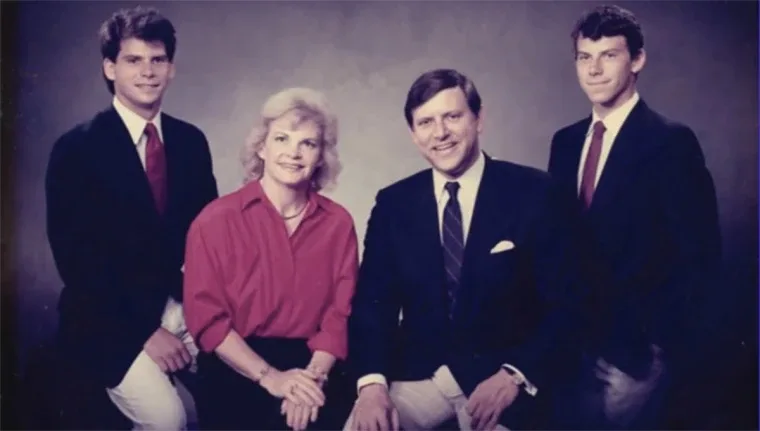
Meet The Menendez Brothers’ Parents: Kitty Menendez and Jose Menendez
Before Lyle and Erik Menendez became two of the most discussed names in American criminal history, there were two people whose lives, choices, and secrets shaped everything that followed. Here is who their parents really were.
The story of the Menendez brothers has been told and retold so many times, across courtrooms, cable documentaries, and now a Netflix drama series, that it can feel as though every corner of it has been examined.
And yet the two people at the center of it all, the ones who were killed on the night of August 20, 1989, in their Beverly Hills home, are often rendered as supporting characters in a narrative about their sons.
Trending Now!!:
What follows is an attempt to restore them to the foreground, on their own terms, as fully realized human beings whose lives were far more complicated than either their public image or their posthumous vilification suggested. But first, to understand the parents, one must understand the sons they raised.
Joseph Lyle Menendez was born on January 10, 1968, in Princeton, New Jersey, and is currently 58 years old. His younger brother, Erik Galen Menendez, was born on November 27, 1970, in Blackwood, New Jersey, and is 55 years old.
Both brothers carry mixed Cuban-American and Irish-American heritage, their father, Jose, being a Cuban-born entertainment executive, and their mother, Kitty, an Irish-American former schoolteacher from Illinois. They were raised Catholic, in keeping with their father’s cultural roots. Lyle is the only sibling Erik has ever known, and Erik is the only one Lyle has.
The family moved frequently as Jose‘s career accelerated through the entertainment industry, passing through several states before settling in Beverly Hills, California, where the brothers attended school and built the closest thing they had to a stable life. Both were ranked amateur tennis players in their adolescence, with genuine professional aspirations. Lyle stands at 6 feet 1 inch, and Erik at approximately 6 feet 2 inches.
Lyle‘s educational path was uneven. He was initially rejected by Princeton University and attended a local community college before eventually gaining admission, only to be suspended later for plagiarism. He never completed his degree there.
Erik‘s course was interrupted before it had properly begun. He graduated from Beverly Hills High School in June 1989 and had been preparing to enroll at the University of California, Los Angeles, when the murders occurred that August. Years later, from inside prison, Erik pursued his education seriously and eventually earned a sociology degree from UC Irvine.
Their romantic lives, shaped almost entirely by incarceration, have been among the more unusual chapters of an already extraordinary story. Lyle, before his arrest, had a relationship with Jamie Lee Pisarcik that his parents reportedly forced to an end. While in prison, he married model and salon receptionist Anna Eriksson on July 2, 1996, the same day he was sentenced to life, in a ceremony conducted over speakerphone with Erik serving as best man.
Eriksson filed for divorce in 2001 after discovering Lyle had been writing to another woman, Rebecca Sneed. Lyle subsequently married Rebecca, a former magazine journalist who had since become a defense attorney, in November 2003 at Mule Creek State Prison. In November 2024, Rebecca confirmed publicly that the two had separated, though she stressed that they remain close and that she continues to advocate for his release. Lyle has no children.
Erik, meanwhile, met Tammi Ruth Saccoman through correspondence beginning in 1993, and after years of letters and eventual visits, the two married in June 1999 at Folsom State Prison. Tammi, who had children from a previous marriage, later wrote about their relationship in her 2005 book, “They Said We’d Never Make It: My Life With Erik Menendez.” Erik has no biological children.
Both brothers were convicted of first-degree murder in 1996 and sentenced to life without the possibility of parole. In May 2025, a judge resentenced them to fifty years to life, making them eligible for parole, though both were denied in August 2025 following incidents of rule-breaking and deception.
Their case, now more than three decades old, continues to generate debate about abuse, family, wealth, and the limits of justice. To understand how it began, one must look at the two people who brought it into the world.
Kitty Menendez
Mary Louise “Kitty” Andersen was born on October 14, 1941, in Oak Lawn, Illinois, the youngest of four children in her family. From the outside, it was a respectable, solidly middle-class upbringing. From the inside, it was something altogether more difficult.
Her father owned a heating and air-conditioning business that did well, and her mother stayed home to care for Kitty and her siblings. But although the Andersen family appeared loving and close, Kitty’s father beat her mother, sometimes in front of the children, and beat the children as well. Before Kitty entered grammar school, her father left her mother for another woman.
The divorce scarred her in ways that never fully healed. Throughout her childhood, Kitty was withdrawn and depressed. She had difficulty forming friendships and had few friends in grade school and high school.
Her mother never remarried and became bitter and depressed, and Kitty grew up convinced that divorce was the worst thing that could happen in a woman’s life. That conviction would follow her into her own marriage, with consequences that became the subject of national debate decades later.
What she managed to build despite those early wounds was remarkable in its own right. In her senior year of high school, she applied to and was accepted by Southern Illinois University. In 1958, during her freshman year, she began working in the university’s broadcasting department, learning to produce radio and television dramas.
During her senior year, she had gained enough confidence to compete in and win the Miss Oak Lawn beauty pageant. The girl who had spent her childhood struggling to make friends had transformed herself into a young woman of poise and ambition.
It was at Southern Illinois that she met Jose Menendez. Kitty was a senior and Jose was a freshman when they met, and they quickly became inseparable. To Jose, Kitty was attractive not only physically but in what she represented. To Kitty, Jose offered a depth that she felt few people understood or appreciated. She saw someone willing to work hard and overcome hardship. Both of their families were opposed to the marriage, his because her parents were divorced, hers because of Jose’s Cuban heritage. They married in 1964.
In their early married life, Kitty was an elementary school teacher, but after giving birth to her children, Lyle and Erik, she became a full-time homemaker. That transition, from professional woman to domestic partner of an increasingly powerful man, became one of the defining tensions of her adult life. From afar, Kitty Menendez appeared to be a glamorous housewife and devoted mother. But a much bleaker reality lay hidden, including a deteriorating marriage and substance abuse.
Jose Menendez was reportedly flagrantly unfaithful to his wife, and she was devastated by his infidelity. A friend of Kitty’s told Vanity Fair that Kitty had attempted suicide three times. Her former therapist, Edwin S. Cox, also testified during the brothers’ first trial that she was suicidal over her husband’s eight-year affair with a woman in New York.
According to Kitty’s sister, Joan VanderMolen, the brothers tried to persuade their mother to leave Jose before the murders. “The boys tried to get her to leave, and they promised her they would take care of her and everything,” VanderMolen said. Kitty never did. Whether out of love, fear, financial dependence, or the lifelong conviction she had formed in childhood that divorce was the ultimate failure, she stayed. During the brothers’ first trial, Lyle and Erik’s attorneys argued that Kitty, at times, also participated in the abuse the boys suffered, though this was disputed and never proven.
Erik Menendez, speaking from prison years later, offered a picture of his feelings toward his mother that cut against the simplified narratives. He described missing her tremendously, wishing he could go back and tell her he loved her, and longing for the joy and connection he felt they had never fully shared. It is a statement that speaks not to a cartoonish villain or a sainted victim, but to a woman whose relationship with her children was, like so much else in her life, layered with longing and unresolved pain.
She was 47 years old when she died.
Jose Menendez
Jose Enrique Menendez was born on May 6, 1944, in Havana, Cuba. His father was a soccer player who owned an accounting firm, while his mother was a star swimmer and member of the country’s sports hall of fame. By the standards of pre-revolutionary Cuba, the Menendez family was comfortable, cultured, and connected.
But the world he had been born into did not last. After Fidel Castro came to power in 1960, Jose’s father encouraged him to immigrate to the United States. The teenager settled in Hazleton, Pennsylvania, where he lived in a cousin’s attic, speaking little English, in a country that was not his own, without money or connections, building everything from that point forward through sheer force of will.
He rose from washing dishes to becoming a successful young entertainment executive. The arc of that climb was genuinely extraordinary. He started his career as an accountant for the firm Coopers and Lybrand, and eventually became executive vice president in charge of United States operations at Hertz rental cars, then a subsidiary of RCA. A year later, RCA transferred Jose to its records division, and he was eventually named chief operating officer, with a salary that reflected his considerable standing in the industry.
It was at RCA that he made his name, expanding the label’s Latin catalog and signing world-renowned acts like Duran Duran and The Eurythmics. His colleagues remembered him in characteristically divided terms.
Some found him brilliant and driven. Others remembered a man who was overbearing and made little effort to be liked. One former colleague said he was “one of the few who came from outside the music business that got it” and called him a genius. Another recalled only a general impression that he was overbearing.
After RCA, Jose joined indie film studio Carolco, where he was put in charge of its failing subsidiary, International Video Entertainment. After losing $20 million in his first year on the job, he turned the company around by restructuring its leadership and operations. By 1987, the company had returned to profitability.
The professional portrait, then, was one of relentless competence. The personal portrait was far more troubling. In all his workplaces, he was credited with being highly intelligent and diligent, but was widely disliked as arrogant, rude to colleagues, and abrasive to subordinates.
Lyle told stories of how his father berated employees and mistreated wait staff at restaurants. A former swim team coach who worked with Erik described Jose as so completely overbearing that his intense involvement had the opposite of its intended effect, leaving Erik with diminished self-confidence because nothing he did was ever considered good enough.
The allegations that emerged during the trials about Jose’s conduct within the family went well beyond mere professional unkindness. Both brothers testified that their father had sexually abused them throughout their childhoods. Those claims were disputed, discounted by the judge in their second trial, and contributed to their conviction on two counts of first-degree murder in 1996.
In the years since, however, corroborating testimony has emerged from outside the family. In 2023, former Menudo member Roy Rossello accused Jose of sexually assaulting him at a party in the mid-1980s when Rossello was only 14 years old. The allegation drew renewed scrutiny to a case that had long since passed into American cultural legend, and contributed to the district attorney’s eventual decision to recommend resentencing for both brothers.
On the night of August 20, 1989, Jose and his wife, Kitty, were sitting in the den of their Beverly Hills home watching television when their sons entered the room armed with shotguns. Jose was shot multiple times, including once in the back of the head. He was 45 years old.
The question his life leaves behind is one that courts, journalists, documentarians, and ordinary people have been arguing over for more than three decades: whether Jose Menendez was a disciplinarian father undone by his sons’ greed, or a deeply troubled man whose private actions made the family’s violent end, in some terrible and irreducible way, almost inevitable.
That question has never been resolved to universal satisfaction. His legacy is now inextricably tied to the murder trial and the actions of his sons, and the case continues to fuel debate about abuse, privilege, wealth, and justice.
He is buried beside Kitty in Princeton Cemetery in New Jersey, and their story, for better or worse, shows no sign of ending.
NOTICE!! NOTICE!! NOTICE!!
At TheCityCeleb, we strive to provide accurate and up-to-date biographies and entertainment news, focusing on celebrities. Our editorial team researches information from reputable sources, including interviews, official statements, and verified media.If you spot an error or have additional details, please contact us at editor@thecityceleb.com. We value your feedback and are committed to maintaining trustworthy content.