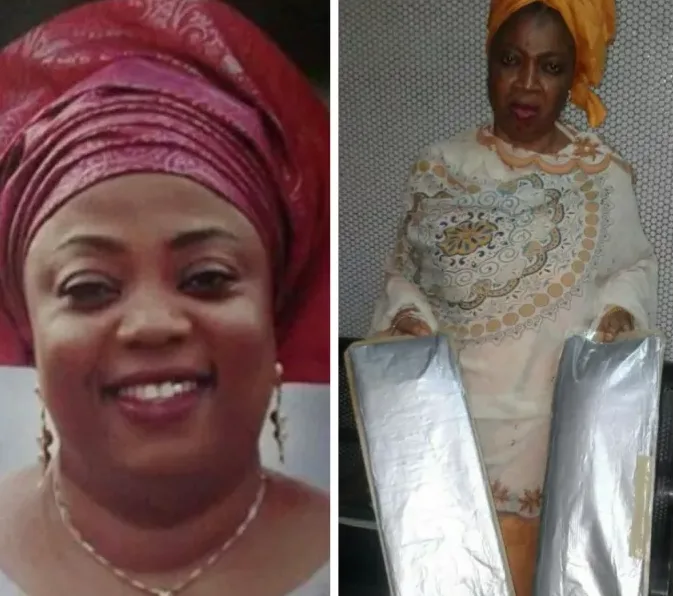
Ariket Funmilola Ogbuaya Sentenced: How Lagos’s Most Glamorous Socialite Unravelled in Court
Funmilola Ogbuaya, known to Lagos society as “Ariket,” has been sentenced to 15 years in prison for her role in a cocaine ring that stretched from Nigeria to Saudi Arabia. The case, nearly a decade in the making, lays bare the shadow economy beneath the glitter of Lagos high society.
Not long ago, videos of Funmilola Arike Ogbuaya dancing at her own 60th birthday party were circulating on social media. A woman in full celebration, surrounded by the kind of Lagos crowd that signals arrival.
Expensive aso-oke. Professional photography. The laughter of people who know they are being watched and don’t mind at all.
Trending Now!!:
That footage now plays like a haunting footnote.
Justice Dehinde Dipeolu of the Federal High Court in Ikoyi, Lagos, sentenced Ogbuaya, widely known in social circles as “Ariket,” to 45 years in prison for the unlawful exportation of 1.595 kilograms of cocaine to Saudi Arabia, handing down 15 years on each of three counts: conspiracy, unlawful possession, and illegal exportation of narcotic drugs. The court ordered that the sentences run concurrently, meaning she will effectively serve 15 years. That term has been backdated to the day her world first began to unravel: May 19, 2017.
The case, filed as FHC/L/124C/2017, began not with the arrest of Ogbuaya herself but with the detention of her co-defendant, Odeyemi Omolara, also known as Ariyo Monsurat Olabisi, who was apprehended on February 23, 2017, at the Murtala Muhammed International Airport in Lagos. Omolara was attempting to board a flight to Saudi Arabia when drug enforcement agents stopped her. What they found in her luggage would set off a chain of events that would take nine years to fully resolve.
During interrogation, Omolara reportedly confessed that Ogbuaya had given her the drugs to transport abroad. That confession, repeated across multiple hearings before multiple judges over the better part of a decade, would become the spine of the entire prosecution. What happened at the moment of arrest is now a matter of court record.




A prosecution witness, Iyabode Shonibare, told the court that when Omolara was apprehended, she raised an alarm and cried out: “Arike has killed me.” It was the kind of statement that investigators do not easily forget, and that defence lawyers cannot easily explain away.
From the beginning, the two defendants took divergent paths through the justice system, paths that reveal as much about legal strategy as they do about culpability. Both women were initially arraigned before Justice Hadizat Rabiu-Shagari, now a Justice of the Court of Appeal, on a five-count charge covering conspiracy, unlawful possession of cocaine, aiding and abetting, and the attempted export of the prohibited drug.
Both pleaded not guilty and were granted bail on varying terms. Midway through the trial, however, Omolara changed her plea. She admitted guilt. Ogbuaya did not. Justice Rabiu-Shagari subsequently sentenced Omolara to 25 years in prison. Omolara later challenged the conviction at the Court of Appeal, but her appeal was dismissed on February 26, 2021, when a three-member appellate panel led by Justice Ebiowei Tobi affirmed the lower court’s decision and held that the appeal lacked merit. With Omolara’s fate settled, prosecutors turned their full attention to Ogbuaya.
The prosecution, led by NDLEA counsel Abu Ibrahim, called nine witnesses and tendered multiple documentary exhibits. The picture they constructed was methodical and damning. A security guard attached to Ogbuaya’s residence, identified simply as Aliyu, testified that Omolara visited the house a day before her arrest and spent the night there.
He further revealed that unknown individuals had earlier delivered the same bag later used for the drug exportation, and that Ogbuaya personally transported Omolara to the airport on the day of her arrest. Consider that sequence carefully: the bag arrives at Ogbuaya’s home, Omolara sleeps there, and the next morning Ogbuaya drives her to the airport. Within hours, Omolara is in handcuffs, screaming her benefactor’s name.
In her defence, Ogbuaya admitted knowing Omolara but denied any involvement in drug trafficking. She claimed Omolara had visited her to seek financial assistance and that she only gave her N10,000, along with a ride to the airport. The court was not persuaded.
At the close of the prosecution’s case, Ogbuaya opted to file a no-case submission instead of opening her defence, a legal manoeuvre that essentially argues the prosecution has not established enough evidence to warrant a response. Justice Dipeolu rejected it. “The prosecution has proved all the essential ingredients of the offences charged against the convict,” the judge held, finding her guilty of conspiracy, aiding and abetting, and the attempted illegal export of cocaine to Saudi Arabia.
To understand why this case gripped Lagos the way it did, one has to understand who Funmilola Arike Ogbuaya was before the courtroom. She owns D Square Event Centre, Zu-Ket Homes, and D Square, businesses that placed her squarely in the aspirational stratum of Lagos entrepreneurship. She was the kind of woman who showed up at events and was the event.
Her nickname, “Ariket,” blended her middle name, Arike, with a flair that suggested she had branded herself as much as any corporation. Reports revealed that she had celebrated her 60th birthday in grand style in Lagos just last year, and the stark contrast between that former lifestyle and her current legal situation is what the public could not stop talking about. Videos from the party circulated alongside coverage of the verdict. The reactions ranged from grief to schadenfreude to something harder to name: a genuine moral reckoning about what wealth can conceal, and for how long.
One detail about this case deserves more attention than it has received: the sheer length of time it took. The conviction comes nearly a decade after Omolara was sentenced to 25 years’ imprisonment for her role in the same drug trafficking operation.
The Nigerian legal system, burdened by case backlogs, procedural adjournments, interlocutory appeals, and the slow grind of high-court scheduling, allowed a woman accused of orchestrating a cocaine export to Saudi Arabia to remain free, attend birthday parties, and run businesses for close to nine years after the drugs were seized.
Ogbuaya’s lawyers would likely present that timeline as proof of her composure and confidence in her innocence. Critics of the system would present it as proof of something else entirely.
The court ordered that the sentence run concurrently from May 19, 2017, the date of her arrest, which means the clock has already been ticking for eight years. She may have considerably less time left to serve than the headline figure suggests.
The case arrives at a moment when Nigeria’s NDLEA, under the leadership of Brig. Gen. Mohamed Buba Marwa has positioned itself as a more aggressive anti-narcotics force than in previous decades, targeting not just drug mules and street-level couriers but the figures suspected of organizing and financing trafficking operations.
For years, the assumption in Nigerian drug enforcement circles was that mules got caught and bosses walked away. The Ariket case, imperfect and slow-moving as it was, is the prosecution’s argument that the system can eventually reach upward.
The question now is what it all means for the woman herself: a 61-year-old businesswoman, once photographed in sequins at her own milestone birthday, now carrying a federal prison sentence that began legally eight years ago and still has years left to run. The parties were loud at Ariket’s 60th. The courtroom, when the judgment was read, was considerably quieter.