
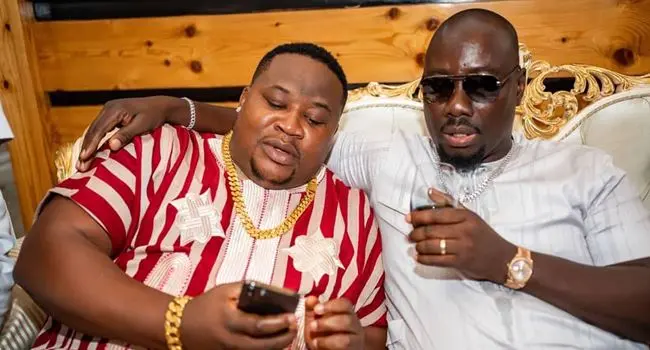
Fear, Power and Wealth: Why Nigeria’s Luxury Elite Are Embracing “City Boy” Politics
In recent weeks, a striking narrative has circulated across Nigeria’s online political discourse.
It suggests that a group of flamboyant nightlife impresarios and luxury entrepreneurs, including Obi Cubana and Cubana Chief Priest, have embraced the populist fervor often labeled “City Boy” politics not out of ideology but out of calculated self-preservation.
Trending Now!!:
The argument is provocative. It asserts that their public alignment with power is driven by a quiet, looming pressure from the Economic and Financial Crimes Commission (EFCC), whose legal authority includes seeking interim forfeiture of assets suspected to be proceeds of unlawful activity. Under Nigerian law, such orders can be granted before a full trial, placing the burden on property owners to justify the origins of their wealth.
This legal framework is not extraordinary by global standards. Many jurisdictions employ similar mechanisms to prevent dissipation of assets during investigations. Yet in Nigeria’s polarized environment, the provision has taken on a symbolic meaning that far exceeds its technical legal scope.
In popular commentary, interim forfeiture is depicted as an instrument that can dismantle fortunes overnight, leaving owners scrambling to produce financial histories that were never meticulously documented.
That fear, whether overstated or not, speaks to a deeper tension in the country’s economic story. Nigeria’s modern wealth has often emerged from informal networks, cash-based transactions, and opaque partnerships that rarely leave the kind of documentary trail courts expect. Success built through influence, patronage, and entrepreneurial improvisation can be celebrated in public but appears precarious under legal scrutiny.
The notion that wealthy entertainers and nightlife figures might therefore gravitate toward political proximity is not implausible. In a system where visibility and influence are intertwined, public allegiance can function as both branding and insurance. Loyalty becomes a signal, a way of situating oneself within the orbit of authority in a landscape where regulatory power is both potent and unpredictable.
Still, the claim that every conspicuous display of political support is motivated by fear oversimplifies a more complex reality. Nigerian elite networks are shaped by friendship, regional ties, and shared business interests that predate any single administration. Reducing their alliances to a single defensive calculation risks ignoring the performative culture of influence that defines the country’s celebrity economy.
Yet it would be equally naïve to dismiss the anxiety underlying the argument. Anti-corruption enforcement inevitably collides with the informal economic structures that produced much of Nigeria’s visible prosperity. When documentation is uneven, and the origins of capital are intertwined with favors and unrecorded transactions, even legitimately earned fortunes can appear vulnerable to forensic examination.
This vulnerability feeds a public imagination that sees the law not merely as a neutral process but as a looming force capable of reshaping entire social hierarchies. The image of a mansion sealed by court order resonates because it captures a broader fear that wealth in Nigeria is conditional, dependent not only on market success but also on the shifting winds of political favor.
The danger in this perception lies beyond the reputations of individual businessmen or socialites. It risks eroding confidence in the fairness of institutions. If citizens begin to believe that property rights hinge on political alignment rather than due process, then the legitimacy of anti-corruption efforts themselves becomes suspect, no matter how legally grounded they may be.
The online narrative, with its dramatic tone, may exaggerate the immediacy of state power. Courts do not operate in secrecy, and defendants retain the right to challenge forfeiture orders. Still, the story’s persistence reveals a profound unease about how power, wealth, and accountability intersect in contemporary Nigeria.
Whether these high-profile figures are truly acting out of fear cannot be proven. What can be observed is that the claim’s plausibility reflects a fragile relationship between Nigeria’s wealthy elite and the institutions designed to regulate them. In that fragile space, every show of loyalty is scrutinized, every political gesture interpreted as either conviction or calculation, and every fortune viewed as both success and potential liability.