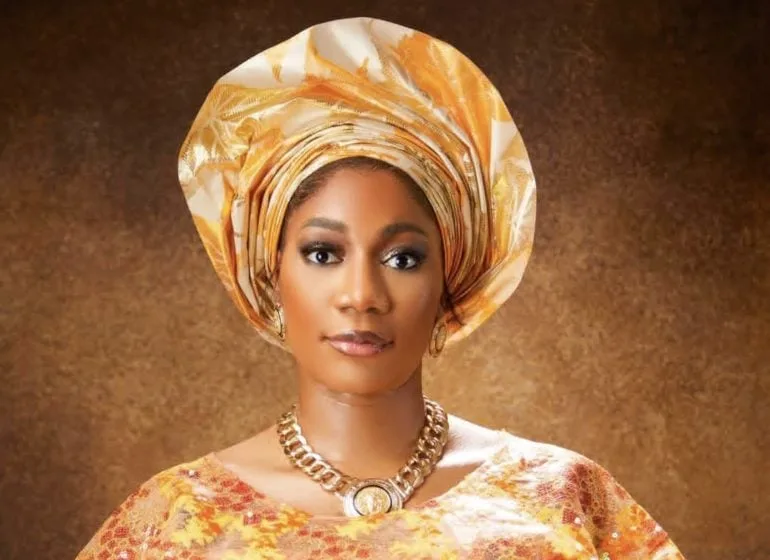
Nigerian Herbalist and Influencer, Sisi Alagbo’s Leaked Sex Tape Has Become Public
For years, Eniola Fagbemi had made a business out of intimacy. Under the name Sisi Alagbo, she had built one of the most recognizable personal brands in Yoruba-language social media, selling herbal remedies and aphrodisiac products, speaking candidly about female desire and marital health, and cultivating an audience of women who trusted her precisely because she said the things that most people in her world did not.
Nearly 400,000 people followed her on Facebook alone. She had been featured on BBC News Yoruba. She had travelled to China and Qatar to expand her trade. She had, by most measures available to a woman in her position, made something of herself.
Trending Now!!:
This week, that something came apart in the most public way imaginable.
A video depicting Ms. Fagbemi, her husband Akeem Adesola, and an unidentified third woman in an intimate encounter began circulating on WhatsApp groups and Telegram channels on Tuesday before spreading rapidly to gossip blogs, Instagram pages and explicit-content websites. By Wednesday, it had reached the kind of saturation on Nigerian social media that makes containment not merely difficult but impossible. Ms. Fagbemi confirmed the video was real.
“I own my mistakes and I apologize with all sincerity of the video circulating online,” she wrote in a Facebook post. “I am deeply sorry to everyone who felt disappointed in me.” She described herself as having been unable to eat or sleep for days, and she appealed to her followers not to abandon her. “Please let’s move on past this because this media is where I get little support to feed.”
The post carried the familiar cadence of a public apology, but it also carried something rawer, the voice of a woman who understood, in real time, that the platform she had spent more than a decade constructing could be dismantled inside of 48 hours. “I don’t want to injure myself,” she wrote. “I only have a little strength left.”




Mr. Adesola, a licensed civil engineer who has appeared in promotional videos for his wife’s herbal business, offered no detailed public statement. Social media accounts reported that he responded to the video’s circulation with a single Arabic phrase, “Astaghfirullah”, a Muslim expression of seeking forgiveness from God, a response that struck many observers as conspicuously sparse given the gravity of what had transpired.
The question of how the video reached the public has become as charged as the video itself. Alhaja Mewolaka, a prominent figure who once served as Ms. Fagbemi’s godmother before the two had a public falling-out, was among the first to discuss the footage openly on social media.
She claimed that Mr. Adesola had recorded the encounter and shared it inadvertently in a WhatsApp group, from which it was then downloaded and distributed further. If accurate, that account would place the incident squarely within the legal definition of non-consensual intimate image sharing, what is commonly called revenge pornography, which is a criminal offense under Nigeria’s Cybercrimes (Prohibition, Prevention, etc.) Act of 2015, as amended in 2024.
Whether the leak was deliberate or accidental has not been established. But the speed with which Nigerian social media accepted the premise of deliberate spousal sabotage reflects something meaningful about the cultural moment: that such an act is considered entirely plausible, and that its plausibility does not particularly shock anyone.
The story is also inseparable from the months of turbulence that preceded it. When Ms. Fagbemi’s remarriage to Mr. Adesola became public in September 2025, it triggered immediate controversy. The man’s first wife, married to him for 15 years, claimed she had not been informed of the union, alleging that both Mr. Adesola and Ms. Fagbemi had blocked her on Facebook to obscure the relationship, and that her husband had telephoned her on the morning of the nikah without once mentioning that he was about to marry another woman. The first wife’s statement, direct and devastating, circulated widely. Alhaja Mewolaka, who had initially praised the marriage, later reversed course publicly, saying she had been misled.
That controversy had barely receded when the footage emerged this week, leaving Ms. Fagbemi to navigate the current crisis from a position already weakened by months of accumulated reputational damage.
The cultural irony is not subtle. Ms. Fagbemi built her following in significant part by selling kayanmata, herbal and aphrodisiac products rooted in a Hausa-derived tradition that Nigerian women have historically used within marriage, and by speaking openly about desire in a society that rarely does.
She positioned herself as a woman who understood the terms of intimacy and could help other women negotiate them. That a private intimate moment has now been turned against her, circulated without her consent as a source of public spectacle, is the kind of reversal that her most sympathetic observers have described as particularly cruel in its geometry.
The pattern, though, is not new. From Tiwa Savage’s 2021 incident involving leaked material to dozens of less prominent cases that never reached public consciousness, the mechanism repeats itself with numbing consistency: a woman builds a public presence, a private relationship fractures, intimate material previously shared in trust becomes a weapon, and the woman absorbs the social cost alone.
Nigeria’s cybercrime law offers a formal route to justice, but advocacy groups working on digital gender-based violence have long noted that enforcement is inconsistent, that documentation requirements are burdensome, and that many victims never pursue legal recourse because the shame attached to the exposure tends to be consuming in ways that a court proceeding rarely undoes.
Regarding the third woman allegedly depicted in the footage, online speculation has produced several names, none of which have been confirmed. At least one individual named in those reports has denied involvement entirely.
Ms. Fagbemi, who is from Ipapo in Oyo State and has described herself as a self-made businesswoman with more than 12 years of experience in herbal medicine, is a mother of three. She has spoken in the past about leaving a previous marriage because of domestic violence, a disclosure that earned her considerable sympathy at the time and helped establish her public persona as a woman who had survived difficulty with her dignity intact.
That persona now sits in a complicated relationship with the events of this week, not because her past suffering was dishonest, but because the internet rarely holds two truths about a person simultaneously, and this one has chosen which truth to amplify.
Her Facebook and TikTok pages remain active. She has not, beyond her initial apology, addressed the video further. The silence may be deliberate. It may also be the particular paralysis that arrives when a violation moves faster than the capacity to respond to it.
What is clear is that the video continues to travel through the private channels of Nigerian social media, forwarded by ordinary people going about their ordinary lives, watched by many who would not describe themselves as doing anything wrong.
And at the centre of it is a woman who built her livelihood on the premise that she understood desire, who now finds that premise being used by the same public that once celebrated her for it, as a reason to look.