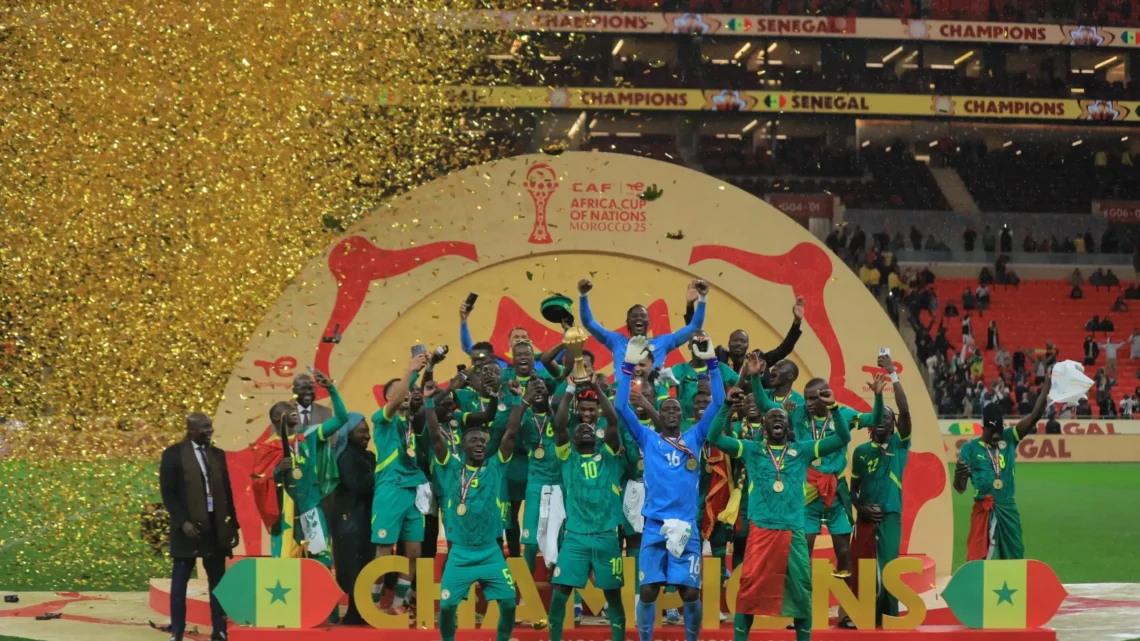
CAF Has Handed Morocco a Trophy That Belongs to Senegal, and African Football Should Be Furious
Senegal won on the pitch, in extra time, with a legitimate goal. What happened next is a masterclass in how African football continues to fail its own people.
Two months. That is how long the Confederation of African Football allowed Senegal’s players to carry the weight of champions, to wear their gold medals, to sleep as Africa Cup of Nations winners, before quietly yanking the title from their hands and dropping it into Morocco’s lap on a Tuesday evening in March.
The CAF Appeal Board ruled on March 17, 2026, that Senegal had forfeited the AFCON 2025 final, declaring Morocco winners by a 3-0 scoreline, a number so detached from the reality of what happened on that pitch in Rabat that it borders on fiction.
Trending Now!!:
This is not justice. This is not integrity. This is African football doing what it has always done best, protecting the powerful while punishing the righteous.
Let me be precise about what actually happened on January 18, inside the Prince Moulay Abdellah Stadium, because the technocrats at CAF would prefer you focus on the rulebook rather than the facts. Senegal had a stoppage-time goal ruled out, and moments later, the referee awarded Morocco a penalty kick following a VAR review, a decision so bewildering that it stopped the entire stadium in its tracks, including the Senegalese players who had just watched the match’s momentum reversed by a call that felt, to put it generously, creative.
Several Senegalese players walked off the pitch in protest, with the support of their head coach, and the game was delayed by 14 minutes before Sadio Mane, acting as the conscience of his team, convinced his teammates to return. Morocco missed the penalty. Senegal went on to win 1-0 in extra time. The better team won on the night. And none of that, apparently, matters anymore.
The AFCON 2025 final controversy has since been packaged by Morocco’s football federation and sympathetic voices as a tale of rule enforcement and sporting integrity. The Royal Moroccan Football Federation described the CAF Appeal Board’s verdict as “reinforcing respect for the laws and ensuring the necessary stability for the optimal conduct of international competitions.” It is the kind of language that sounds elegant in a press release and collapses the moment you subject it to any serious scrutiny.
Morocco, the host nation, had its ball boys attempting to seize equipment belonging to Senegalese goalkeeper Edouard Mendy during the match. For that conduct, Morocco was fined $200,000 for the behaviour of their ball boys who, at one stage, tried to seize a towel being used by Mendy. This is the same federation now lecturing the continent about stability and respect for the laws of the game.
CAF’s case rests on Article 82 of AFCON’s regulations, which states that if a team refuses to play or leaves the ground before the end of regulation time without the referee’s authorization, it will be considered the loser and eliminated from the competition, with Article 84 stipulating that any team violating this rule loses the match 3-0.
On its face, that reads like a clean, defensible regulation. The problem is not the rule. Rules are necessary. The problem is the context in which it is being selectively applied, and the fact that enforcing it two months after the final, after trophies have been lifted, after medals have been distributed, after the world has moved on, represents something far more sinister than rule enforcement. It represents institutional manipulation dressed in legal clothing.
Consider, for a moment, the sequence of events at CAF’s own disciplinary hearing just weeks earlier. At an initial disciplinary hearing, CAF imposed fines of more than $1 million in fines and bans for Senegal and Morocco players and officials but left the result untouched. That disciplinary board reviewed the same incident, the same walk-off, the same 14-minute delay, the same Article 82, and concluded that financial penalties and suspensions were the appropriate remedy.
The result, they decided, should stand. Senegal were champions. Then Morocco appealed, and suddenly, magically, a completely different body at the same organization looked at the same facts and reached the opposite conclusion.
The Appeal Jury’s ruling annulled the earlier disciplinary decision, which had drawn widespread criticism for failing to address what it called the core violations that marred the final. Two decisions, two opposite outcomes, one institution. If that does not tell you something about the internal consistency, or rather the lack of it, inside CAF, nothing will.
Senegal’s government did not mince words. Senegal’s government called CAF’s decision “grossly unlawful and profoundly unjust” and called for the opening of an independent international inquiry into allegations of corruption within the governing bodies of CAF. That call for an investigation is not hysteria.
It is the entirely rational response of a country watching its football team be stripped of a continental title two months after winning it, as the host nation of that same tournament walks away with the trophy. When the circumstances are this specific, when the beneficiary of a suspicious ruling happens to be the country that organized and financed the tournament, asking uncomfortable questions is not inflammatory. It is obligatory.
Here is what the official narrative around AFCON 2025 and this CAF ruling does not want you to hold in your head simultaneously: CAF has a documented, catastrophic history of corruption. This is not speculation or the bitter complaint of a losing side. It is an institutional record.
A documentary by a renowned Ghanaian investigative journalist exposed corruption in soccer across African countries as rampant, with dozens of referees, coaches and officials implicated in taking bribes, showing a sport still operating in a murky world of bribery and secret meetings even years after the FIFA corruption scandal brought down world soccer’s biggest figures.
Ghana Football Association president Kwesi Nyantakyi, who was simultaneously a member of the FIFA Council and a vice president of CAF, was shown accepting $65,000 in bundles of cash from undercover journalists and stuffing it into a black plastic bag. The cash was described openly as shopping money. That is a CAF vice president. This is the same institution now asking you to trust its appeals board’s findings on a case where the host nation happens to be the winner.
The deeper rot in African football refereeing has been documented extensively. Referees get involved in cheating and other malpractices because of greed, occasional threats by officials to satisfy what observers call the win-at-home syndrome, poor remuneration and welfare, and individual corruption facilitated by football officials.
The win-at-home syndrome. That phrase should haunt every conversation about this AFCON final. Morocco was the host nation. The disputed penalty that triggered Senegal’s walk-off was awarded to Morocco deep in stoppage time, moments after a Senegalese goal was controversially ruled out.
One of Africa’s most respected referees, speaking anonymously to a journalist, once acknowledged that it “seems an accepted norm in CAF that people know bribery exists but cannot, do not know how to deal with it, or will not deal with the matter.” That referee was speaking about the broader culture, not this specific match. But the culture is the context, and pretending it does not exist when analyzing this ruling is intellectually dishonest.
CAF president Issa Hayatou was reported to have accepted $1.5 million in bribes from Qatar to secure his support for their 2022 FIFA World Cup bid, according to claims published by The Sunday Times based on a whistleblower’s account.
Hayatou denied the claims, but that allegation sat against the name of the man who led African football for decades. The institution he built does not simply reset its culture the moment a new president takes office. These things calcify. They become systems. And systems protect themselves.
CAF president Patrice Motsepe sought to defend the organization’s integrity and impartiality this week, saying, “It is important for us that ordinary football supporters and spectators in every one of the 54 countries in Africa, in their judgment, not in CAF’s judgment, not in my judgment, regard the decisions of our judicial bodies as fair.”
That is a noble sentiment. But the ordinary football supporters across those 54 countries are watching a country be stripped of its AFCON title because its players walked off the pitch in protest of a refereeing call, returned to the pitch, and then won the match legitimately. Those supporters are watching the title go to the host nation. Asking them to regard that as fair requires either a tremendous amount of faith in CAF’s impartiality or a complete indifference to history.
The rule itself, Articles 82 and 84, is also worth interrogating as a standalone matter, independent of the corruption question. The appeal verdict seemed to override the referee’s own authority to make field-of-play decisions, which is itself a significant legal contradiction.
IFAB’s Laws of the Game, the global standard for football governance, state clearly that the decisions of the referee regarding facts connected with play are final. The referee in Rabat did not declare a forfeit. The referee did not abandon the match. The referee allowed play to resume, watched Morocco miss the penalty, and officiated the rest of the game to its conclusion. The contest ended with a result.
This marks the first time in history that a global football tournament winner has been decided retrospectively by a governing body, which alone should cause anyone who cares about sport to pause and feel deeply uneasy.
African football expert Mimi Fawaz captured it accurately on Sky Sports News, noting it is quite sad to see how things have developed, and that the controversy puts a stain on African football, particularly when the continent’s biggest stars, the players who make European leagues richer and more competitive, are at the center of a governance disaster of this magnitude.
Some of Senegal’s Premier League stars responded to the ruling by posting laughing emojis on Instagram, alongside photos of themselves holding the AFCON trophy, and honestly, what other response is appropriate? When the institution tasked with protecting your interests has failed you this completely, laughter is sometimes the only dignified reply.
Senegal will appeal to the Court of Arbitration for Sport in Switzerland, and that is the right move. CAS operates independently of CAF, and an independent tribunal reviewing the evidence without CAF’s internal pressures and political considerations is exactly what this situation demands. But even a successful appeal cannot undo the damage already done to African football’s reputation on a global stage.
The AFCON 2025 controversy is now international news, and the story it tells is not one of disciplined governance or courageous rule enforcement. The story it tells is of an institution that initially punished both sides financially and left the result intact, then reversed course under pressure from the host nation’s federation, and handed that host nation a 3-0 victory it never earned on a football pitch.
Morocco’s players deserved better than this, too. The Atlas Lions played the final. They competed. They lost in extra time after missing a penalty. They are now being handed a trophy that will carry, as one prominent analyst put it, an asterisk in the minds of fans for as long as African football is discussed.
None of the star players of Morocco’s squad had publicly celebrated the reversed result as of Tuesday evening, and there is something telling in that silence. Even the supposed beneficiaries of this ruling understand, on some level, that a 3-0 administrative victory is not the same as lifting a trophy you won on the field.
Senegal’s coach, Papa Thiaw, said after the final that he acted to protect his players from injustice. You can debate his judgment. Reasonable people will disagree about whether walking off the pitch, even temporarily, was the right tactical or ethical response to a controversial refereeing decision.
But the punishment that follows, stripping a country of a continental title it won through 90 minutes of extra time and a goal scored in open play, is categorically disproportionate to the infraction. It is also uniquely and suspiciously convenient for the host nation.
African football deserves better governance than this. Its players deserve better. The billions of fans across 54 countries who wake up at odd hours to watch AFCON matches, who argue about their national teams in markets and on buses and in barbershops from Dakar to Lagos to Nairobi, deserve a governing body that makes decisions based on principle rather than pressure. What CAF has delivered this week is not integrity. It is its absence, gift-wrapped in the language of regulation.
The trophy sits in Rabat now. The paperwork says Morocco are champions. But in Dakar, and in every corner of the continent where people watched that final with their own eyes, they know what they saw. Senegal won. And no appeals board ruling, no matter how carefully worded, can change that.