
Cold Chain Challenges in African Agriculture
Unreliable power, broken roads and ten-year payback periods leave most African produce uncooled, and the fixes that work look nothing like a bigger cold room.
Roughly one crate of fresh produce in twenty in Africa travels through anything that could be called a cold chain. The rest sits in the sun, rides in open trucks, or waits on market floors where tomatoes soften within a day or two.
Africa’s cold chain fails because five problems feed one another: unreliable or expensive electricity, costly equipment with long payback periods, poor roads and scarce refrigerated vehicles, fragmented small-scale supply lines, and a shortage of financing that smallholders can use. Together, they contribute to post-harvest losses of 30 to 50 percent for perishable produce.
Trending Now!!:
The bill is large. Nigeria alone loses an estimated $2.3 billion to $3.3 billion a year to post-harvest inefficiencies, and the Food and Agriculture Organization (FAO) puts losses of some fresh crops in sub-Saharan Africa at up to 40 percent. Estimates for highly perishable fruit and vegetables run as high as 70 percent.
The spread between those figures reflects real differences between crops, seasons and countries, so they are best read as a range rather than a single number.
Why a Cold Room Is Not a Cold Chain
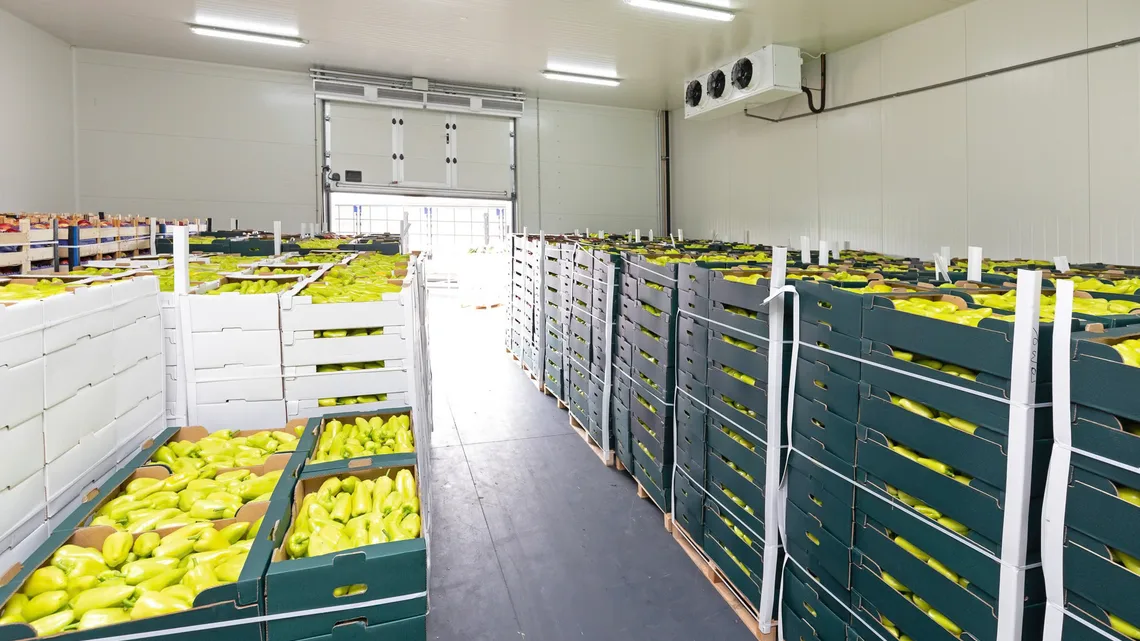
A cold room in a market is one link. A chain starts at the farm, where produce must shed field heat quickly. Harvested fruit and vegetables keep respiring; if the heat is not removed through pre-cooling, moisture loss and ripening speed up.




The chain then continues through cold storage at an aggregation point, refrigerated transport, cold handling at ports or airports, and cold display at the point of sale.
Failure at any link undoes the rest. Kenya shows the pattern clearly. Industry representatives there identify farm-level cooling and pre-cooling as the weakest points, followed by road transport and consolidation. Airport handling is comparatively developed. Money has flowed to the end of the chain that already works, while the first mile, where most damage begins, stays uncovered.
Capacity figures show how uneven the picture is. South Africa, the most mature market in southern Africa, holds about 13 cubic metres of cold storage per 1,000 residents. Rwanda has a total of 6,162 cubic metres, and 58 percent of it serves export flowers. Storage tends to be built where foreign buyers demand it, not where local families buy tomatoes.
The Electricity Problem
Refrigeration is a continuous load. A phone can charge when the grid returns; a cold room that loses power for a day starts to lose product. Grid power across much of sub-Saharan Africa is both unreliable and expensive, and many farming communities have no connection at all. Diesel generators fill the gap, adding fuel cost, noise and emissions to every kilogram cooled.
The most credible workaround is solar power paired with thermal storage. ColdHubs, the Nigerian company founded by Nnaemeka Ikegwuonu, runs walk-in cold rooms on rooftop solar panels. The rooms use propane (R290) as the refrigerant and store cold in a phase-change material, while batteries only power auxiliary equipment overnight. Large battery banks are expensive and hard to scale in open-air markets, which is why storing cold, rather than electricity, matters.
Solar is not a complete answer. Panels solve the daytime energy supply, but cloudy spells, dust and theft of equipment remain operational risks. A solar cold room also needs a trained technician within reach, and in remote areas that is often harder to find than sunshine.
Capital and the Payback Trap
The strongest evidence on what solar cold storage delivers comes from a study by Hiroyuki Takeshima of the International Food Policy Research Institute. Seven solar cold units were installed in horticulture markets in northeast Nigeria, each holding up to three tonnes, with seven comparable markets serving as a control group. The initial user pool was 251 market agents, roughly 36 per unit.
The results were strong. The share of loss value in gross revenue fell by about 11 percent. Sales revenue and volumes rose by nearly 70 percent, sales prices rose by as much as 20 percent, and produce stayed fresh for seven to eleven days. After operating costs, each unit earned a net profit of around $8,000 a year.
The economics are less comfortable. Construction cost about $40,000 per unit, with running costs near $150 a month. The study puts payback near ten years once interest is counted, though the panels should last more than 25 years. Earlier installations by ColdHubs were priced nearer $28,000 per cold room, so cost depends heavily on design and scale.
A ten-year payback on a unit that profits handsomely is the capital trap. Commercial lenders look at the first decade, farmers look at the next harvest, and neither can carry that equipment alone. Grants and donor money have filled the gap so far, which explains why the technology works in pilots and scales slowly.
Roads, Trucks and the Last Mile
Storage is only half the problem. Perishables must move, and the vehicles that move them are scarce. Poor roads, worsened by rainy seasons in countries such as Zambia, stretch journey times. Farmers often haul fruit long distances to processing centres in ordinary trucks, and every extra hour erodes shelf life.
Exporters face a different version of the same issue. Kenya relies on air freight for fresh produce bound for Europe, and the cost shapes the whole business. Okisegere Ojepat, chief executive of the Fresh Produce Consortium of Kenya, has said:
“The cost of freight is the single most expensive part of this business.”
Capacity is as tight as price. In peak seasons, cargo space for flowers is scarce, and rates climb, and Ethiopian Airlines has built a cold chain system whose air freight rates are roughly half those charged by freight forwarders in Kenya.
Rwanda has taken a hands-on approach: its export agency handed over refrigerated trucks to horticultural exporters under a co-investment model, with partners funding 60 percent and exporters 40 percent. Rwanda’s horticulture exports rose 29.1 percent to just over $75 million, and growers are pressing RwandAir for more cargo aircraft as avocado volumes grow.
Sea freight is the other lever. Exporters of produce that tolerates longer transit are weighing a gradual move from air to sea, which cuts cost and emissions but demands exactly the container-level temperature control that many shippers still lack.
Fragmentation and Missing Skills
Most African fresh produce is grown by smallholders on a hectare or two. Each produces too little to fill a refrigerated truck, so loads must be consolidated, and consolidation is itself a weak link. A reefer that leaves half empty carries the same fixed cost per trip, which pushes up the cost per kilogram and makes cold transport uneconomic for the people who need it most.
Skills compound the problem. Cold storage management, refrigerated transport and food safety compliance all require trained staff, and the supply of them is thin. A cold room with the wrong set point, or a door left open during loading, wastes the investment as surely as a power cut.
Cross-border trade barriers add friction. Paperwork, inspections and inconsistent standards delay perishable shipments at borders, and a delay that is merely irritating for dry goods can be fatal for cut flowers or berries.
Export Corridors Versus Domestic Markets
Cold chain products make up about 5 percent of Africa’s total trade by value, a share that barely moved over several years. Morocco, South Africa and Egypt lead exports, and the European Union accounts for over 40 percent of import values and 35 percent of export values. Trade among African countries represents only 10 to 15 percent of cold chain trade, which shows how little the continent’s own markets are served.
Investment is rising all the same. The African cold chain logistics market is valued at about $10.9 billion and is projected to reach roughly $14.9 billion at a growth rate near 8.3 percent a year.
Much of that growth is driven by urbanisation, with the urban share of the population expected to climb from 45 percent to 60 percent in coming decades, and by supermarkets and restaurant chains. In East Africa, international quick-service restaurant brands have pulled operators into the market, with four in Kenya and two in Uganda, because they insist on audited cold chain standards.
This is a double-edged development. Formal retail demand builds high-quality cold chains, but they serve the shops and restaurants that already exist. The open-air market trader selling fish or leafy vegetables, who accounts for most of the domestic trade in perishables, sees little of it.
Cooling as a Service and What It Changes
The most promising answer to the capital problem is to stop asking farmers to buy equipment. Under cooling as a service, a provider owns, runs and maintains the cold room, and users pay only for what they store. The model removes the upfront cost and shifts the maintenance burden to a business equipped to carry it.
Pricing can be granular. ColdHubs charges per crate per day, about ₦100 (roughly $0.07 at recent exchange rates, though the study that reported this fee cited about 28 US cents when it was set). In its latest impact report, it serves over 11,100 farmers, retailers and wholesalers through 58 cold rooms and 10 refrigerated trucks.
In Kenya, SokoFresh runs solar cold storage on a service basis for more than 7,000 farmers. In Ghana, AkoFresh rents out refrigerated tricycles on a pay-per-use basis, and InspiraFarms has raised new funding to extend off-grid cold storage in southern and eastern Africa.
Koolboks applies the same logic to freezers. The Nigeria- and France-based company raised $11 million in a Series A round, sells solar freezers outright or through pay-as-you-go instalments, and keeps its portfolio at risk near 3 percent through remote monitoring and customer verification. The company has found Kenya and parts of Central Africa harder to enter because of regulatory and financing hurdles, a reminder that models do not travel as easily as press releases suggest.
One adoption lesson stands out: farmers who have never used cold storage do not trust it. ColdHubs began with free trials so that traders could see the difference for themselves before paying.
Misconceptions Worth Correcting
Cold storage is not the answer to every post-harvest loss. A joint study by the FAO and the World Bank put grain losses in sub-Saharan Africa at around $4 billion a year, enough to meet the minimum food needs of at least 48 million people. Grain loss is fought with drying, airtight bags and sealed silos, not refrigeration.
A review of 324 studies found that with improved handling, airtight storage, cold chain infrastructure and better packaging, losses fell to roughly 8.2 percent for cereals, 7.3 percent for vegetables, 6.2 percent for fruit and 11.5 percent for roots and tubers. Cold chains matter most for fruit, vegetables, fish, meat and dairy.
A second misconception is that loss statistics are precise. The headline figures of 30 to 50 percent, 40 percent and 70 percent describe different crops, different stages and different methods. Treat them as indicators of scale, and demand crop-level data before building anything.
A third is that a cold room by itself raises incomes. In the Nigerian study, gains came from the combination of lower losses, longer shelf life and better selling prices, because traders could wait for demand instead of dumping stock at a discount. Where buyers are absent, or roads are impassable, the same equipment sits idle.
A Rule of Thumb for Judging Any Cold Storage Project
The simplest test is to compare the daily fee with the value a day of cooling protects. Take a hypothetical crate of tomatoes worth $20 at market. A fee of about 28 cents a day equals 1.4 percent of the crate’s value.
Holding the crate for three days costs about 84 cents, or roughly 4 percent. If cooling prevents more than 4 percent of that crate’s value from being lost, or lets the trader wait for a price at least that much higher, the service pays for itself.
Three questions follow from the arithmetic, and a project that fails any of them is likely to disappoint:
- Does the crop lose value fast enough at ambient temperature that a few days of cooling changes the outcome?
- Is a buyer or truck waiting on the other side, so the stored produce actually reaches a better market?
- Can the operator earn enough per tonne-day to keep the unit running and repaired for years, not just through the grant period?
Projects that answer yes to all three tend to survive. Those that rely on equipment alone, with no market, no transport or no maintenance plan, tend to become expensive sheds.
What People Ask