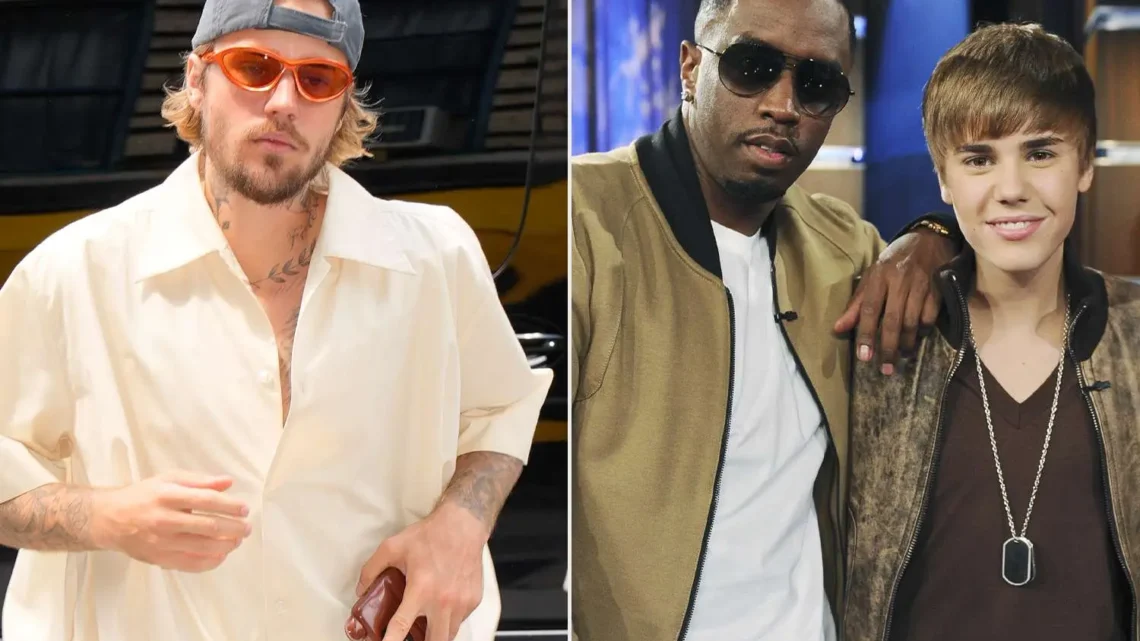
Diddy Groomed Justin Bieber? The Truth About Their Friendship, Videos, and Bieber’s Denial
When Sean "Diddy" Combs was arrested on federal sex trafficking charges in September 2024, a resurfaced 2009 YouTube video of a 15-year-old Justin Bieber spending 48 undisclosed hours with the rap mogul reignited one of entertainment's most persistent questions. Bieber has since denied being among Combs' victims. But the friendship, the footage, and the industry structures that made it all possible are still very much worth examining.
For years, the friendship between Sean “Diddy” Combs and a teenage Justin Bieber existed as one of those only-in-Hollywood arrangements that raised eyebrows but never quite broke into the mainstream conversation.
It was eccentric, yes. Odd, perhaps. But in the entertainment industry, odd is often just Tuesday. Then Diddy was arrested.
Trending Now!!:
On September 16, 2024, Sean Combs was arrested on charges of racketeering conspiracy, sex trafficking by force, and transportation for purposes of prostitution. He has denied all allegations and pleaded not guilty to all three felony counts.
The moment that indictment became public, the internet did what the internet does, and it went searching for every name, every video, every photograph, every half-remembered interview that could be placed anywhere near Diddy. Justin Bieber’s name surfaced almost immediately, and it has not left the conversation since.
The questions being asked are blunt. Did Diddy groom Justin Bieber? What really happened during those now-infamous 48 hours they spent together when Bieber was 15 years old? Why did Bieber go through years of very public emotional and psychological turbulence just as his star was rising? And what does his recent denial actually mean, given the wider context of everything that has emerged about Combs and his alleged operation?
Those are not unreasonable questions. But they deserve serious, carefully sourced answers, not the kind of viral speculation that has dominated TikTok feeds and Reddit threads for months. Let us start from the beginning.
How a 15-Year-Old Ended Up in Diddy’s World
Justin Bieber rose to fame at 13 after being discovered on YouTube, and his rapid ascent placed him in circles with older industry icons, including Diddy, who is 24 years older than him. That age gap is not a minor detail.
It is one of the central facts that any honest examination of this story has to hold onto. A 24-year difference between a grown man with enormous power and a child with enormous talent is not a mentorship dynamic that most parents would rush to encourage, regardless of who the grown man happened to be.
Bieber was signed to Usher, who is famously one of Diddy’s protégés. It was not long before Justin and Diddy met and started hanging out. The connection, in other words, was already baked into the structure of how the music industry passed young talent from one powerful figure to another.
Usher himself had been through Diddy’s orbit as a teenager. Now here was Bieber, a boy barely out of middle school, being folded into the same network.
The “48 Hours With Diddy” Video
No piece of footage has done more to fuel the grooming speculation than the video Bieber himself uploaded to his YouTube channel in November 2009. Bieber, then 15, uploaded his first video collaboration with Diddy on his YouTube channel.
Titled “48 Hours With Diddy,” the clip shows Bieber spending two days with the rap mogul in Los Angeles after launching a social media campaign to produce a song for him. Diddy bragged that he had bought a Lamborghini for the teen star ahead of his 16th birthday.
“As soon as you turn 16, I’m gonna let you rock this,” Diddy vowed as he unveiled the luxury car. “You know, you gotta ride with your seatbelt and everything. The keys is yours, when you get to be 16.”
That alone reads differently in 2025 than it did in 2009. A grown man buying a teenage boy a Lamborghini, dangling it as a gift contingent on age, is the kind of detail that, once you know what Combs was allegedly doing behind closed doors, sits in the stomach like a stone.
But there is more. The most infamous moment from the vlog involved Diddy’s description of how he planned to spend his 48 hours with Bieber. “Right now, Bieber is having 48 hours with Diddy. Him and his boy, they’re having the times of their lives,” the rapper said. “Where we’re hanging out and what we’re doing, we can’t really disclose. It’s definitely a 15-year-old’s dream.” He then told the camera they were going to go “full buck crazy.”
When Bieber suggested they “go get some girls,” Diddy hugged him and referred to Bieber as “a man after my own heart.”
The phrase “we can’t really disclose” is what feeds the speculation machine. When a powerful adult tells a teenage boy that what they are doing together is too private to share with the public, that is, in any other context outside of celebrity culture, a sentence that triggers immediate concern.
That it was uploaded as a fun YouTube video, and received at the time as a harmless celebrity hangout, says something uncomfortable about how the entertainment industry has long normalized access to minors by powerful men.
Diddy also said in the video, “He’s signed to Usher, and I had legal guardianship of Usher when he did his first album. I don’t have legal guardianship of him but for the next 48 hours, he’s with me and we’re gonna go full buck crazy.”
The invocation of “guardianship,” even in a joking context, was not accidental. It framed the relationship as one of custodial authority, and it drew a direct line between Bieber and the young Usher, whose time in Combs’ care has also attracted sustained scrutiny.
The Freak Off Rumor and the AI Song
There was a rumor that Justin attended one of Diddy’s “Freak Off” parties, where alleged sexual abuse occurred. Justin never commented on that, and there is no evidence to suggest it is true.
In April 2024, a song attributed to Justin Bieber called “Diddy Party” went viral on TikTok and Twitter. Social media users noticed that the lyrics seemed to allude to the allegations against the music mogul: “Lost myself at a Diddy party, didn’t know that’s how it go, I was in it for a new Ferrari, but it cost me way more than my soul.”
However, experts say the song appears to have been created with AI. When CBS News used multiple AI audio detection tools, the results indicated that the song was likely AI-generated. There is no record of Justin ever sharing or releasing it.
This matters enormously. The AI song became, for a large portion of the internet, treated as a genuine confession. It was not. It was fabricated, and its viral spread demonstrates how quickly digital misinformation can harden into perceived fact, particularly when the underlying narrative already has emotional momentum.
People wanted it to be real, so they treated it as real. That is not journalism. That is not justice for anyone involved, least of all the actual victims of Combs’ alleged crimes.
The 2021 Pat-Down Video
Following Diddy’s 2024 arrest, footage resurfaced from sometime in 2021 of Diddy greeting Bieber and then seemingly patting him down.
In the video, Diddy appears to be telling Bieber something, but his comments cannot be deciphered. Newsweek reported that Diddy may have been patting down Bieber’s chest to see whether he was wearing a wire or some other type of recording device, but there is no definitive evidence to prove this.
That 2021 video, unlike the 2009 YouTube clip, carries a different kind of weight. By that point, Bieber was an adult.
The idea that Combs might have been checking whether Bieber was cooperating with investigators, whether or not that interpretation is accurate, reflects how the relationship between the two men had by then evolved into something more complicated than a friendly mentorship from years past.
Suge Knight’s Claims
In a new interview with Michael Franzese, Death Row Records co-founder Suge Knight claimed that Diddy groomed Justin Bieber and had sex with Usher. “It was the saddest thing in the world what they did to Justin Bieber,” Knight said. “I hate to say that because I really like Justin Bieber. I feel bad for Justin Bieber.”
Knight added, “He had grown men take Justin Bieber when he was young to a romantic vacation, showing pictures on Instagram with no women, nobody else but grown, successful men and this little kid. Not only is it a bad look, it’s sad.”
It bears noting, with some firmness, that Suge Knight is not a reliable narrator. He is a convicted felon speaking from behind bars, with his own long history of manipulation, violence, and score-settling within the music industry.
His claims about Bieber and Usher should not be treated as evidence. They should be treated as one extremely compromised individual’s allegations, stated without proof, about events he was not present for. Knight’s words contributed significantly to the spread of the grooming narrative, but they are not, on their own, substantiation.
Bieber’s Behavior Through the Years: Context vs. Confirmation
The part of this story that has led many people to connect the dots in a particular direction is Bieber’s very public unraveling in the years following his teenage friendship with Combs.
The arrests, the erratic behavior, the emotional rawness that bled through interviews and social media posts, the obvious spiritual searching, the eventual marriage to Hailey Baldwin (Hailey Bieber), and what appeared to be a slow rebuilding of his sense of self, all of it has been mapped onto the grooming narrative by fans who believe that trauma explains what they observed.
In his 2021 documentary Justin Bieber: Seasons, he admitted to struggling with exploitation in the industry. He has spoken about rebuilding his mental health after years of pressure.
The problem with using Bieber’s struggles as confirmation of grooming is that those struggles are entirely consistent with what we already know about child stardom in general, without any abuse involved at all. The industry has always chewed up young talent.
The isolation, the money, the loss of a normal adolescence, the adults around a teenage star who have financial incentives to keep that star productive rather than protected, none of that requires a Diddy to produce severe psychological consequences. It requires only Hollywood.
That does not mean nothing happened. It means the suffering we observed is not proof that any particular thing happened.
Justin Bieber’s Denial, and Why It Matters
Justin Bieber has denied that he was ever groomed by Diddy when he was a teenager. On May 16, 2025, a representative for Bieber issued a formal statement addressing the speculation.
“Although Justin is not among Sean Combs’ victims, there are individuals who were genuinely harmed by him,” the spokesperson said in a statement, as reported by People. They added, “Shifting focus away from this reality detracts from the justice these victims rightfully deserve.”
This marked Bieber’s first public comment on the matter since Combs’ September 2024 indictment.
The statement is precise, and its precision is deliberate. It does not say the friendship with Diddy was innocent or untroubling. It says Bieber was not among Combs’ victims.
The second sentence of the statement is the one that deserves the most attention, because it redirects the conversation toward the people who were genuinely harmed and away from a celebrity rumor cycle that, however well-intentioned, risks crowding out the real case with speculation.
After Diddy’s initial arrest in September 2024, a source told People that Bieber was focused on his family following the birth of his son the month prior. “He’s aware of Diddy’s arrest and all the allegations,” the insider said. “It’s not anything that he wants to focus on, though.”
A source close to Bieber also told Us Weekly that he wanted “nothing to do” with the disgraced rapper. “Justin has been advised to stay as far away as possible from anything and everything related to Diddy,” the insider said. The source insisted that Bieber was focused on supporting his wife, Hailey, following the birth of their son, Jack Blues Bieber, in August 2024.
What the Friendship Actually Tells Us
Even if we take Bieber’s denial at full face value, which every honest analysis should do in the absence of contrary evidence, the friendship between Combs and a 15-year-old Bieber still tells us something worth examining.
It tells us that a man now on trial for sex trafficking had structured access to teenage boys through the music industry’s mentorship chain. It tells us that the adults around those boys, managers, label executives, publicists, parents, normalized that access because the man providing it was powerful and financially beneficial to them.
And it tells us that the entire apparatus of celebrity culture was arranged in a way that made the behavior visible, publicly documented on YouTube, and simultaneously invisible, dismissed as industry eccentricity.
Sean Combs is currently standing trial in New York City on charges that include sex trafficking, racketeering conspiracy, and transportation to engage in prostitution. If convicted, the 55-year-old could face life in prison.
He has pleaded not guilty to all charges. According to federal prosecutors, Combs orchestrated parties referred to as “Freak Offs,” where he allegedly drugged and trafficked women. His legal team insists all activities were consensual and denies that he ever forced anyone to engage in sex acts.
The trial is the story. Not the speculation about who attended a party, not the AI-generated song, not Suge Knight’s jailhouse interview. The trial is where the evidence is tested, where victims testify, and where the legal system does the work that social media cannot.
The Danger of Grooming Speculation Without Evidence
There is a version of this coverage that treats every resurfaced video as a smoking gun, every period of Bieber’s emotional distress as corroboration, and every unverified claim as confirmation.
That version is irresponsible, not because Bieber deserves protection from scrutiny, but because the actual victims of Sean Combs deserve a world where their cases are taken seriously rather than diluted by unsubstantiated celebrity gossip.
Grooming is a real and devastating pattern of behavior. It involves the calculated use of gifts, access, emotional manipulation, and isolation to normalize sexual exploitation of minors.
When we apply that term loosely, without evidence, to every awkward interaction between a powerful adult and a young person, we make it harder to identify and prosecute the real thing. We make it easier for perpetrators to dismiss legitimate accusations as part of a pattern of internet hysteria.
If Justin Bieber says he was not a victim, the responsible position is to believe him unless evidence contradicts his account. That is what we would demand for anyone else. It should apply to him, too.
The Broader Reckoning the Industry Still Owes
What the Bieber-Diddy story does, regardless of what occurred privately between them, is force a conversation that the entertainment industry has evaded for decades.
Young artists, particularly Black and Latino teenagers in the hip-hop and pop worlds, have long been cycled through relationships with older, more powerful men under the banner of mentorship.
The music industry has treated that pipeline as a feature rather than a risk. The Combs case suggests that, if the prosecution’s narrative holds up at trial, the pipeline was also a vector for exploitation.
The question is not only what Diddy did. The question is what the industry built around him that allowed it to happen, who looked away, who profited, and who sent a 15-year-old boy off for 48 undisclosed hours with a grown man and called it a dream come true.
That reckoning is owed, whatever the full truth about Justin Bieber turns out to be.