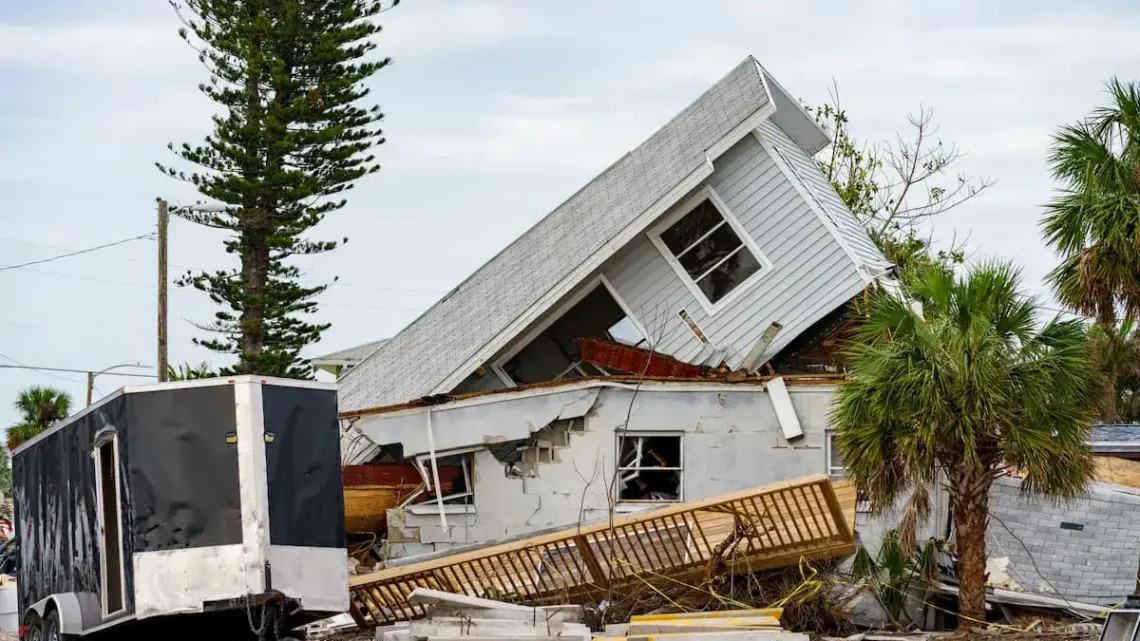
How Climate Risk Is Beginning to Show Up in Property Insurance Premiums
As wildfires, floods, and hurricanes rewrite the rules of catastrophic loss, insurers are doing something they have never done at this scale before: pricing the future into your renewal notice, and millions of homeowners are only beginning to understand what that means for their mortgages, their property values, and their financial security.
The bill for decades of building in the wrong places is finally arriving, and it is landing in your mailbox every renewal season.
There is a particular kind of dread that sets in when a homeowner opens a renewal notice and sees a number they cannot recognize. Not a modest adjustment, not an inflation bump, but a figure that looks like a misprint.
Trending Now!!:
This has become a ritual for millions of Americans over the past several years, and it is not a coincidence or a corporate shakedown. It is something more fundamental: the property insurance industry is, for the first time in its modern history, being forced to price the future instead of the past.
For most of the twentieth century, actuaries built their models on historical loss data. They looked backwards, averaged out bad years, and arrived at a premium that reflected what had already happened.
That methodology worked well when climate patterns were relatively stable, when a bad hurricane season was the exception, and when a major wildfire in a populated area was a once-in-a-generation event. That era is over.
What is now unfolding across the United States, and increasingly around the world, is a fundamental repricing of climate risk in property insurance. It is not a trend. It is a structural shift, and anyone who owns a home, carries a mortgage, or has a financial stake in the housing market is going to feel it.




How We Got Here: The Long Runway Nobody Watched
The honest version of this story begins not with climate science, but with decades of decisions that loaded more and more people into harm’s way. Coastal communities expanded steadily southward and eastward into flood-prone zones.
Suburban sprawl pushed housing developments up into the wildland-urban interface, the dry, fire-prone edges where neighbourhoods meet forests and chaparral. Engineers, architects, and developers followed the rules that existed, and regulators allowed it because the losses, when they came, were manageable, or at least insurable.
Home insurance premiums rose 40 percent faster than inflation between 2017 and 2022, according to a report by the Bipartisan Policy Center. Insurance prices climbed 74 percent from 2008 to 2024, while home prices increased 40 percent during the same period, according to the Joint Center for Housing Studies at Harvard University. The compounding of those two trends has made it harder to reach homeownership at all, let alone maintain it.
Meanwhile, the climate signals that underwriters had been quietly watching for decades began arriving all at once. Hurricane Helene in late 2024 made landfall as a Category 4 storm, then pushed catastrophic flooding hundreds of miles inland through the Appalachian mountains, territory no one had historically prepared for tropical cyclone damage.
The Los Angeles wildfires of January 2025 killed at least 31 people, destroyed over 16,000 structures, and generated economic losses estimated as high as $250 billion. Insurance companies are expected to pay $40 billion in claims, the largest insured loss from a wildfire anywhere, ever.
These are not outliers anymore. They are data points in a trend line that the industry can no longer afford to ignore.
What Insurers Are Actually Seeing
Spend any time talking to people who work on the risk modelling side of large property insurers, and one thing becomes clear very quickly: the problem is not that disasters are happening. It is that the losses are clustering in ways that traditional diversification cannot absorb.
Reinsurance premiums, which are what insurance companies pay to spread their own risk, rose between 45 percent and 100 percent in 2023 alone in the United States. Those costs are typically passed through directly to the premiums charged to consumers. When the cost of wholesale risk transfer doubles in a single year, retail prices are going to follow, full stop.
U.S. property insurance premiums are projected to reach $546 billion by 2030. The forecast reflects a compound annual growth rate of 6 percent, with premiums expected to rise 8.2 percent in 2026 as carriers respond to elevated loss costs and ongoing climate-related risks.
The mechanism here matters. Insurers do not simply absorb losses and pass them along. What they are doing is more consequential: they are changing how they define insurable risk. A property that was perfectly insurable in 2018 at a standard rate may now be placed in a higher-risk tier, offered coverage with a dramatically elevated deductible, or declined entirely.
Average deductibles rose 22 percent in 2025, and insurers are increasingly scrutinizing property-specific risk factors, such as roof age. Advanced technologies, including AI-driven inspections, satellite imagery, and drone assessments, are helping carriers evaluate homes more accurately and price policies based on actual conditions rather than assumptions.
That last part is important. The satellite and AI tools are not being deployed to help homeowners. They are being deployed to help insurers identify which homes they no longer want to cover.
The Geography of Exposure
Not all risk is created equal, and the geography of rising premiums tells a story that is worth reading carefully.
The state where home insurance rates increased the most between 2023 and 2025 is Louisiana, with a 58 percent rate increase. Florida remains the most expensive state for home insurance overall, though rates have shown a slight reduction recently following legislative reforms aimed at curbing litigation costs.
In 2025, Colorado, Texas, and Georgia saw some of the steepest rate hikes, driven by each state’s unique combination of climate risk and regulatory constraints. Colorado continues to face a convergence of escalating wildfire exposure, severe convective storms, and rapidly rising reconstruction costs. Homeowners purchasing a new policy in Colorado in December 2025 were paying $666 more than in 2024.
California sits in its own category entirely. In the state’s most extreme fire risk areas, one in five homes has lost coverage since 2019. There are now over 150,000 uninsured households in these areas in California alone.
The compounding effect in California has been particularly stark. The California FAIR Plan, designed as a backstop insurer of last resort for properties private insurers deem too exposed to wildfire, saw enrollment jump 43 percent between September 2024 and December 2025 following the catastrophic LA fires.
The plan’s total liability is now nearly $700 billion, more than double the level two years prior. That figure should alarm anyone who understands that the FAIR Plan was never designed to be a primary insurer for a significant fraction of the state’s housing stock. It was designed as a temporary safety valve, not a load-bearing wall.
The Invisible Tax on Mortgage Debt
One of the less-discussed dimensions of the climate insurance crisis is what it means for the mortgage market, which is to say, for nearly every middle-class household in America.
Mortgage lenders generally require borrowers to purchase sufficient insurance to cover a home’s full replacement cost. Nearly $13 trillion of outstanding household mortgage debt relies, in part, on insurance coverage. Without insurance, banks taking on greater risk would charge more interest on mortgage loans.
Federal Reserve Chair Jerome Powell testified before the Senate Banking Committee in February 2025 that if you fast-forward 10 or 15 years, there will be regions of the country where you can’t get a mortgage, there won’t be ATMs, banks won’t have branches, and things like that.
Powell is not a climate activist. He is the most senior central banker in the world, and he is describing a scenario in which climate-driven insurance withdrawal triggers a cascading contraction of credit, property values, and basic financial services in entire regions of the country.
Elevated insurance costs are directly impacting borrowers’ debt-to-income ratios, delaying closings, and in some cases preventing borrowers from qualifying for mortgages altogether. As insurance consumes a larger share of monthly housing costs, lenders are facing more pressure to help borrowers navigate the insurance process.
This is the quiet systemic risk that rarely makes front pages but is already visible in closing documents, in underwriting rejections, and in the growing number of home sales that fall apart because a buyer cannot find coverage at a price that makes the purchase viable.
Who Bears the Burden
The distributional consequences of climate-driven premium increases are not random. They follow existing lines of inequality with uncomfortable precision.
Much of the increase in insurance premiums observable at the national level can be explained by high-wealth ZIP codes, where premiums have substantially increased. The correlation of these ZIP codes with high climate risks is partially explained by the overlap of desirable, highly valued property in areas with exposure to hazards, including low-lying beachfront properties and neighbourhoods at the edge of fire-prone forests.
But the picture is more complicated than rich neighbourhoods paying more. A household with low adaptive capacity may lack the resources to take protective actions, instead being forced to live with higher risks of disaster-related property damage and displacement, as well as less affordable housing.
Among the many factors that contribute to adaptive capacity at the household level, income, homeownership, and home value are powerful proxies for the financial liquidity of the households within a region.
In practical terms, this means that a wealthy homeowner in a fire-prone area can absorb a premium increase, install fire-resistant roofing, clear vegetation, and invest in mitigation measures that bring their rates back down. A renter or low-income homeowner in the same neighbourhood cannot.
As premiums soar and coverage options decline, some homeowners are being priced out of this vital protection. Households that don’t have a loan might forgo insurance as good coverage slips out of reach. And without adequate insurance, natural disasters can become tipping points that set back hard-earned financial gains, especially for low-income households.
The Actuarial Revolution Nobody Asked For
For much of its history, the property insurance industry priced risk using historical loss tables. If your county flooded twice in the last 50 years, your flood risk was calculated accordingly. If wildfires hadn’t reached your neighbourhood in living memory, your exposure was priced as minimal.
That backwards-looking model is collapsing under the weight of forward-looking reality. Insurers in California had historically been required to formulate catastrophe factors in their rates based only on historical data.
Insurers argued that the growing risks of wildfire due to climate change warranted the use of probabilistic modelling for the catastrophe load rather than relying on past experience. California regulators eventually agreed, allowing forward-looking catastrophe models, and several major carriers indicated they would resume writing new insurance in high-wildfire-risk areas as a result.
Then came the January 2025 LA fires, and the calculus shifted again.
The broader industry is now grappling with a challenge that has no clean precedent: how do you price a risk that is systematically worsening? The standard actuarial response, raise rates to match expected losses, works when losses are volatile but mean-reverting. It does not work when losses are on a structural upward trajectory. At some point, the honest answer is not a higher premium. The honest answer is that the risk is uninsurable at a price anyone can pay.
The Excess and Surplus Market Fills the Gap
As standard admitted carriers retreat from the highest-risk markets, a parallel insurance system is absorbing the overflow.
The Excess and Surplus, or E&S, market consists of insurers that are not bound by the same state regulations as standard carriers. They can write policies in high-risk areas that admitted carriers avoid, but they typically charge more and offer fewer consumer protections.
E&S products accounted for roughly 16 percent of policies in California, Florida, and Texas by December 2025, up from under 2 percent in 2023. That is a remarkable acceleration, and it represents a significant degradation in the quality of coverage available to homeowners in those markets.
E&S policies are often written with higher deductibles, more exclusions, and less regulatory oversight. They are better than nothing, which is precisely why so many people are signing them.
The growth of this shadow coverage market is itself a signal: the standard market’s answer to climate risk, in many high-exposure areas, is simply to leave.
What Homeowners Can Actually Do
The systemic forces driving premium increases are not something an individual homeowner can reverse. But there are meaningful decisions that can change a specific household’s exposure within those forces.
Invest in Mitigation Before You Need To
The gap in premiums between homes with newer roofs and homes with older roofs is widening fast. Insurers have sharpened their focus on property-level risk factors, with roof age emerging as a key determinant in pricing and coverage decisions. The premium differential between newer roofs and those 11 to 15 years old widened substantially in 2025.
Fire-resistant roofing, upgraded windows, cleared defensible space, and flood-resistant construction are not just safety measures. They are now premium-reduction investments, and in some states, they are the difference between having coverage and not having it.
Understand What Your Policy Actually Covers
A recurring pattern in disaster aftermath is homeowners discovering that their policy does not cover what they thought it did. Flood damage is routinely excluded from standard homeowners’ policies.
Many wildfire policies now carry percentage-based deductibles on the total insured value, which can mean tens of thousands of dollars in out-of-pocket costs before coverage begins. Reading the declarations page carefully and comparing actual replacement cost estimates against insured values is not optional anymore.
Know Where Your State’s Last Resort Program Stands
State Farm stopped offering new homeowners’ policies in California, where wildfires are a big concern. Some insurers have gone insolvent. Both Louisiana and Florida have seen insurers become insolvent following recent hurricanes.
When that happens, the state’s insurer of last resort becomes the only option. Knowing what that option costs, what it covers, and how financially stable it is in your state is basic due diligence for any homeowner in a high-risk market.
The Property Value Question No One Wants to Answer
Behind every conversation about insurance premiums is a harder conversation about what climate risk eventually does to property values.
A 2025 report by First Street Foundation projects $1.47 trillion in net property value losses over the next 30 years due to insurance pressures and shifting consumer demand. That is not a projection about physical damage. It is a projection about the feedback loop between insurance withdrawal, buyer hesitation, and declining demand in the most exposed markets.
The Senate Budget Committee has warned that this dynamic could cascade into plunging property values in communities where insurance becomes impossible to find or prohibitively expensive, and that a collapse in property values has the potential to trigger a full-scale financial crisis.
These are not fringe positions. They are increasingly mainstream assessments from serious institutions that are watching the data in real time.
The Regulatory Reckoning
States are responding, unevenly and with varying degrees of effectiveness. Florida’s legislative reforms to limit litigation-driven claims costs have made a measurable difference in that market’s trajectory. California’s regulatory overhaul, allowing forward-looking risk models, attracted commitments from several major carriers to return to high-wildfire-risk areas.
But there are limits to what regulation can do when the underlying risk is genuinely, structurally elevated. Private insurance companies now pricing in climate disaster risk are passing unaffordable premiums to customers, many of whom are then forced to go bare or turn to government-backed programs, or the firms flee vulnerable markets altogether.
The deeper regulatory question, one that no state has fully answered, is whether restricting building in high-risk zones is a viable political option. Neither California nor Florida is taking big steps toward restricting building in high-risk zones.
The economic and political forces against such restrictions are powerful, and the communities that would bear the consequences of continued development in exposed areas are often those with the least political leverage to stop it.
The Bigger Picture: Insurance as a Climate Signal
One way to understand what is happening in the property insurance market is to see it as the first honest price signal that climate change has generated at scale. Carbon emissions have no price in most markets. Future flood risk is not routinely disclosed in real estate transactions.
But insurance companies have a direct financial incentive to price risk accurately, which means that when they raise premiums, pull out of markets, or decline to renew policies, they are communicating something real about underlying conditions.
Insurance markets are a leading indicator of how financial markets will deal with the climate crisis. Just as insurers won’t do business in key areas now, so too will investors avoid those kinds of risks. Insurance markets may be the first to show the effects of the climate crisis, but the disruption won’t stop there.
What comes after insurance withdrawal is a cascading sequence: higher borrowing costs, declining property values, reduced tax bases for local governments, and ultimately, a fiscal and social crisis in communities that built their identity and equity around homeownership in places that are becoming genuinely hazardous.
What Comes Next
The home insurance market showed early signs of stabilization in 2025, as carriers regained profitability and cautiously expanded availability in some regions. Still, premiums remain historically high, climate risks continue to intensify, and homeowners are taking on more financial responsibility through higher deductibles and stricter property-level underwriting.
Stabilization is not resolution. The forces behind premium increases, warming temperatures, more intense storms, longer and more destructive fire seasons, rising reinsurance costs, and outdated infrastructure in high-risk zones are not abating. What the industry is experiencing right now is a managed repricing, not a solved problem.
Whether rates will continue to increase in 2026 and beyond depends on a lot of factors, including rate increases that insurance companies have already filed but that haven’t reached many homeowners yet, and some of which are still in the process of regulatory approval.
The trajectory is not ambiguous. The cost of living in the most climate-exposed parts of the United States is rising in ways that household budgets have never had to accommodate before. Property insurance, for generations a predictable and manageable line item, has become the place where the full weight of deferred reckoning with climate change is beginning to land.
For homeowners, the immediate challenge is navigating a market that has fundamentally changed the rules. For policymakers, the challenge is building systems that do not simply shift uninsurable risk onto those least equipped to carry it.
And for anyone with a long-term financial stake in real property, the challenge is looking clearly at the data and understanding that the repricing happening right now is not the end of the adjustment. It is closer to the beginning.
What People Ask