How to Identify Water Damage Before It Becomes a Structural Issue
Water silently destroys homes from the inside out. Here is how to spot the early warning signs of water damage before they evolve into costly structural failures.
Water does not knock before it enters. It seeps, it drips, it pools in corners where no one looks. By the time most homeowners notice anything wrong, the damage has already been working quietly for months, sometimes years, behind drywall, under flooring, inside the bones of a house that looks perfectly fine from the living room.
After more than a decade of walking through damaged properties, from freshly flooded basements in the Midwest to crumbling load-bearing walls on the Gulf Coast, one truth stands above all others in this field: the homeowners who catch water damage early pay a fraction of what those who ignore it eventually spend.
Trending Now!!:
Water damage affects roughly 14,000 people every day in the United States, and a single inch of floodwater costs the average homeowner around $27,000. Hidden leaks alone can drain nearly 10,000 gallons of water from a household annually.
Those numbers are not scare tactics. They are the logical outcome of ignoring signals that were present long before the crisis.
This guide is not a checklist to print and forget. It is a walkthrough of how water actually behaves inside a structure, where it hides, what it looks like when it has been hiding for a while, and precisely when you need to stop being a homeowner and start calling a structural engineer.
Why Water Damage Is So Difficult to Catch Early
The reason most people miss early water damage is not negligence. It is architecture. Modern homes are designed to hide their infrastructure behind finished surfaces, which means a pipe leaking inside a wall has nowhere visible to announce itself.




The water travels the path of least resistance, migrating along framing members, pooling inside floor assemblies, and saturating insulation before it ever produces a stain on a visible surface.
The other challenge is that early-stage water intrusion mimics perfectly normal seasonal behaviour. Paint swells slightly in humid summers. Doors stick a little in winter. Wood creaks.
Most people attribute these things to the natural movement of a house, and they are not entirely wrong. Houses do settle. The problem is that moisture accelerates and exaggerates every one of those normal behaviours, and learning to distinguish between the two is the core skill of early detection.
Reading the Walls: What Discoloration Is Actually Telling You
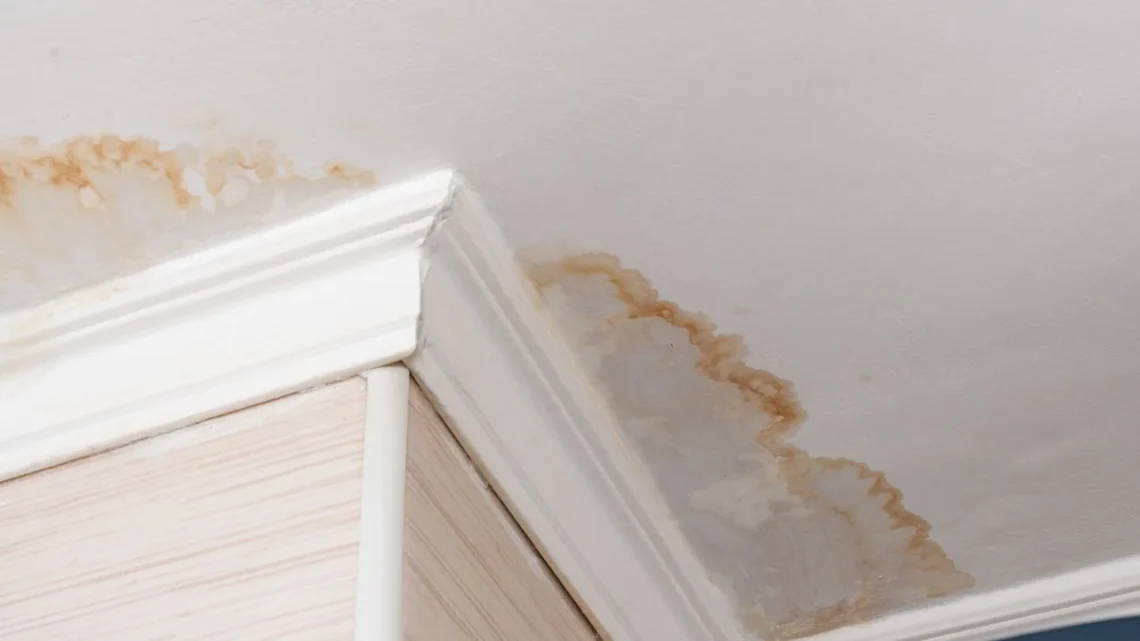
Brown, yellow, or dark stains on walls and ceilings are among the first visible signs of water intrusion. Water rings or streaks suggest past or ongoing moisture issues, and excess moisture causes paint to crack, bubble, or peel away from the surface.
What the textbooks leave out is the difference between an old stain and an active one. An old water stain is dry to the touch, flat, and usually has a clearly defined ring edge where minerals were deposited as the water evaporated.
An active stain is different. Press on it gently, and you may feel slight softness in the drywall beneath. The stain itself may appear fresher or darker toward the centre. The wall around it might feel cool in a way that is inconsistent with the rest of the room.
The location of a stain matters as much as its appearance. A stain on an interior wall near a bathroom almost always points to a slow plumbing leak, either a supply line connection or a failing wax ring under a toilet.
A stain on an exterior wall typically signals either flashing failure at a window or roof, or inadequate vapour management where condensation is forming on the cold side of an under-insulated wall cavity. These two scenarios have completely different repair requirements, and conflating them is one of the most common and costly mistakes homeowners make.
When certain sections of walls, ceilings, or floors feel soft, spongy, or appear swollen, it signals prolonged water exposure.
This occurs as water saturates the materials and progressively breaks down their structural integrity. At that point, the drywall is no longer just cosmetically damaged. It is a sign that moisture has been present long enough to threaten what is behind it.
The Smell That Tells You Everything
Smell is underrated as a diagnostic tool. Musty or earthy odours often indicate mould or mildew growing behind walls. Rotten odours suggest prolonged moisture exposure that has begun to decay the structural materials themselves.
Mold growth requires three things: moisture, warmth, and an organic food source. Drywall and wood framing provide the food source. A house provides warmth.
All water damage provides the moisture. When those three conditions align, mold establishes itself within 24 to 48 hours of sustained wetness. The smell typically appears before the visible growth does, which makes it an early warning that visible inspection alone would miss.
The most revealing smell scenario is one that most homeowners report almost identically: the musty odor that only appears when the HVAC system runs.
This happens because air handlers pull air from return registers, and if those registers are near a moisture source inside a wall, the system circulates that musty air through the entire house. If your home smells fine with the AC off and worse when it runs, you have a hidden moisture problem somewhere in or near your duct path.
Floors: Where Water Damage Reveals Itself Most Honestly
Floors are often the most honest reporters of water damage in a building because water is heavy and gravity always wins. Regardless of where a leak originates, water migrates downward. This means that floor damage can be the symptom of a problem that is actually located several feet above or to the side of the visible distress.
Waterlogged floors, particularly near bathrooms or kitchens, can become soft or spongy underfoot. Wood floors present their own specific vocabulary. Cupping, where the edges of planks rise higher than the center, indicates that the underside of the flooring is absorbing more moisture than the top surface.
Crowning is the reverse, the center rises higher than the edges, and typically occurs when a floor that was previously cupped dries too quickly from the top down while the subfloor remains damp. Both conditions point to sustained moisture exposure.
Tile floors are deceptive. Tile itself does not absorb water, but the grout lines do. More importantly, the thin-set mortar and cement board beneath the tile are extremely sensitive to moisture.
When a tile floor in a bathroom feels slightly bouncy or hollow in certain spots, the substrate beneath it has likely been compromised. Tap the tile surface with your knuckle across a wide area.
A solid, dense sound indicates good adhesion. A hollow, drum-like sound indicates delamination, meaning the tile has separated from its bed, almost always due to water infiltration.
The Foundation and Basement: Where Structural Damage Starts
This is the area that separates minor remediation from major reconstruction, and it deserves more attention than it gets in general homeowner guides.
Reading Crack Patterns Correctly
Not all cracks in a foundation or basement wall mean the same thing. The type of crack, its orientation, and whether it is growing are the three data points that matter.
Horizontal cracks in block or poured concrete walls are among the most serious findings in any basement inspection. They indicate lateral soil pressure and can signal structural compromise that requires prompt professional attention.
Stair-step cracks in concrete block walls typically indicate differential settlement, where one section of the foundation is moving at a different rate than another. Vertical cracks, often the result of concrete curing or minor settlement, are generally less structurally urgent than horizontal ones but still require evaluation to prevent water infiltration.
The practical way to monitor whether a crack is actively growing is to mark its endpoints with a pencil and date them. Check back in 30 and 90 days. If the crack has extended beyond your marks, you are dealing with ongoing movement, not historic settlement, and a structural engineer needs to assess it before you do anything else.
Efflorescence: The White Powder Nobody Takes Seriously Enough
White, chalky mineral deposits that appear on concrete and block surfaces are a direct indicator of water moving through the wall.
This phenomenon, called efflorescence, is formed when water carries dissolved salts through masonry and deposits them on the surface as it evaporates. The stain itself is harmless. What it represents is not.
Efflorescence tells you that water has been moving through your foundation wall consistently enough to carry minerals to the surface. That means there is hydrostatic pressure on the exterior of that wall, and if that pressure ever exceeds the wall’s design capacity, you will get cracking, bowing, and eventually structural failure.
Wall Bowing and Inward Lean
A wall that is visibly out of plumb, particularly at the center, indicates ongoing soil pressure and demands immediate professional assessment.
When soil around a foundation becomes saturated with water, it exerts what engineers call hydrostatic pressure against the home’s walls. This constant pressure can cause cracking, bowing, and even shifting of the foundation itself.
In block foundations, even a quarter-inch of inward bow is worth measuring and monitoring. By the time a wall has bowed an inch or more, you are likely looking at steel reinforcement and carbon fiber strapping as the minimum repair, costs that climb quickly into the tens of thousands.
The Attic: The Leak Source Most Homeowners Never Check
The attic is the origin point of a significant percentage of wall and ceiling water stains, and most homeowners visit it perhaps once a decade. This is a mistake.
Areas around chimneys, vents, skylights, and flashing are common entry points for water. Inspectors specifically look for water stains on beams or roof sheathing, wet or sagging insulation, and areas of rotting wood.
What you are looking for in an attic inspection is not always dramatic. It is often a gray or dark discoloration on the underside of the roof sheathing, the plywood or OSB panels to which your shingles are fastened.
That discoloration is mold. Mold on roof sheathing almost always means one of two things: either a roof penetration is leaking, or the attic is not adequately ventilated, and condensation is forming on the cold sheathing surface during winter months.
The distinction matters because the solutions are completely different. A roof leak requires identifying and repairing the penetration.
A condensation problem requires improving attic ventilation, adding or repositioning soffit and ridge vents, and sometimes adding insulation to the attic floor to keep the living space’s warm air from rising into the attic and condensing.
Feel the insulation batts if you can do so safely. Wet or matted insulation has lost most of its thermal value and, more critically, is holding moisture against the framing members above and below it. This is how attic roof damage quietly begins to work its way into the structural ceiling joists.
Doors, Windows, and Floors That No Longer Make Sense
When foundations move, the building frame distorts. This distortion often manifests first at doors and windows, which require precise alignment to operate properly.
A door that suddenly starts dragging on its frame, or a window that has become difficult to open or lock properly, is not simply a seasonal quirk if it develops in a part of the house where it has never occurred before.
These are among the most reliable early signs of foundation movement, and foundation movement is almost always driven by water, either erosion around the footing, expansive soil activity, or hydrostatic pressure on a basement wall.
Sticking windows or sloping floors can be subtle signs of foundation settlement, particularly when they occur in combination. If you notice a door sticking in the same season that you notice a slight slope in a nearby floor, treat those two observations as a single data point, not two separate minor inconveniences.
The Tools That Make You Better at This Than Your Naked Eye
A homeowner does not need a forensic toolkit to catch early water damage, but a few inexpensive items dramatically improve detection capability.
A moisture meter is the single most valuable tool for this task. Pin-type meters are inexpensive, widely available, and will tell you immediately whether a wall, floor, or ceiling material contains elevated moisture.
Normal wood moisture content in a climate-controlled home should be between 6 and 10 percent. Readings above 16 percent indicate a problem. Readings above 20 percent indicate active moisture intrusion and potential mold risk.
A flashlight with a side-lighting or raking angle reveals surface irregularities that overhead or frontal lighting obscures. Run the beam along a wall surface at a low angle and surface waves, bubbling, and depressions become dramatically more visible.
Professionals use thermal imaging and moisture meters to identify water migration paths, a technique called moisture mapping. Thermal imaging cameras have become affordable enough that serious homeowners now purchase or rent them.
They detect temperature differentials on surface materials, and because wet materials hold temperature differently than dry ones, they can reveal moisture behind walls and under floors that no visible sign has yet announced.
When to Stop DIY-ing and Call a Professional
Reconstruction becomes necessary when the building’s strength, not just its appearance, has been affected.
Understanding that threshold matters enormously, because the instinct to patch and paint over water staining rather than investigate its cause is exactly how minor remediation turns into structural reconstruction.
Load-bearing walls, beams, or columns that support the weight of a home are critical structural components, and any damage to these elements requires the expertise of a structural engineer to assess the extent of the damage and recommend corrective measures. Foundation cracking, tilting, or any movement is a red flag that signifies potential structural compromise.
The specific situations that require immediate professional involvement are:
Any horizontal crack in a basement wall, particularly in block construction. This is not a monitor-and-wait situation.
A wall or ceiling that feels soft to the push of your hand, especially in areas adjacent to plumbing or below a bathroom. The drywall may need to come out to assess framing damage.
Any floor deflection, meaning a floor that bounces or feels springy when walked on, in areas that were previously solid. This suggests subfloor saturation or joist damage.
Persistent musty smell that does not resolve after airing the space out. Hidden mold colonies behind walls require professional remediation, not household cleaning products.
Doors that stick or windows that will not close properly in combination with any of the above. The combination of symptoms is the signal, not any single one in isolation.
The Real Cost of Waiting
Water damage restoration costs an average of $3,864, and can range from $450 on the low end to $16,000 or higher depending on the source and extent of the damage. Class 4 water damage, which occurs when water has penetrated the structural materials of the home, can cost between $20,000 and $100,000 to repair.
Between 2019 and 2023, water damage and freezing accounted for 22.6% of all home insurance claims, with an average claim amount of $15,400.
Critically, damage caused by prolonged neglect disqualifies a homeowner from insurance claims entirely. The policy pays for sudden and accidental damage. It does not pay for the consequences of ignoring a leak for three years.
The math is not complicated. A moisture meter costs $30. A professional inspection costs a few hundred dollars.
Catching a slow plumbing leak before it saturates a floor joist system costs whatever the plumber charges. Waiting until the floor feels spongy and the subfloor needs replacing, framing dried and inspected, flooring reinstalled, and mold remediation completed, that is a project that routinely exceeds $15,000.
A Practical Inspection Routine That Actually Works
Walk your home systematically twice a year, once in spring after winter freeze-thaw cycles and once in early fall before heating season begins. Neither visit needs to take more than 45 minutes.
Start in the basement or crawl space. Check for damp spots, rust around pipe joints, and any discoloration or warping in walls and ceilings. A flashlight and a sharp nose for musty smells are the only tools you need at this stage.
Look at the foundation walls from the inside, scanning for efflorescence, cracks, and any sign of bowing. Press your palm flat against the wall in multiple places. It should feel dry and room temperature. A cool, slightly damp sensation means moisture is migrating through.
Move upward through the house. Check under bathroom and kitchen sinks. Scan the ceilings below bathrooms on the floor above. Open the cabinet beneath the kitchen sink and look at the back of the cabinet floor, where slow drain line leaks collect unnoticed for months.
Finish in the attic. Bring the flashlight. Look at the underside of the roof sheathing, especially near any penetrations. Look at the top of the exterior walls where they meet the rafters. This junction, called the eave, is a common entry point for wind-driven rain and a common site for ice dam water damage in cold climates.
Document what you find with photos, dated and stored somewhere you will not lose them. If you are selling a home or buying one, this documentation record is both due diligence and legal protection.
The Final Word
Water damage is not a dramatic event in most cases. It is a patient, invisible process that works on timescales of months and years, quietly compromising materials that were designed to last decades.
The structural problems it eventually produces, rotted floor joists, bowed foundation walls, failed roof sheathing, deteriorated load-bearing connections, are expensive, disruptive, and almost entirely preventable with consistent attention.
The houses that develop structural water damage problems are rarely houses where a catastrophe happened.
They are usually houses where a succession of small signals was dismissed as seasonal, cosmetic, or minor. A stain that was painted over. A musty smell that was assumed to be the basement. A sticky door that was planed down and forgotten.
Learn to read what your house is telling you. It speaks quietly, but it never stops speaking.
What People Ask