How to Teach Yourself Basic Accounting Without Going Back to School
You do not need a classroom, a tuition bill, or four years of your life to understand how money moves through a business. Here is how to build real accounting skills from scratch, on your own terms.
The first time someone asked me to explain why their business was profitable on paper but perpetually broke in real life, I realized how desperately most people need a working understanding of accounting, and how few ever get it.
Not because the knowledge is unavailable. It is everywhere. But because most people assume it belongs exclusively to those who sat through four years of lectures in a business school classroom.
Trending Now!!:
That assumption has cost a staggering number of small business owners, freelancers, and career changers both money and peace of mind.
You do not need a degree to understand how money moves through a business. You need curiosity, a structured approach, the right resources, and the patience to sit with confusion long enough for it to resolve.
I have spent over a decade helping people, from restaurant owners to tech founders to side-hustle entrepreneurs, build financial literacy from scratch. What follows is the most honest and practical guide I can offer for doing exactly that.
Why Accounting Feels Harder Than It Actually Is
The word “accounting” carries a kind of gravity that makes people flinch. It sounds technical. Permanent. Like a profession wrapped in regulatory language and government compliance.




And while professional accounting certainly can be all of those things, the foundational layer, what most people actually need to know, is not particularly complicated. It is just rarely taught in plain language.
The problem is that most introductory resources either oversimplify to the point of uselessness or assume too much prior knowledge.
The textbook approach drops you into debits, credits, and journal entries without first explaining why they exist. That gap in context is where most self-learners give up.
The fix is simple: start with the why before the how.
Start With the Three Financial Statements
Before you open any accounting software or enrol in any course, you need to understand what accounting is actually trying to produce. Everything, every debit, every credit, every journal entry, is working toward generating three documents that tell the financial story of a business.
The Income Statement
The income statement illustrates the profitability of a company under accrual accounting rules. In plain terms, it answers one question: did the business make or lose money during a specific period? It lists revenue at the top, subtracts all the expenses incurred to generate that revenue, and arrives at a net profit or net loss at the bottom. This is the document most new business owners obsess over, sometimes to a fault.
The Balance Sheet
The balance sheet is the financial statement that reports a company’s assets, liabilities, and shareholders’ equity, all at a specific time.
Think of it as a photograph taken at a specific date, not a video. It captures what the business owns (assets), what it owes (liabilities), and what is left over for the owner (equity). The relationship between these three items is expressed as the fundamental accounting equation: Assets = Liabilities + Owner’s Equity.
This equation never breaks. Ever. If it does in your books, something has been recorded incorrectly, and finding the error is the entire purpose of the balancing process.
The Cash Flow Statement
The cash flow statement combines all the cash inflows a company receives from its operations and external investments. It also includes the cash outflows that pay for the company’s operations and investments during the period.
This is the statement that solves the mystery I mentioned at the opening. A business can show strong profit on the income statement and still be unable to pay its bills if cash is tied up in unpaid invoices or sitting in inventory. The cash flow statement exposes that gap.
Spend time with these three documents before anything else. Pull the annual report of any publicly traded company you find interesting and simply read through the financial statements. You do not need to understand every line immediately. The exposure alone builds pattern recognition that accelerates everything that follows.
Understand Double-Entry Bookkeeping Before You Touch Software
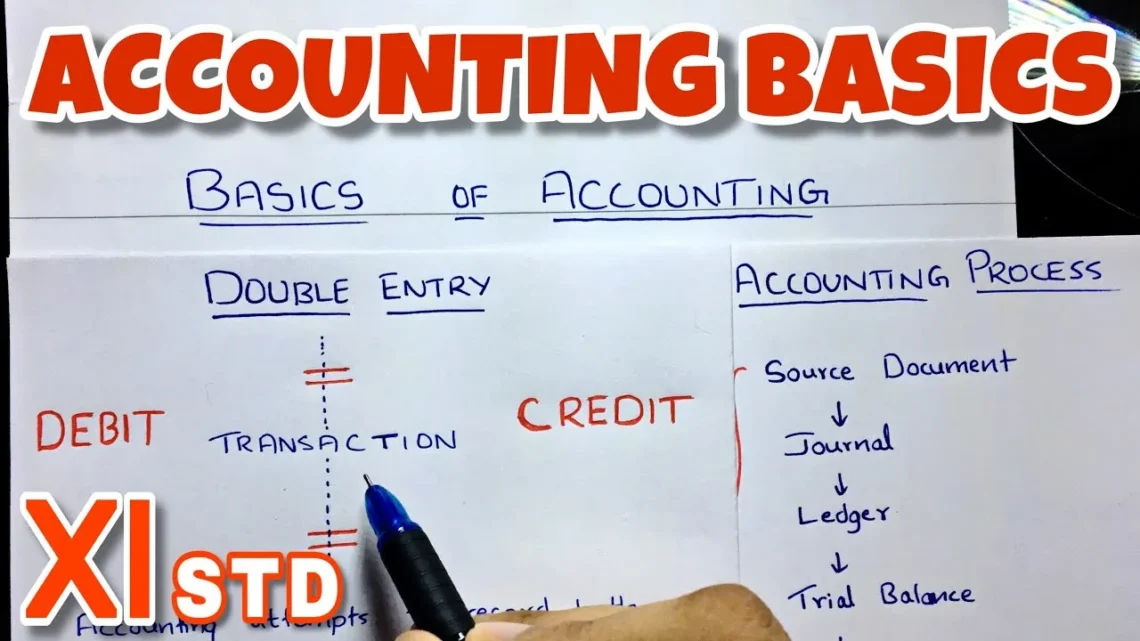
Every financial transaction in a properly maintained set of books gets recorded in two places simultaneously. This is the double-entry system, and it is the spine of all modern accounting.
The double-entry method is a system in financial accounting for bookkeeping where every entry is marked twice. Each entry has opposing accounts into which it is being marked. The visual representation is called a T-account, named for the shape it creates, with debits listed on the left and credits on the right.
Here is where most self-learners get confused, because the words “debit” and “credit” do not mean what everyday banking language has trained them to mean.
A credit to your bank account from a customer payment is great news in real life. In accounting, that same transaction is recorded as a debit to your cash account (asset goes up) and a credit to your revenue account. It sounds backward. It is not, once you internalize the rules.
An increase in an asset is recorded as a debit, which corresponds to an increase on the left side of the equation. Conversely, an increase in liabilities or owner’s equity is recorded as a credit.
A practical example: you purchase $500 worth of office supplies with cash. The office supplies account (an asset) increases, so you debit it. The cash account (also an asset) decreases, so you credit it. Both sides of the entry equal $500. The books remain balanced.
Practice this with simple, real-life transactions: your rent, a client payment, a utility bill. Do not rush toward software. Understanding the mechanics manually means you will never be at the mercy of an auto-categorization error that takes hours to trace.
The Cash vs. Accrual Decision You Cannot Ignore
One of the earliest and most consequential choices anyone setting up their own books faces is whether to use cash basis or accrual basis accounting. Most self-taught learners pick one without fully understanding the implications.
Cash accounting recognizes revenue and expenses only when money changes hands, but accrual accounting recognizes revenue when it’s earned, and expenses when they’re billed but not paid.
The primary difference between cash basis accounting and accrual accounting is the timing of when you recognize income and expenses.
For a freelancer who invoices and gets paid within a few days, cash basis is perfectly logical. For a product-based business that ships inventory in December but collects payment in January, cash basis distorts the picture significantly. You might show a terrible December and a fantastic January when the economic reality spans both months.
Your books could show a large amount of revenue when your bank account is completely empty. That is the accrual trap that catches small business owners who adopt it without understanding its implications for cash management.
The general guidance for self-learners is this: start with cash basis. It is simpler, more intuitive, and mirrors how most people already think about money. As your business grows and you bring in more revenue, particularly if you extend credit to clients or carry inventory, the transition to accrual becomes a natural next step.
Build Your Foundation With These Free and Low-Cost Resources
Khan Academy and Coursera
Khan Academy’s motto is “For free. Forever. For everyone,” and it delivers, with an enormous library of videos, articles, and exercises to help you learn and practice accounting skills. The accounting and finance section covers everything from basic financial statements to more advanced concepts, all at no cost.
Coursera hosts Wharton School’s Introduction to Financial Accounting course, which has helped hundreds of thousands of people build genuine accounting competency.
Auditing the class is free, and you can access all the course materials, including exam questions and solutions, so you can test yourself on the material. If you want a certificate, you pay a fee, but for the knowledge itself, the free audit is more than sufficient.
AccountingCoach
This resource deserves a dedicated mention. It offers deep, narrative-driven explanations of accounting concepts with worked examples built around real business scenarios.
The explanations use progressive sample transactions to illustrate how business events are recorded using debits and credits, demonstrating the practical application of accounting concepts in a small business context. It is one of the best free resources for understanding the why behind accounting entries.
Intuit’s Free Bookkeeping Certification
The Intuit Bookkeeping Certification is a great starting point if you’re new to bookkeeping and want a program that’s free, flexible, and career-focused.
The program is broken into five modules plus a final exam, covering topics like financial statements and journal entries. Once you complete and pass it, you earn an official Intuit Bookkeeping badge that carries real weight on a resume or freelance profile.
YouTube
Do not underestimate how much accounting instruction lives on YouTube, completely free. Channels dedicated to bookkeeping and small business finance cover everything from bank reconciliations to payroll basics. The advantage of video is that you can pause, rewind, and watch a specific concept as many times as it takes.
Learning QuickBooks Online: The Practical Bridge
Conceptual accounting knowledge becomes genuinely useful when it is paired with the ability to operate software that the professional world actually uses.
QuickBooks Online is the most widely used small business accounting software in the world, and knowing how to use it is a job-ready skill that commands real market value, from bookkeeping freelancers charging $50 to $100 per hour to accounting professionals who streamline client workflows.
Intuit’s ProAdvisor certification is the most credible free QuickBooks credential available. It is recognized by small businesses and accounting firms, and it gets you listed in Intuit’s ProAdvisor directory, which is a real source of client leads for freelance bookkeepers.
The ideal sequence is: learn the theory first, then apply it inside the software. Many self-taught learners skip directly to clicking around in QuickBooks without understanding what the entries mean.
They can enter data, but they cannot interpret it, which means they cannot catch errors, and in accounting, errors compound in ways that are expensive to untangle later.
A good intermediate milestone is being able to look at a QuickBooks report and understand what every line is telling you without needing someone else to translate it.
The Mistakes Self-Taught Learners Make Most Often
Mixing Personal and Business Finances
This is the single most common and destructive mistake. The moment you start a business, open a separate bank account and a separate credit card. Full stop.
When personal and business transactions share the same account, your books become nearly impossible to reconcile cleanly, your tax deductions become difficult to defend, and your profitability picture is permanently blurred.
Ignoring Bank Reconciliation
There are five main types of accounts, and total debits and credits must always equal the same. This is where we get the term “balancing your books.” Bank reconciliation is the process of confirming that what your accounting software shows matches your actual bank statements, down to the last transaction.
Many self-taught bookkeepers skip this step because it feels tedious. The problem is that unreconciled books quietly accumulate errors that eventually surface as large, confusing discrepancies right before tax season.
Building a Chart of Accounts That Is Too Complicated
A common mistake is creating too many highly specific categories when a single broader category would work better.
On the flip side, lumping everything into “Miscellaneous” makes it impossible to analyze spending or prepare accurate tax returns. For most small businesses, 30 to 50 accounts is plenty. Start with your software’s default chart of accounts and modify from there only as genuine need arises.
Confusing Profit With Cash
This mistake is conceptual rather than mechanical, and it is far more dangerous. A business can be profitable on the income statement and simultaneously insolvent if it cannot collect on its receivables or has overextended its credit terms.
Learning to read the cash flow statement alongside the income statement is what separates financially literate business owners from those who are always surprised by their bank balance.
Waiting Until Tax Season to Open the Books
Accounting done once a year is not accounting. It is archaeology. The most effective self-taught bookkeepers set aside a regular block of time, weekly or at minimum monthly, to update their records.
The longer you wait, the harder it becomes to remember what a transaction was for, the more likely something is miscategorized, and the more painful the reconciliation process becomes.
How to Structure Your Self-Study Plan
H3: Weeks One and Two: Financial Statement Literacy
Read through the income statement, balance sheet, and cash flow statement of two or three real companies.
Pull anything from the investor relations page of a publicly traded business you recognize. Study the structure. Understand what each section is measuring. Do not move forward until the relationship between the three statements feels logical.
H3: Weeks Three and Four: The Mechanics of Double-Entry
Work through the double-entry accounting section on AccountingCoach or the Khan Academy finance series.
Complete every exercise available. Record at least 20 to 30 transactions manually on paper using T-accounts before touching any software. The friction of doing it by hand builds understanding that clicking through a software interface cannot replicate.
H3: Month Two: Software Familiarization
Sign up for a QuickBooks Online trial. Enter a month’s worth of hypothetical or real transactions. Reconcile against a bank statement.
Run the three main reports and ensure they reflect the transactions you entered accurately. Pay attention to where the software puts things automatically and question anything that surprises you.
H3: Month Three: Certification and Application
Complete the Intuit Bookkeeping Certification. If you are a small business owner, begin applying what you have learned to your own books.
If you are building toward a freelance bookkeeping career or a finance-adjacent role, pursue the QuickBooks ProAdvisor certification, which is a legitimate, recognized credential that requires zero tuition.
When Self-Teaching Has Its Limits
There are situations where the honest advice is: bring in a professional. If your business carries inventory, employs multiple people, or operates across state lines with varying tax obligations, the complexity of your books can escalate beyond what a self-taught foundation can safely manage alone.
Similarly, if you are behind on tax filings or have years of unreconciled books, a professional accountant or bookkeeper cleaning up the historical records first is worth every cent.
The goal of learning accounting yourself is not to replace professional expertise. It is to be informed enough to understand what your numbers are telling you, to catch errors before they become crises, and to communicate meaningfully with the professionals you eventually hire.
Business owners who understand basic accounting ask better questions, make better decisions, and are significantly harder to mislead.
Accounting remains one of the most stable and financially rewarding career paths for people without degrees because every business needs someone to track money and keep financial records accurate.
That need exists at every scale, from a one-person consulting practice to a mid-size enterprise. Understanding the fundamentals places you on the right side of that divide, whether you are running your own operation or building a career in finance.
The Mindset That Actually Gets You There
The people who succeed at teaching themselves accounting are not the ones with the strongest math backgrounds. They are the ones who stay consistent. Accounting concepts build on each other in a very direct, linear way.
Missing a foundational idea and jumping ahead creates gaps that surface later as confusion, usually at the worst possible moment, like when you are trying to close your books before a funding conversation or a tax deadline.
Make learning part of your routine. Completing coursework on a regular cadence will allow you to make steady progress toward your educational goal. Even if you only have 45 minutes free, you can log in from anywhere, make some progress through a module, and then get back to your daily tasks feeling like you’ve made some headway.
The goal in the first few months is not mastery. It is fluency. You want the language of accounting, revenue, expenses, assets, liabilities, reconciliation, to stop feeling foreign and start feeling like the natural vocabulary of financial thinking. Once that shift happens, everything else accelerates.
You start reading your reports differently. You catch things you used to miss. You stop dreading tax season because your records are already in order.
That is the real payoff of learning accounting without going back to school. Not the credential, though the credentials you pick up along the way are genuinely useful. The payoff is the clarity. The ability to look at a set of numbers and understand, with confidence, exactly what they mean.
What People Ask