Osteoporosis: Prevent It Before It Starts
Bone loss stays silent until something breaks. Peak bone mass, heavy lifting, smart calcium use and well-timed scans decide whether anything ever does.
Bone loss makes no noise. No pain announces it and no symptom tracks it, so for most people the first evidence is a wrist, hip or vertebra that breaks in a fall from standing height or lower. By then, years of preventable erosion are already banked.
Preventing osteoporosis comes down to two jobs: building the densest skeleton possible by about age 30, then slowing the loss that follows with heavy, impact-loaded exercise, adequate calcium and protein, no smoking, limited alcohol, a review of bone-harming medications, and a bone density scan at 65 or sooner when risk factors exist.
Trending Now!!:
The Silent Disease That Announces Itself With a Break
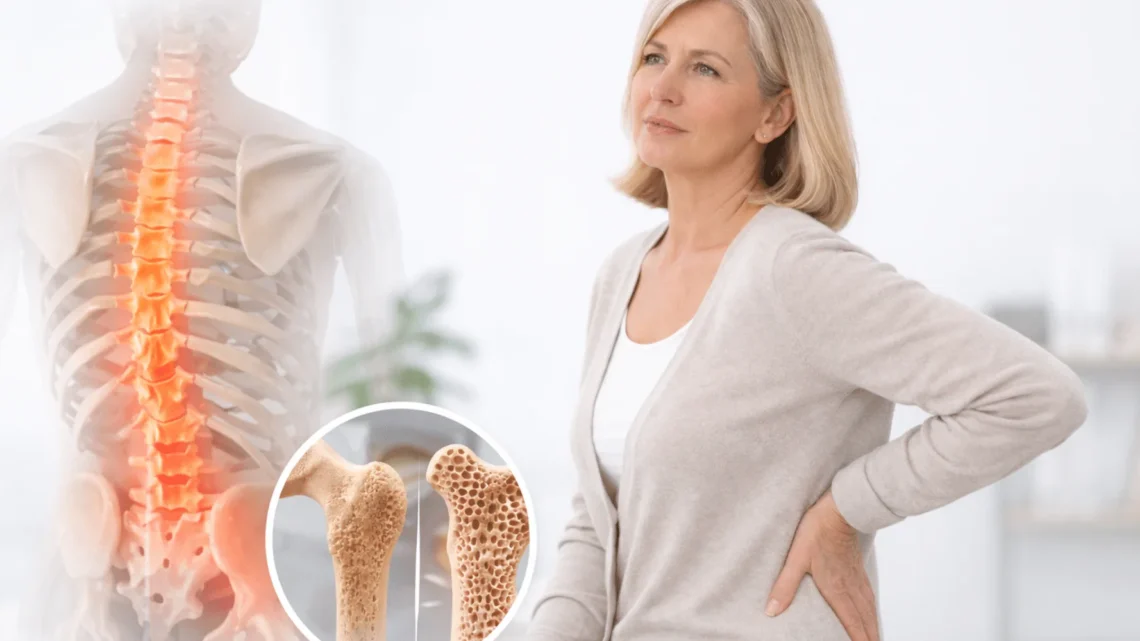
Osteoporosis is a condition in which bone has lost enough mass and internal structure to fracture under loads that healthy bone absorbs easily.
Diagnosis rests on a bone density scan. A score at the hip or lumbar spine that sits 2.5 standard deviations or more below the average for a healthy young adult, a T-score of minus 2.5 or lower, meets the World Health Organization threshold.
The scale is larger than most people assume. The Centers for Disease Control and Prevention puts osteoporosis at 12.6 percent of US adults aged 50 and older: 19.6 percent of women and 4.4 percent of men. Low bone mass, the earlier stage that raises the odds of developing osteoporosis, affects 43.1 percent, roughly 47.6 million people.




Among women 65 and older, the osteoporosis rate climbs to 27.1 percent, against 5.7 percent for men. The Bone Health and Osteoporosis Foundation estimates that one in two women and up to one in four men will break a bone because of the disease.
The break matters more than the diagnosis. Only 40 to 60 percent of people who fracture a hip recover their previous mobility and ability to manage daily activities, and recent studies put one-year mortality after hip fracture between 17 and 25 percent. Prevention costs little by comparison, and unlike many health risks, a good share of it sits within a person’s control.
Peak Bone Mass: The Account Opened in Childhood
Bone is living tissue, rebuilt continuously. In childhood and adolescence, deposits far exceed withdrawals. The National Institutes of Health notes that up to 90 percent of peak bone mass is in place by about age 18 in girls and 20 in boys. The final plateau arrives somewhere between the mid-twenties and age 30, depending on the skeletal site.
Genes set the ceiling, but lifestyle choices influence an estimated 20 to 40 percent of adult peak bone mass. The stakes of that range are large: modelling estimates widely cited in the field suggest that a 10 percent higher peak bone mass could cut fracture risk in older age by as much as half.
For parents, this translates into unglamorous habits. Dairy or fortified alternatives at meals, plenty of running, jumping and ball sports, and no restrictive dieting during growth all feed the account. One warning sign deserves a medical visit: missed periods in a girl or young woman who is underweight or training heavily usually mean estrogen is too low to support bone growth.
The early window is not the only window. A person in their forties cannot rebuild adolescence, yet the other half of the equation, how fast bone is lost, stays open for decades.
Menopause and the Fastest Loss
Women face a loss curve that men do not. In a long-running US study that followed women across the menopause transition, bone density fell fastest from about a year before the final period to about two years after, averaging roughly 2.5 percent a year at the lumbar spine and 1.8 percent at the femoral neck. After that window, the pace eased to about 1.1 percent a year.
Body weight shaped the damage. Women in the lowest third by weight lost bone 35 to 55 percent faster than women in the highest third. Thin women arrive at menopause with less in reserve and spend it faster.
The practical consequence is one of timing. Prevention that begins with a first scan at 65 arrives after the steepest descent is over. Perimenopause is the moment for strength training and a calcium check.
In a recent analysis, women not using hormone therapy lost bone faster during the first five years after menopause. Still, hormone therapy carries its own risks and benefits, which makes it a decision for an individual conversation with a clinician rather than a bone-only calculation.
Men lose bone more gradually, and their risk rises most after age 70. Rarer does not mean absent: 4.4 percent of men over 50 already meet the criteria for osteoporosis.
Calcium and Vitamin D: Where the Evidence Stops
Intake targets are well established. Adults 19 to 50 need 1,000 mg of calcium daily. The figure rises to 1,200 mg for women past 50 and men past 70, while men 51 to 70 stay at 1,000 mg.
Vitamin D targets are 600 IU through age 70 and 800 IU after. Ceilings exist too: 2,000 mg of calcium and 4,000 IU of vitamin D daily, beyond which kidney stones and other problems become a concern.
Those numbers do not establish that pills are the answer. The gut absorbs only 15 to 20 percent of the calcium in food, and vitamin D helps that process along. The US Preventive Services Task Force recommends against low-dose supplementation, 400 IU or less of vitamin D3 and 1,000 mg or less of calcium, to prevent fractures in postmenopausal women, and calls the evidence on higher doses insufficient.
The largest test of vitamin D alone, the VITAL trial, followed 25,871 generally healthy adults for about five years. A dose of 2,000 IU daily produced no reduction in total or hip fractures. Meryl LeBoff, the Harvard Medical School professor who led the fracture analysis, concluded that the results do not support vitamin D supplements for fracture prevention in generally healthy men and women.
Two caveats keep this from becoming a license to ignore vitamin D. Participants were mostly replete, with only 2.4 percent below the threshold for severe deficiency, so the trial says nothing about people who are genuinely deficient. Deficiency is a medical finding, corrected under clinician guidance. Separately, very large, infrequent doses should be avoided because they have been linked to more falls and fractures.
A rule that holds up in practice: count food first, then supplement only the shortfall. A cup of milk or yogurt supplies roughly 300 mg of calcium, and fortified plant milks vary by label. Consider a hypothetical 55-year-old woman who eats a yogurt, drinks a milky coffee and follows an ordinary mixed diet, landing near 850 mg a day.
Her gap against the 1,200 mg target is about 350 mg, which one modest tablet covers. A 1,200 mg supplement on top of that diet would overshoot the target and add risk without adding bone.
Exercise: Bone Responds to Force, Not Minutes
Bone adapts to the magnitude and the rate of strain placed on it. An hour of gentle walking, valuable for the heart and mood, sends a weaker signal to the skeleton than a few heavy sets or a short series of jumps. Swimming and cycling build fitness while loading the bones very little.
Andrea Singer, clinical director of the Bone Health and Osteoporosis Foundation, outlines a prescription built on weight-bearing impact activity four to seven days a week and resistance training two or more days a week. The bigger the force, the stronger the stimulus to form new bone.
The strongest evidence for heavy loading comes from the LIFTMOR trial. It enrolled 101 postmenopausal women, averaging about 65, with low bone mass. For eight months, half trained twice weekly for 30 minutes under supervision, doing five sets of five repetitions at more than 85 percent of their one-repetition maximum, plus impact work. The comparison group followed a gentle home program.
Lumbar spine density rose 2.9 percent in the lifting group and fell 1.2 percent in the comparison group. At the femoral neck, the lifters gained 0.3 percent while the others lost 1.9 percent. A follow-up analysis found no vertebral fractures, and spinal curvature improved.
The limits matter. Participants were screened and supervised, and the program was built around technique. Someone with diagnosed osteoporosis, a prior spinal fracture or unexplained back pain should not improvise a heavy-lifting plan from a trial summary; a physical therapist or exercise physiologist with bone-health training can adapt it safely.
For healthy adults, a simple rule of thumb separates bone work from general fitness: any activity that can be sustained for an hour while chatting counts as health, not bone. The bone-building minutes are the heavy, brief and jarring ones. A sensible progression looks like this:
- Start with two strength sessions a week covering a squat or sit-to-stand pattern, a hip hinge, a push and a pull, using loads that make the last repetitions difficult.
- Add short impact work, such as brisk stair climbing, heel drops or small hops, once joints tolerate it.
- Increase load gradually over months, and stop any movement that produces sharp or spinal pain.
Habits That Quietly Cost Bone
Smoking is associated with lower bone density and a higher fracture risk. Heavy drinking interferes with bone, and three or more drinks a day is the level at which risk is generally flagged. Low body weight on its own accelerates loss, which is why restrictive eating and some extreme training regimens show up in bone years later.
Deliberate weight loss is the newer concern. Losing roughly 7 to 10 percent of body weight through diet begins to register as bone loss and higher bone turnover, a pattern also seen after bariatric surgery. Weight-loss drugs in the GLP-1 class have sharpened the question.
In a randomized trial of 195 adults with obesity, combining exercise with a GLP-1 drug preserved hip, spine and forearm density despite larger weight loss, while the drug alone reduced hip and spine density compared with placebo or exercise alone.
A pooled review attributed about 30 percent of the weight lost on these drugs to lean mass. Whether this translates into more fractures remains unsettled, and a small 20-week pilot in older adults found no change in density.
The defensible position is neither alarm nor dismissal. Anyone losing weight quickly, particularly after menopause, benefits from resistance training, adequate protein and calcium, and a request that the prescriber include bone health in monitoring.
Medications and Conditions That Change the Math
Glucocorticoids, the steroid tablets prescribed for inflammatory and autoimmune conditions, are the most common cause of drug-induced bone loss.
Professional guidelines advise bone-protective treatment for people starting glucocorticoid therapy expected to last at least three months, and for women taking aromatase inhibitors after breast cancer. Inhaled steroids reach the bloodstream far less, so their risk is lower. After oral steroids stop, fracture risk falls mostly within the first year, though not entirely back to baseline.
Other drug classes carry smaller or less certain effects: proton pump inhibitors, certain antidepressants, some antiepileptic drugs, thiazolidinediones for diabetes, androgen deprivation therapy and long-term heparin. People who take a proton pump inhibitor and need a calcium supplement are usually steered toward calcium citrate, which depends less on stomach acid for absorption.
Never stop one of these medications to protect bone. Each is usually doing necessary work, and the right move is to ask for a fracture risk review while continuing treatment.
Underlying conditions such as hyperthyroidism and cancer can also drive bone loss, and screening guidance for the general population does not cover them, so they call for individual assessment.
Falls: The Other Half of Fracture Prevention
A fracture needs two ingredients: fragile bone and a fall. Older adults fracture far more often than younger adults with the same bone density, because bone quality declines and fall risk rises with age. For that reason, age is a stronger predictor of fracture than the density number itself.
Falls prevention therefore belongs inside any bone plan. Clear walkways, good lighting, balance exercises and a periodic review of medicines that cause dizziness cost little and reduce the second ingredient. Strength training does double duty here, since stronger legs catch a stumble that weak ones turn into a break.
Screening: Who Should Be Scanned and When
The US Preventive Services Task Force recommends bone density screening for all women 65 and older. For postmenopausal women under 65, it suggests a two-step approach: assess for risk factors first, then scan those at increased risk.
The risk factors it names include menopause, low body weight, a parent with a hip fracture, smoking and excess alcohol, and other conditions or medications, including corticosteroids, can add to the list. For men, the Task Force finds the evidence insufficient to judge the balance of benefits and harms, which is not the same as saying men are safe.
The standard test is dual-energy X-ray absorptiometry, or DXA, a low-dose scan that measures density at the hip and spine. Fracture risk calculators such as FRAX combine density with age, history and lifestyle to estimate the probability of a major fracture, and they often change the picture more than the scan alone.
A working decision rule: any one of four triggers justifies asking for a risk assessment before 65. They are a fracture from a fall at standing height or lower, a parent who broke a hip, three months or more of oral steroids, and menopause combined with low body weight, smoking or heavy drinking.
Reading a Borderline Result
A T-score between minus 1.0 and minus 2.5 falls in the low bone mass range, often called osteopenia. It is a risk marker, not a disease, and its meaning depends heavily on age.
A score of minus 2.0 at 52 describes a different future from the same score at 72, which is why a fracture risk estimate matters more than the label.
Ask for the actual T-score and the ten-year fracture probability, and keep both. The first scan is most valuable as a baseline: later scans, ideally on the same equipment, show the rate of loss, and a rate faster than expected for age is often the earliest signal that a plan needs to change.
What People Ask