Ozempic, Wegovy, and Mounjaro: An Honest Side-by-Side Breakdown
Two molecules, four brand names, and one head-to-head trial: how semaglutide and tirzepatide compare on weight loss, safety, cost, and what happens when treatment stops.
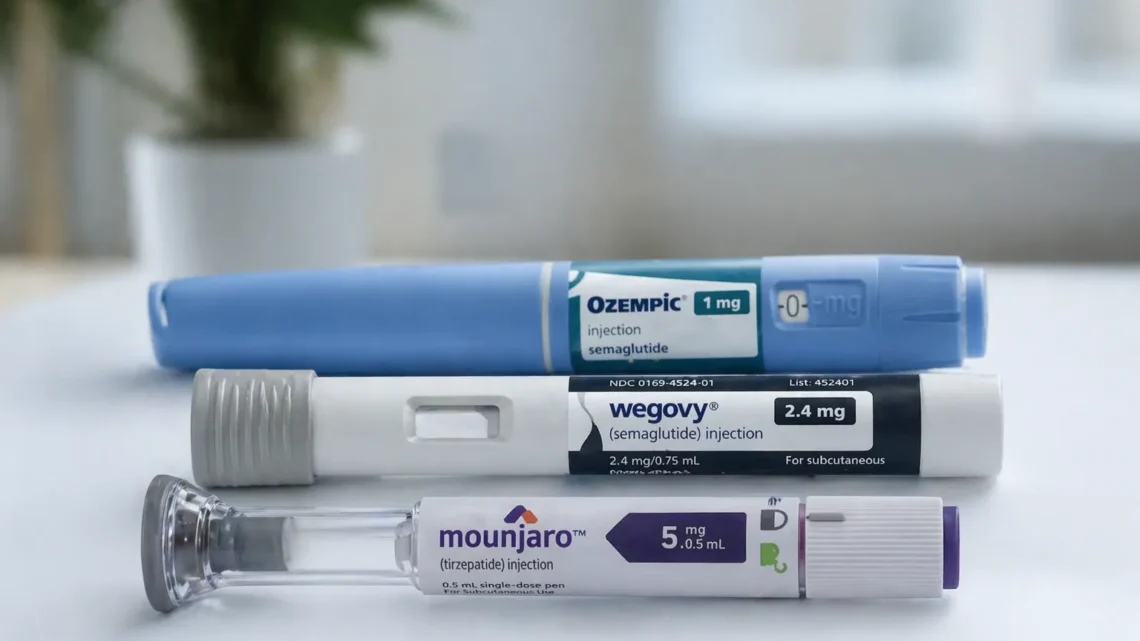
Ozempic and Wegovy contain the same drug, semaglutide, while Mounjaro contains tirzepatide, which combines GLP-1 and GIP activity.
In head-to-head testing, tirzepatide produced about 20.2% average weight loss against 13.7% for semaglutide at 72 weeks. Ozempic and Mounjaro are labeled for type 2 diabetes; Wegovy and Zepbound, the matching weight-loss brands, are labeled for obesity.
Trending Now!!:
Most comparison articles stop there, which leaves the reader with a leaderboard and little else. The more useful question is which drug fits a particular diagnosis, budget, and tolerance for side effects, and what happens after the first prescription runs out.
Price, coverage, new pills, higher doses, and a steady flow of regulatory action have changed the answer in the past year, so the details matter.
Two Molecules, Four Brand Names
The confusion begins with branding. Novo Nordisk sells semaglutide as Ozempic for type 2 diabetes, with added labelling around cardiovascular and kidney protection, and as Wegovy for chronic weight management.
Eli Lilly sells tirzepatide as Mounjaro for type 2 diabetes and as Zepbound for obesity and obstructive sleep apnea. The molecule inside each pair is identical; the label, the maximum dose, and the price differ.




Those differences have practical consequences. Ozempic tops out at a lower dose than Wegovy, and insurers generally cover Ozempic only against a diabetes diagnosis.
A patient who requests Ozempic for weight loss alone is likely to meet a prior authorization denial, which is the point at which many people discover that Wegovy or Zepbound was the on-label product all along. The same logic applies to Mounjaro and Zepbound.
The mechanisms differ in a way that explains the efficacy gap. Semaglutide mimics GLP-1, a gut hormone that slows gastric emptying and dampens appetite. Tirzepatide adds GIP receptor activity, and researchers believe the combination acts on appetite and metabolism through complementary pathways.
What the Head-to-Head Evidence Shows
Only one randomized head-to-head trial in obesity exists. SURMOUNT-5 enrolled 751 adults with obesity or overweight and no diabetes, randomizing them to the maximum tolerated dose of tirzepatide (10 or 15 mg) or semaglutide (1.7 or 2.4 mg) for 72 weeks.
Tirzepatide delivered a 20.2% average reduction in body weight against 13.7%, roughly 22.8 kg versus 15.0 kg. Reaching a 25% loss was achieved by 31.6% of the tirzepatide group and 16.1% of the semaglutide group.
Lead investigator Louis Aronne summarized the result plainly: “tirzepatide led to greater weight reduction compared to semaglutide.” The trial also found that discontinuation happened more often on semaglutide, while injection-site reactions were more common on tirzepatide.
Two caveats deserve attention. The trial was open-label, so participants and clinicians knew which drug was in use. More importantly, the semaglutide arm used the 2.4 mg ceiling that defined Wegovy until a 7.2 mg version was approved in March.
In the STEP UP program, that higher dose produced 20.7% average loss at 72 weeks, with roughly a third of participants losing 25% or more. Cross-trial comparisons are unreliable because the populations and protocols differ, but the gap between the two molecules is probably narrower at the highest semaglutide dose than the SURMOUNT-5 headline implies.
The higher dose carries its own trade-offs. Altered skin sensations, such as tingling or sensitivity, were reported by about 22% of participants on 7.2 mg compared with 6% on 2.4 mg. Gastrointestinal complaints also rose with dose.
For diabetes specifically, tirzepatide also outperformed semaglutide 1 mg on blood sugar and weight in the SURPASS-2 trial, which is why Mounjaro is often the stronger choice when both glucose control and weight reduction are priorities.
Where Semaglutide Still Holds Ground
Efficacy is not the only criterion. Wegovy carries a labeled indication for reducing the risk of heart attack, stroke, and cardiovascular death in adults with established heart disease who are overweight or obese.
Tirzepatide cardiovascular outcome trials are still underway, so the evidence base for heart protection remains deeper for semaglutide.
Semaglutide also has the longer track record, the only approved pill built on a weight-loss label, and the higher-dose option.
A clinician managing a patient with known cardiovascular disease may reasonably prefer the drug with outcome data over the drug with the larger weight-loss number.
Side Effects and the Eye Question
Gastrointestinal effects dominate for both drugs: nausea, vomiting, diarrhea, and constipation, usually mild to moderate and concentrated around dose increases.
SURMOUNT-5 found a similar adverse event profile for the two. Both carry warnings for gallbladder problems and pancreatitis, and both carry a boxed warning about thyroid C-cell tumors based on rodent studies.
The newer concern is vision. Non-arteritic anterior ischemic optic neuropathy, known as NAION, is a sudden loss of vision from reduced blood flow to the optic nerve.
The European Medicines Agency’s safety committee concluded that NAION is a very rare side effect of semaglutide medicines, and Australia’s regulator has added class-wide warnings to product information for GLP-1 drugs.
Lilly acknowledges the published research on tirzepatide and says it continues to monitor safety data, though its German product information does not list NAION as a side effect.
The evidence remains largely observational, and studies have not agreed on the size of the risk. The American Academy of Ophthalmology has not recommended that patients stop semaglutide, but advises anyone who experiences vision loss while taking it to stop the drug and contact their prescriber.
Because millions of people now use these medicines, even a very rare event translates into real cases, which is the reason regulators keep watching.
What Each Drug Actually Costs
Cash pricing has changed more than any other part of this market. TrumpRx.gov, launched in February, does not sell anything itself; it routes patients to manufacturer self-pay programs.
At the time of writing, those programs list the Wegovy and Ozempic pens at $199 a month for the first two fills of the lowest doses, then $349. Zepbound vials start at $299 a month for the 2.5 mg and 5 mg doses and rise to $449 for higher doses.
Mounjaro is the pricing outlier. Because it is labeled for diabetes, it sits outside Lilly’s Zepbound self-pay program, and cash prices through telehealth intermediaries range from about $499 to $1,899 a month.
A patient paying cash for tirzepatide with no diabetes diagnosis will almost always pay less for Zepbound than for Mounjaro, for an identical molecule.
Several fine-print items trip people up:
- The $199 starter pricing for Wegovy and Ozempic is a promotional offer, scheduled to end December 31.
- Cash payments may not count toward an insurance deductible or out-of-pocket maximum.
- Novo Nordisk plans to cut the list price of Wegovy and Ozempic to $675 a month on January 1, a move aimed at patients with coinsurance or high deductibles rather than at cash buyers, whose prices do not change.
Medicare now offers its own route. The GLP-1 Bridge, a pilot that began July 1 and runs for 18 months, gives eligible Part D enrollees access to Wegovy, Zepbound, and Foundayo for a flat $50 monthly copay that does not rise with dose.
The limits are significant: beneficiaries already covered for a GLP-1 under Part D for conditions such as type 2 diabetes or sleep apnea are excluded, the Extra Help subsidy cannot be applied, and the $50 does not count toward the annual out-of-pocket cap.
Prices in this market shift often, so verifying current figures with the manufacturer program or pharmacy before committing is a sound habit.
The Pill Era
Injections are no longer the only option. The Wegovy pill, a 25 mg daily semaglutide tablet, was approved in December as the first oral GLP-1 for obesity.
In the OASIS 4 trial, adherent participants lost an average of 16.6% of body weight at 64 weeks, against 2.7% on placebo. Novo Nordisk CEO Mike Doustdar declared at approval, “The pill is here,” and the starting dose launched at $149 a month cash, with higher doses priced at $299.
Eli Lilly’s rival, orforglipron, sold as Foundayo, was approved roughly three months later after a 50-day review under the FDA’s priority voucher program. It is a small molecule rather than a peptide, so it can be taken without restrictions on food or water, and it is easier to manufacture at scale.
The trade-off is potency: at its highest dose, trial participants lost about 11.2% of body weight over nearly 17 months, below the semaglutide pill and well below the injectables.
Pills expand access for people who avoid needles and may ease supply pressure, but none matches tirzepatide injections on raw weight loss.
What Happens When Treatment Stops
The most common misreading of these drugs is treating them as a course of treatment with an end date.
A BMJ meta-analysis of 37 studies and 9,341 people found that weight returned at about 0.8 kg a month after stopping semaglutide or tirzepatide, double the rate seen after other weight-management medications, with a projected return to baseline in roughly a year and a half. Blood pressure and blood sugar improvements drifted back on a similar schedule.
Real-world data softens the picture slightly. A Cleveland Clinic study of 7,938 patients who stopped semaglutide or tirzepatide after three to twelve months found modest regain at one year.
Lead researcher Hamlet Gasoyan pointed to restarting and switching as the likely explanation: many patients resumed the original drug or moved to another obesity treatment. Switching in both directions was common, with 16.1% moving from tirzepatide to semaglutide and 18.6% moving the other way.
The implication is that cost and coverage should be judged over years, not months. A regimen that is affordable for six months and unaffordable for twelve may produce worse outcomes than a cheaper, lower-dose plan sustained for longer.
Compounded Versions Are a Different Product
The shortage that once justified mass compounding of semaglutide and tirzepatide is over, and regulators have turned attention to the telehealth firms still selling copies.
The FDA sent 30 warning letters to telehealth companies in March and another 25 in June, citing marketing that implied compounded products were equivalent to approved drugs.
In May, the agency proposed excluding semaglutide and tirzepatide from the list of bulk substances that outsourcing facilities may compound, concluding the evidence did not show a clinical need. The agency had logged more than 1,700 adverse events tied to compounded versions by that month.
A compounded product may contain the same active ingredient, but it has not been reviewed for safety, effectiveness, or manufacturing quality. With brand-name cash prices now starting under $200 for several products, the savings argument for compounding has weakened considerably.
A Four-Question Framework for Choosing
A practical decision comes down to four questions, best worked through with a prescriber:
- Which diagnosis is on the chart? Type 2 diabetes points to Ozempic or Mounjaro, while obesity without diabetes points to Wegovy or Zepbound, and the label determines both coverage and cash price.
- How much weight loss is the goal? Tirzepatide is more likely to reach 20% or more, while semaglutide at standard doses typically lands in the low-to-mid teens and the 7.2 mg dose narrows the gap.
- Does heart disease change the calculation? Established cardiovascular disease strengthens the case for Wegovy, given its outcome data.
- Who pays, and for how long? Matching the drug to a coverage route that can last years matters more than the lowest first-month price.
No single product wins on every measure. Tirzepatide leads on weight loss, semaglutide leads on cardiovascular evidence and oral options, and the cheapest path usually runs through the brand that matches the diagnosis.
The treatment that works is the one a patient can afford, tolerate, and stay on, because the data on stopping leave little doubt about what follows an interruption.
What People Ask