
What a Bare-Bones Emergency Fund Actually Looks Like in 2026
How much cash a minimum viable safety net requires, where to keep it, and why a modest cushion changes how households handle surprise expenses
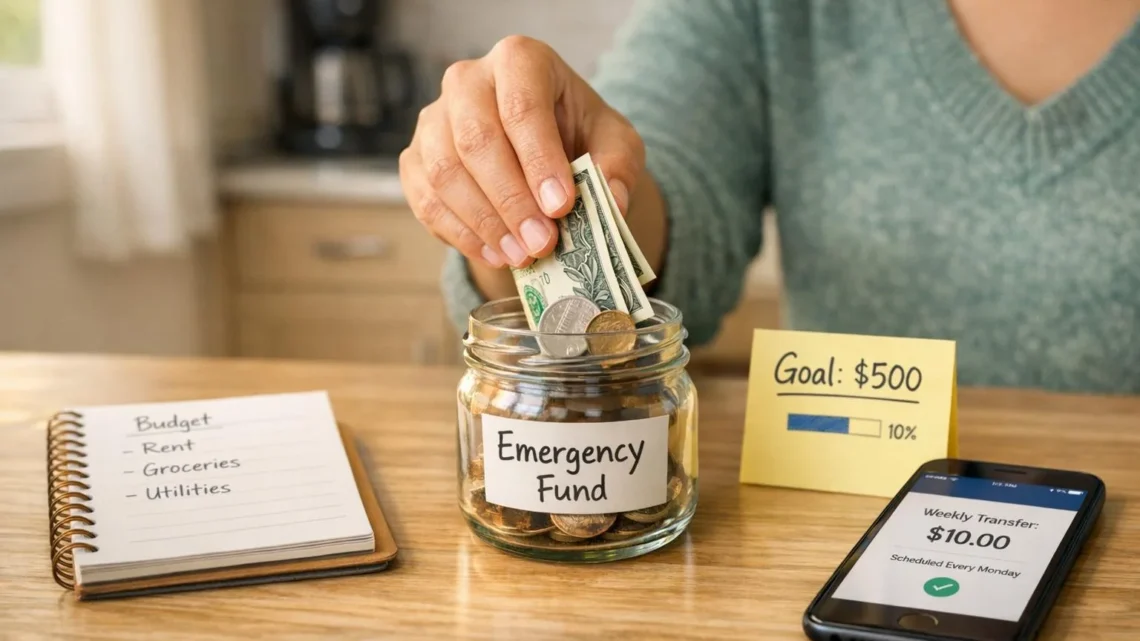
A bare-bones emergency fund is a separate, liquid cushion of roughly $1,000 to $2,000, or one month of essential expenses if that figure is larger, held in an insured high-yield savings account.
It exists to absorb a single ordinary shock, such as a car repair or urgent medical bill, without a credit card.
Trending Now!!:
The traditional advice of three to six months of expenses is sound, and it is also out of reach for a large share of households. The minimum version matters more than the ideal one because it is the level at which small problems stop turning into debt.
Why the Minimum Matters More Than the Ideal
The Federal Reserve’s most recent household survey found that 63% of adults would cover a hypothetical $400 emergency expense using cash, savings, or a credit card paid off at the next statement. That share is unchanged from the prior year and down from a high of 68% in 2021. Another 12% of adults said they would be unable to pay the expense by any means.
The $400 test is a gentle one. Private surveys that use a $1,000 threshold show a wider gap: Bankrate found that just 47% of Americans have sufficient liquidity or access to funds to cover a $1,000 emergency expense, while a separate U.S. News survey found that 43% of Americans lack enough savings to pay for a $1,000 surprise expense. The two surveys use different wording and methods, so the figures should not be merged, but both point the same way.
Balances are also thin among households that do save. In the U.S. News survey, the median emergency balance among savers was $5,000, half of the previous year’s figure. Bankrate reported that 58% of Americans say their emergency savings have not increased from a year earlier, and 29% have more credit card debt than emergency savings.




The practical reading is that the typical emergency is larger than the fund meant to cover it. LendingClub put the average cost of an emergency at $1,700 in 2023, which is well above a $400 test and above the $1,000 starter figure that personal finance writers have repeated for decades.
The $1,000 Rule and Its Limits
The $1,000 starter fund is described as gospel in personal finance circles for two decades, and its logic is behavioral as much as mathematical. A reachable first target gets people saving, and the first few hundred dollars stop an overdraft or a payday loan from turning a bad week into a bad year.
The Consumer Financial Protection Bureau’s guidance stresses that even a small amount of emergency savings meaningfully reduces the likelihood of taking on high-interest debt.
Critics point to the arithmetic. For the average person, $1,000 likely will not cover one month of living expenses, and many modern emergencies, from a transmission to an insurance deductible, exceed it. The fair position is that $1,000 works as a first rung, not a finish line.
The $2,000 Threshold
The strongest recent evidence for a slightly higher floor comes from Vanguard. A survey of more than 12,000 of its investors found that having at least $2,000 in emergency savings was associated with financial well-being 21% higher than among those with none, measured with the CFPB’s well-being questionnaire.
An income of $500,000 raised well-being by 12%, and assets of $1 million or more by 18%, so the modest cushion outperformed both.
The behavioral differences were concrete. Investors with no emergency savings spent an average of 7.3 hours a week thinking about and dealing with their finances, against 3.7 hours among those with at least $2,000.
About 51% of those with no savings reported rising financial stress, against 15% of those with $2,000 or more. Paulo Costa, the Vanguard behavioral economist who co-authored the research, summarized the finding this way: “That initial $2,000 makes a big difference.”
Two caveats apply. The sample was Vanguard investors, who skew more affluent than the general public, and the result is an association rather than proof that savings cause well-being.
The researchers did, however, control for income, education, and total financial assets, which makes the pattern harder to dismiss as a simple proxy for wealth.
Calculating the Essentials-Only Month
The more useful number for most households is not a round figure but one full month of essentials, because that is what a missed paycheck actually consumes.
Essentials means the costs that continue regardless of what happens: housing, utilities, groceries, transportation to work, insurance, minimum debt payments, phone and internet, and necessary medical costs. Dining out, subscriptions, travel, and shopping drop out of the calculation.
Consider an illustrative household. Rent of $1,600, utilities of $250, groceries of $600, transportation of $450, insurance of $300, minimum debt payments of $400, phone and internet of $150, and medical costs of $100 total $3,850. A $2,000 buffer covers about half of that month, and the gap between the starter fund and a full essentials month is where most job disruptions land.
One widely shared approach, the 1-3-6 method, formalizes this progression. It ties targets to actual monthly expenses, one month first, then three, then six, rather than a static $1,000 rule, and it prioritizes paying off debt above 6% interest once the first month is funded.
Where the Money Should Sit
Account choice matters less in dollars than most rate-comparison pages suggest. The average rate on a traditional savings account is only 0.38%, according to the FDIC, while top high-yield accounts currently advertise up to 4.70% APY, with another major comparison list topping out at 4.35%. At 4%, a $2,000 fund earns about $80 a year, and a full $3,850 month earns roughly $155.
Several features matter more than the headline rate. The account should be FDIC-insured, which is standard among institutions monitored by Bankrate’s editorial staff, and it should carry no monthly fee and no punishing minimum balance.
It should also sit at a different institution from the checking account, which adds just enough friction to discourage casual spending. Rates deserve a skeptical read: they are variable and can change at any time, and some of the highest advertised figures are promotional. One leading offer, for instance, pays up to 5% for six months, with a linked checking account and deposit requirements.
The money should not be invested. The CFPB’s guidance is that emergency savings should be kept liquid and separate, because a market drop and a layoff often arrive together.
Debt, Interest Rates, and the Sequencing Problem
The most common planning dilemma is whether to build the fund or attack credit card balances first. Credit card rates remain elevated, and Bankrate found that 29% of Americans carry more card debt than emergency savings.
Paying only minimums while holding a small buffer is usually the workable middle path: the buffer prevents the next emergency from adding to the balance, which would undo the payoff effort.
The bare-bones fund and high-interest debt repayment are therefore sequential, not competing. A starter cushion comes first, debt above roughly 6% interest comes next, and the larger fund is built once the expensive balances are gone.
Mistakes That Quietly Empty the Fund
The most frequent error is counting a credit limit as an emergency fund. Available credit is borrowing, and the interest begins on day one.
A second error is leaving the fund in the checking account, where it becomes indistinguishable from spending money. A third is confusing emergencies with predictable costs.
Annual insurance premiums, holiday gifts, and car registration are sinking-fund items, and mixing them in drains the reserve. The pattern is common: in the U.S. News survey, 23% of Americans admitted tapping emergency savings for holiday purchases.
Sizing the fund to income instead of expenses is a quieter mistake, since a household with a $6,000 paycheck and $3,850 in essentials needs the second number.
The last error is failing to refill the account after a withdrawal. A fund that was used correctly has still done its job only if the next shock finds it restocked.
Households That Need More Than the Minimum
A bare-bones fund suits a dual-income household with stable employment and renters’ or basic insurance. It is thin for others. Single-income households, freelancers with irregular pay, and workers in volatile industries need to push toward three months or more. Homeowners face a different risk profile, and the Vanguard analysis noted that owning a home, having children, or managing chronic medical problems may call for a larger cushion.
At the other end, saving advice has a ceiling. Among lower-income households, the Federal Reserve survey found that 4 in 10 adults earning under $50,000 could not cover even a $100 emergency using savings alone.
Bankrate’s financial analyst Stephen Kates noted that rising income is the most important factor in maintaining and boosting emergency savings, outweighing spending control. For households in that position, the first $500 is a legitimate milestone, and income growth is a legitimate part of the plan.
The Workplace Option Few Employers Offer
A lesser-known tool exists for employees. SECURE 2.0 allows employers to offer pension-linked emergency savings accounts, with automatic enrollment at up to 3% of post-tax pay, and contributions are designated Roth and stop once the balance reaches $2,500.
Adoption has been minimal: an Alight survey found merely 1% of employers had adopted it, and a retirement industry publication describes adoption as close to nonexistent. Proposed legislation would raise the cap from $2,500 to $5,000 and eliminate the exclusion for highly compensated employees. Employees can ask their plan administrator whether the feature is available.
A Three-Tier Build Plan
The most reliable way to reach a workable cushion is to treat it as three tiers instead of one distant target.
The first tier is the shock tier: $500 to $1,000, enough to handle a flat tire or an urgent copay, typically built in the first few weeks through automatic transfers on payday.
The second is the buffer tier: roughly $2,000, or half of the essentials-only month, whichever is larger, which aligns with the Vanguard evidence. The third is the runway tier: one full essentials month, which turns a job loss from an immediate crisis into a short search.
Beyond that, the conventional three-to-six-month target becomes appropriate, and the choice between building it and investing extra cash becomes a personal tradeoff. Scale matters less than rhythm. Costa has noted that saving as little as $10 a week is a workable start.
The practical test of a bare-bones fund is simple: a surprise bill of $1,500 arrives this week, and the response is a transfer from savings rather than a swipe of a credit card. A fund that passes that test has done what a minimum fund is supposed to do, and every dollar added afterward buys more time instead of more basic protection.
What People Ask