A Family Trust Set Up Too Late
My father had three months to sign one piece of paper, and he spent most of them complaining about the price of rice.
Rodel Aquino drove a jeepney from Project 4 to Cubao for thirty-one years in Quezon City, Metro Manila, and he never let anyone tell him what was good for him.
Trending Now!!:
The lawyer called in March. He said next week. She called in April. He said after the fiesta. In June, he fell in the bathroom with a toothbrush in his hand, and the left side of his face slid down like warm wax.
I am Jessa. I am thirty-eight, I work the night shift at a call center in Eastwood, and I have never lived anywhere except my father’s house. My younger brother Migs left at twenty-six. He is a nurse in Calgary now, and he has sent forty thousand pesos home on the fifth of every month for nine years. He has never missed one. The roof, the water tank, the caregiver, the pills: most of it was his money and my hands.
Nobody said this out loud, but the split felt fair to both of us until the day it did not.
Attorney Dolores Bautista has an office above a Jollibee in Cubao. Her secretary put a SkyFlakes next to my coffee as if this were a normal visit. Dolores set a brown envelope on the desk and told me my father had sat in that same chair in January, read everything, and walked out without signing.


Inside was a trust, three pages long. The house and lot in Project 4 would stay in the trust. I could live there for as long as I wanted. After me, it would pass to Sofia, Migs’s daughter, who is seven. Migs would receive the savings, two point three million pesos sitting in a BDO account.
In the margin, in my father’s slanted capital letters, he had written: Tell Migs after I sign. Not before.
I read the last two words three times.
Dolores took off her glasses. Without his signature, this is only paper, she said. The doctor will not say he understands what he is signing. The law will split the house between you and Migs, half and half, as if your father never thought about it at all.
I asked her what the house was worth. She said a buyer on that street would pay around fourteen million. I did not feel anything for about a minute. Then I felt the number, and the number sat in the room like a stranger who had walked in without knocking.
I took the jeepney home because a taxi was too much money for a day like that. The driver had a plastic Santo Niño on the dashboard and a speaker playing old Eraserheads songs. A woman beside me was counting coins into her palm, and I counted with her, because I did not know what else to do with my eyes.
At home, Ate Nena, the caregiver, was feeding my father lugaw with a plastic spoon. His right hand found mine and squeezed. I smiled at him and told him nothing. Rice had gone up again at the market in Anonas, and his pills at Mercury Drug now cost more than my phone bill. I kept the envelope in my bag all night, like something warm.
Migs called on Viber at five in the morning, my time. It was his lunch break. I could hear a microwave beeping behind him.
Ate, I am not saying sell it tomorrow, he said. I am saying a good care home in Marikina is forty-five thousand a month, with real nurses.
Papa is not going to a care home.
You sound tired. You have sounded tired for nine years.
I did not answer. I was standing at the sink with a cup of three-in-one coffee, watching the powder sink slowly into the water.
I have to tell you something, he said. His voice changed. After the divorce, I took loans. I owe almost thirty thousand dollars, Ate. I did not tell you because you already had enough.
I put the cup down. I thought about every fifth of the month, every GCash notification, every time I said thank you and meant it. He had been paying our father’s bills with borrowed money.
So half of the house is mine anyway, he said, softer now. That is just the law, Ate. I am not trying to hurt you.
It is the law, I said. I almost laughed.
You have never paid rent in your whole life, he said, and then he went quiet, because he heard himself.
You have never wiped him, I said.
Neither of us hung up. We listened to each other breathe across fifteen hours of difference. Somewhere in Calgary, a microwave beeped again.
Say something, he said.
The signal is bad, I told him. The signal was perfect.
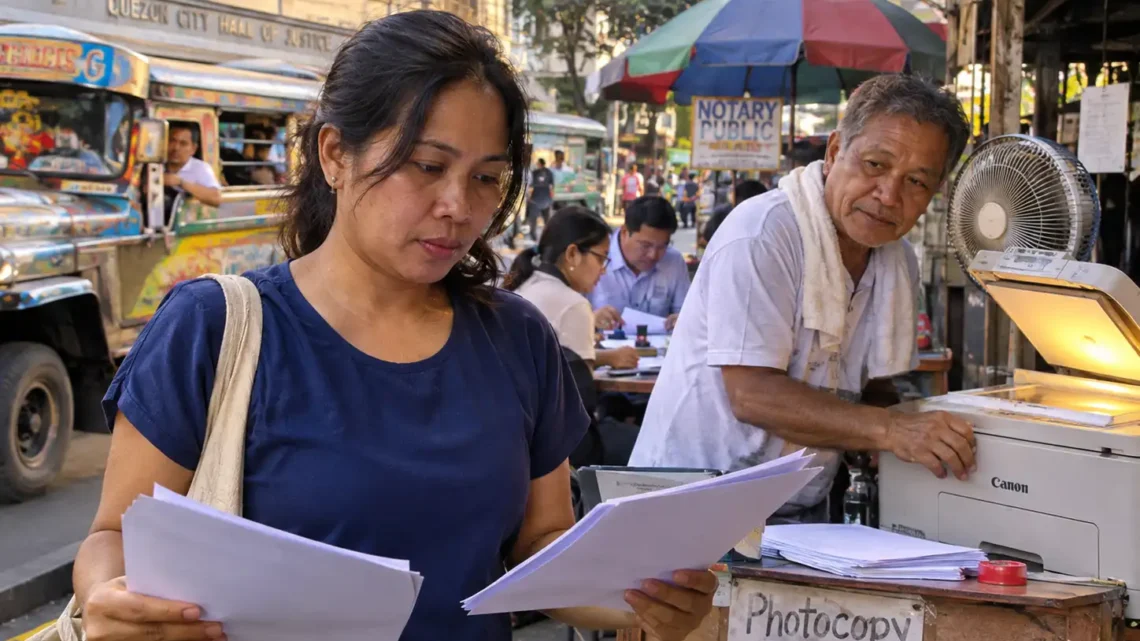
That afternoon I walked to the stalls outside the Quezon City Hall of Justice, where the notaries sit under umbrellas with their rubber stamps, and the photocopy machines run all day. I had not decided anything. I told myself I was only going to make a copy to keep safe, because a person should always keep a copy.
The man at the machine was about sixty, with a towel around his neck and a small electric fan aimed at his face. His name tag said, Mang Ernie. He took the three pages without looking at them, which I appreciated.
I watched the first page slide out warm. My father’s capital letters came up grey on the glass, a little crooked, a little proud. Not before. He knew Migs would ask for his half. Maybe he wanted to protect me from my brother. Maybe he wanted to protect my brother from me. Maybe he just wanted to sign it on a good day, with everyone calm and the rice cheap, and the good day never came.
Ilan po, Ma’am? Mang Ernie asked. How many?
Two, I said.
He fed the pages in again. The machine hummed. A jeepney stopped at the corner, and the barker leaned out and shouted Cubao, Cubao, Cubao, the way my father used to, the way I heard it through my bedroom wall every morning of my childhood.
I paid him twelve pesos. I stood on the sidewalk with a copy in each hand, and I still did not know which one was for me and which one was for my brother.
Love that waits for a better week usually ends up in a drawer.