Every Great Photo I Took Started With a Bad One
The first time I held a DSLR camera, I did not feel like an artist. I felt like someone had handed me a steering wheel and expected me to race.
It was 2013. I was twenty-four, broke, and standing in the middle of a Portland farmer’s market with a borrowed Canon 5D Mark II hanging around my neck like a dare.
Trending Now!!:
My cousin Derek, who had been shooting weddings and street photography for six years at that point, had simply placed the camera in my hands, stepped back, and said, “Shoot something. Anything. Stop thinking.”
I shot a blurry photo of a trash can.
He looked at it, nodded slowly the way people nod when they are trying not to laugh, and said, “Beautiful composition. Wrong subject.”
That was my beginning.



Over the next decade, I would go on to shoot editorial portraits, travel photography across eleven countries, product photography for e-commerce brands, and eventually full cinematic videography and short documentary films.
I would learn color grading, mirrorless camera systems, gimbal stabilization, and the kind of post-processing workflow that turns a flat RAW file into something that makes people stop scrolling. But none of that knowledge arrived cleanly or politely.
It arrived through humiliation, through missed shots, through corrupted SD cards, and through a few moments so beautiful I had to remind myself to breathe and keep the camera still.
This is the story of what photography and videography actually taught me about seeing the world.
The first real lesson came three months after that farmer’s market afternoon. I had been practicing obsessively, watching YouTube tutorials on aperture, shutter speed, and ISO, memorizing the exposure triangle like a student cramming for a final exam. I thought understanding the technical side of photography was the whole game. I was wrong about that in a way that would take years to fully understand.
Derek had booked me as a second shooter on a small wedding in Eugene. The couple, Rachel and Marcus, had a budget that did not stretch far, and Derek was doing them a favor by taking the job at half his usual rate. My job was simple: capture candid moments while he handled the formals and the ceremony.
“Stay invisible,” he told me on the drive up. “The best documentary-style photography happens when people forget you are there.”
I understood the instruction. I did not understand what it meant.
During the reception, I was so focused on my camera settings, on getting the correct white balance for the indoor reception lighting, on not blowing out the highlights in the fairy light canopy above the dance floor, that I missed the moment Rachel’s grandmother pulled her onto the dance floor and the two of them swayed together to a song no one else seemed to know. By the time I raised my camera, the grandmother had sat back down.
The moment was gone. Not technically gone. But emotionally gone, which in photography is the only kind of gone that matters.
Derek caught it. I saw his image later during the editing process, and it was one of those photographs that makes your chest feel tight.
The grandmother’s hand on Rachel’s back. Both of their eyes closed. The soft bokeh of the reception lights bleeding into the background. Perfect natural light photography. Perfect timing. He had not adjusted a single setting. He had just been present.
“This is what separates portrait photography from portrait documentation,” he told me when we were culling the images the following day. “Anyone can document. A camera phone documents. What you are trying to do is feel the room and anticipate the image before it exists.”
I started approaching photography differently after that. Less gear obsession, more emotional intelligence.
The gear obsession is real, and it is a trap every photographer and videographer falls into at some point. I spent four months saving to upgrade from a crop sensor body to a full-frame mirrorless camera, convinced that the sensor size was the reason my images were not sharp enough, not commercial-grade, not portfolio-worthy.
I bought the Sony A7 III, which at that point felt like holding the future in my hands. The autofocus system alone was a revelation, fast, accurate, eye-tracking that could lock onto a moving subject with the kind of precision that made my older manual focus technique feel prehistoric.
My images got better. But not because of the camera. They got better because by the time I could afford that camera, I had two years of additional shooting experience inside my hands. The muscle memory was there. The compositional instincts were sharper. The camera was just catching up to where I already was.
This is what camera companies do not tell you in their marketing materials: the best camera for photography is the one you understand deeply enough to stop thinking about. A photographer who knows a mid-range mirrorless system inside out will almost always outshoot someone who just bought a flagship body and does not understand how to read light.
Speaking of light, nothing in this industry humbled me quite like learning to work with natural light photography in unpredictable conditions.
I was in Lisbon in 2018, contracted to shoot a travel content campaign for a small sustainable clothing brand. The brief called for golden hour photography, warm tones, the kind of sun-drenched lifestyle imagery that performs well on Instagram and converts well in digital marketing campaigns.
The client had budgeted three days for outdoor shooting. On day one, it rained without apology from dawn until ten at night. On day two, the light was flat and grey, the kind of overcast sky that flattens every surface and strips the warmth from every color.
I called my contact at the brand, a creative director named Sofia, and I could hear the tension in her voice before she even finished saying hello.
“Please tell me you have something,” she said.
“I have the grey,” I told her. “Let me show you what I can do with the grey.”
I spent day two shooting in the narrow streets of Alfama, using the soft diffused light the overcast sky was actually providing, which is genuinely excellent for fashion and portrait photography because it eliminates harsh shadows and creates an even, flattering illumination across the subject’s face.
I used a portable LED panel to add warmth where I needed it, pulled the highlights down in post-processing and pushed the shadows, leaned into a moody, desaturated color grade that turned what should have been a disaster into a cohesive visual story.
Sofia called me that evening after I sent the first batch of edited images.
“These are better than anything we had on the mood board,” she said.
“The grey helped,” I told her, and I meant it completely.
Day three delivered golden hour in full. And yes, those images were extraordinary. But the Alfama grey-sky series became the campaign’s hero content. That campaign went on to generate significant engagement and was featured in two independent photography blogs as an example of compelling travel photography under difficult conditions.
Videography came later, and it came harder.
Photography had trained my eye, but video added time to the equation. A photograph is a decision made in one fiftieth of a second. A video is ten thousand decisions made simultaneously: composition, movement, audio, pacing, color, story structure, focus pulling, gimbal technique, and the invisible architecture of how one shot connects to the next to create something that feels alive and intentional rather than assembled.
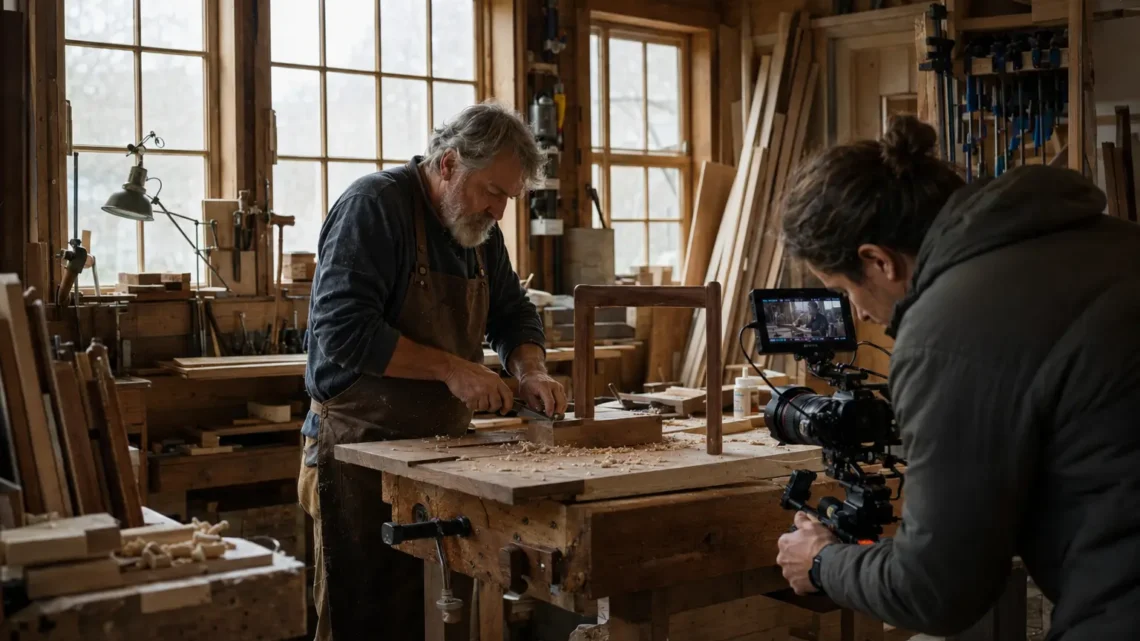
My first real videography project was a short documentary about a furniture maker named Elias in rural Vermont. He had been building handmade wooden furniture the same way for thirty years, using traditional joinery techniques that most modern workshops had abandoned.
A mutual friend connected us, and I drove up with a Sony A7S III, a Ronin gimbal, two prime lenses, a shotgun microphone, and more confidence than was strictly warranted.
I shot for two full days. The footage looked gorgeous on the camera screen. I came home, loaded everything into Premiere Pro, and stared at my timeline for four hours without cutting a single clip.
I had beautiful images of Elias’s hands. I had close-ups of wood shavings curling off a planer. I had wide shots of the workshop filled with afternoon light that came through the windows like something from a Terrence Malick film. What I did not have was a story. I had assembled footage.
I had not thought about narrative structure before I pressed record, and now I was sitting in front of seventeen hours of visual material with no clear throughline connecting any of it.
I called a filmmaker friend, James, who had been directing short documentary content for nearly eight years.
“Tell me the one thing you want the audience to feel when the film ends,” he said.
I thought about it. “That something worth preserving is quietly disappearing.”
“Good,” he said. “Now go find the moment in your footage where Elias says something that makes you feel exactly that. Build everything else around that moment.”
I found it. It was a throwaway line Elias had said while sweeping wood dust off his workbench at the end of day one. He had not been addressing the camera. He had just been talking to himself, or to the room, and he said, “Nobody teaches this anymore. So I just keep doing it alone.”
That fourteen-second clip became the emotional spine of the entire film. Everything else was built outward from it. The film ran nine minutes, screened at two regional film festivals, and won an audience choice award at one of them.
Ten years in, here is what I know that I could not have read in any book or learned from any tutorial.
The best camera settings in the world do not compensate for being in the wrong emotional place when you shoot. Commercial photography and videography is a technical craft, yes, but it is also an act of attention, and attention is something you either bring to the frame or you do not. You can correct exposure in post-processing. You cannot correct distraction.
Every piece of equipment I ever bought was a tool, not a solution. The mirrorless camera, the cinema lens collection, the 4K video capability, the drone for aerial photography, the color grading suite, the studio lighting kit: none of it made me a better visual storyteller on its own.
Practice made me better. Failure made me much better. Watching my own mediocre work with honest eyes and asking why it was mediocre made me the best version of what I currently am, which is still, on most days, a student.
And the light, always, the light.
Last spring I was in Kyoto, finishing the final leg of a travel documentary project that had taken me across four countries over eighteen months. I was shooting alone at the Fushimi Inari shrine at five in the morning, before the tourists arrived, when the fog came down through the torii gates in a way that I have genuinely no vocabulary to describe properly.
The entire path disappeared into white. The red gates materialized and dissolved at the same time. My camera was already in my hands, already set from the previous shot. I composed, I pressed, and I captured something that, for the first time in a decade, made me feel the way Derek’s grandmother photo had made me feel all those years ago.
I stood there in the fog for a long time after, camera at my side.
Not taking pictures. Just looking.
Sometimes that is the most important thing a photographer learns to do.