Five Thousand Naira for Water That Knew My Family’s Secrets
Ogechi almost didn’t go. She was standing in front of her mirror on Ogui Road, powder halfway across her cheek, when her aunt Nkechi banged on the door like NEPA had finally brought light and someone needed to celebrate immediately.
Get dressed, we’re going to see Papa, Nkechi said, already sweating through her blouse. Not the small ones on Facebook Live. The real one. The one at Coal City Miracle Ground.
Trending Now!!:
Ogechi had heard about him before, the way you hear about a fire three streets away, secondhand and exaggerated. People called him “Papa Sees Far,” and the stories that followed him were the kind that made you roll your eyes in the morning and check your doors twice at night.
She went anyway, because in Enugu, on a Saturday with nothing else planned, you follow your aunt into whatever madness she’s cooking, if only for the free transport and the promise of suya after.
The Miracle Ground sat behind a stretch of uncompleted buildings past Independence Layout, close enough to Nike Lake that the air still carried a wet, green smell.
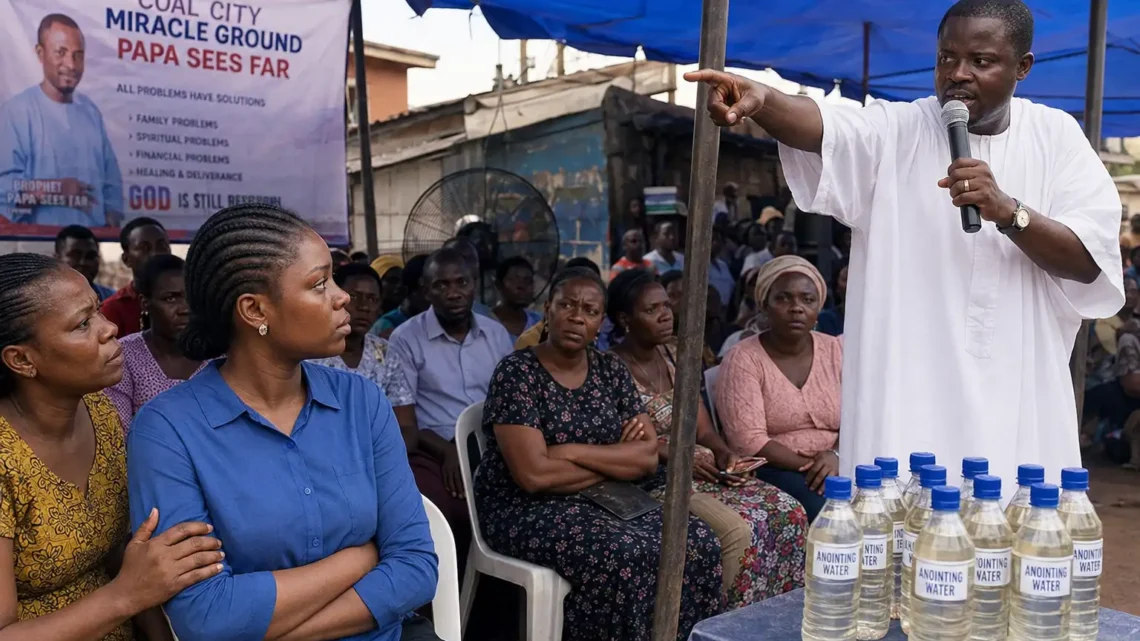
There were maybe three hundred people under a blue tarpaulin canopy, fanning themselves with church programs, humming songs that hadn’t started yet. A generator coughed somewhere behind the stage, the kind of low mechanical groan that never fully leaves your ears once you’ve heard it.




Ogechi sat at the back, arms folded, already composing the story she’d tell her friends later about the mad prophet and his mad followers. Then the man walked out.
He was smaller than she expected, wrapped in a plain white agbada, no gold chains, no theatrics, no dancing entourage. He didn’t shout. He walked to the microphone and simply looked out at the crowd, slow, the way a man looks over a field he’s about to harvest.
Someone here came because their aunty forced them, he said, and the crowd laughed, a warm rolling laugh that made Ogechi’s stomach tighten just slightly. That is fine. God does not mind how you arrived. He only minds that you are here.
She told herself it was a coincidence. Every gathering has a reluctant niece or nephew dragged along.
Then he pointed, not vaguely into the crowd the way those television prophets do, but directly, arm extended like a spear, straight at her.
You, he said. The one in the blue blouse, sitting like this is not your business.
The whole tarpaulin turned to look. Ogechi felt her face go hot.
Your grandmother’s name was “Nwakaego”, he continued, and she used to sit outside your father’s compound in Abakpa, cracking palm kernels with a small stone, telling you that a woman who cannot feed herself will always answer to a man who feeds her.
Ogechi did not move. She could not move. Her grandmother had died when she was nine years old. Nobody in Enugu, nobody at that Miracle Ground, nobody outside her own family had ever known that nickname, “Nwakaego,” a joke name her grandmother’s mates gave her because she was obsessed with saving money even as a child.
Nkechi grabbed her wrist, whispering, see, see, I told you, this one is real oh.
The prophet wasn’t finished. He said her grandmother was not resting well, that something was left undone, a debt, a promise, a piece of land in the village that nobody had settled since her death.
He said the family needed to do a “cleansing” before the end of the month, and that the ground itself, this Miracle Ground, sold small bottles of “anointing water” blessed that morning by Nike Lake’s dawn mist, five thousand naira each, non-negotiable, cash only, no transfer because network fails but faith does not fail.
By the time the service ended, Ogechi had bought four bottles. Her aunt bought six. She didn’t remember handing over the money.
She remembered her hands shaking, her mouth dry, the smell of the lake mixing with diesel smoke from the generator, and the prophet’s eyes, calm and patient, watching her the whole time like a man who already knew the ending of a story he hadn’t finished telling.
That night she couldn’t sleep. She kept replaying the name, “Nwakaego,” turning it over like a stone in her palm. She called her father in Abakpa at midnight.
Papa, who else knew grandma’s nickname? she asked.
Her father laughed, tired and confused. Nobody uses that name again since she died. Why?
She told him everything. The tarpaulin, the generator, the man in white, the pointed finger, the water. Her father went quiet for a long time, long enough that she thought the call had dropped.
Ogechi, he finally said, your cousin Chidi posted something on Facebook two years ago, a whole tribute for grandma’s anniversary, using that name. It’s still on his page. Anybody fit see it if they search well well.
The floor of her room seemed to tilt slightly. She opened her phone right there in the dark, searched, and found it, her cousin Chidi’s old post, public, three hundred and forty comments, “Nwakaego” spelled out plainly in the second paragraph, along with the palm kernel story, the stone, the whole memory laid bare for any stranger with data and patience to find.
She sat on the edge of her bed holding four bottles of lake water that suddenly felt very heavy and very stupid in her hands.
The eerie part wasn’t that the prophet was a fraud. Frauds she understood, frauds were Tuesday in Enugu, frauds were everywhere from Yahoo boys on Zik Avenue to contractors who disappeared with government road money before a single stone was laid on Ogui Road.
The eerie part was how much work it must have taken. Someone, somewhere, had sat with a notebook and a phone, scrolling through hundreds of Facebook pages, cross-referencing names, building a small dossier on strangers just so a man in white could stand under a blue tarpaulin and make three hundred people believe their dead were speaking.
She didn’t sleep that night. Not because she feared her grandmother’s ghost, but because she kept thinking about the quiet, patient labor of the lie, the sheer human effort someone had spent studying her family’s grief just to sell her lake water for five thousand naira a bottle.
She poured all four bottles down the sink the next morning. Nkechi cried when she found out, said Ogechi had “offended the ancestors,” and didn’t speak to her for almost three weeks.
Ogechi still thinks about Papa Sees Far sometimes, usually late at night when the generator outside her window hums the same low groan as the one at the Miracle Ground. She’s stopped calling it a miracle. She calls it homework now, someone else’s homework, done on her family’s memories, graded in cash.
The real haunting was never her grandmother. It was realizing how easily a stranger could know you better than you know yourself, simply by caring enough to look.