He Came to Test Our Water in Lagos and Stayed for Me
Two hundred naira, said Mama Ngozi, without looking up from her phone. Dry season price.
I counted the notes out slowly. It was 5:40 on a Monday morning in Bariga, Lagos, and I was standing in my work shoes beside a rusty tank, my bank ID already hanging round my neck.
Trending Now!!:
The jerrycan weighed twenty-five litres. My arms knew it before my head did.
Last week it was one hundred and fifty, I said.
Last week it rained. She finally looked up. Yetunde, I am not the one who makes the sun.
Five jerrycans a day. That was what my mother and I needed for cooking, bathing and washing plates, and the tap in our kitchen had been dry since before I got my first salary.




I did the sum on the danfo to the Third Mainland Bridge, squeezed between a woman carrying a basin of tomatoes and a man asleep against the window. One thousand naira a day. Thirty thousand a month, just to wash.
My salary was not small, but it was not big enough for everything either. Nothing is these days. Rent, transport, data, light, food, and now water.
I was thirty-one. I was tired in a way that sleep did not touch.
I had also been saving for two years to leave my mother’s house and rent a one-bedroom in Yaba, where I could finally hear my own thoughts. The money sat in my account like a held breath: two million, three hundred thousand naira.
On Wednesday my mother, Abike, sent me a photo on WhatsApp. It was the empty tank, with the bottom showing green. Under it she wrote: Water don finish. I never bathe.
I looked at the photo through a whole budget meeting. Nobody noticed. I was good at that, looking present.
That evening I sent a voice note to my friend Ife, walking too fast and talking faster. I said I wanted to dig a borehole in the compound. I said the quote was one million, nine hundred thousand for drilling, a tank and a solar pump.
I said there would also be a hand pump, so the thing would still work on days when the sun and the cloud were not cooperating.
Ife replied with her own voice note, nine seconds long. Yetunde, you are mad. Who does this? You are supposed to be leaving that house.
She was right. I paid the deposit anyway.
The man who came to survey the land arrived on a Saturday in green rubber boots, holding a Gala between his teeth like a cigar while he unfolded a metre-long tripod.
His name was Chidi. He was from Enugu, he was about thirty-four, and he had a way of staring at the ground like it owed him an answer.
He walked around the compound for forty minutes. He measured the front, the back, the side by the gutter. My mother watched from the window with her arms folded.
The water is here, he said at last. He pointed at my late father’s pawpaw tree.
That tree is my father’s, I said.
Then your father knew something. He finally took the Gala out of his mouth. Pawpaw loves water. Wherever it grows this fat, something is underneath.
I did not know what to say, so I went and boiled Indomie.
Drilling started on Monday. Baba Kunle, the driller, came with a truck that sounded like it was clearing its throat for the last time, and a boy called Rasheed who did everything Baba Kunle pointed at. By midday every child on our street was standing on the fence. By two, the adults had joined them.
I did not go to work. I told my manager it was a family emergency, which was not even a lie.
On Wednesday the first proper rush of mud shot out of the pipe, straight up, with a roar.
It landed squarely on Pastor Emmanuel, who was passing in a white wrapper on his way to the midweek service. He stood there dripping brown. He did not say a single word. He just looked up at the sky as if it had personally betrayed him.
Chidi laughed so hard he sat on a bucket and the bucket cracked underneath him.
It was a stupid laugh. It came out of his whole body, like a sneeze he had been holding in all day. Rasheed started laughing, then Baba Kunle, and then I was laughing too, bent over my knees, tears on my face, in front of the entire street.
I cannot explain why this was the moment. A man fell on a bucket on a Wednesday. That was all. But I remember thinking, quietly, somewhere under the noise: I would like to hear this again.
Nobody tells you that falling for someone is mostly paying attention. Over the next three days I paid attention. He ate everything I cooked and complained about the pepper every time.
He wore the same boots with a different sock on each foot, and I never told him. He had worked in eleven states and still got lost in Lagos. He kept a small notebook where he wrote down the depth of every hole he had ever drilled, like other men keep phone numbers.
On Thursday evening we sat on plastic chairs outside while Baba Kunle packed up for the night.
You hate your job, he said. It was not a question.
I did not say anything.
You checked your phone seven times while I was explaining the casing.
It was work.
It was your face, he said. Work does not make a face like that.
I told him about the burnout. I told him about the Sunday nights that started on Saturday afternoons now. I told him about the savings I had broken open for this hole in the ground, and that I did not know if I was brave or stupid.
He did not say either. He said, Both is allowed.
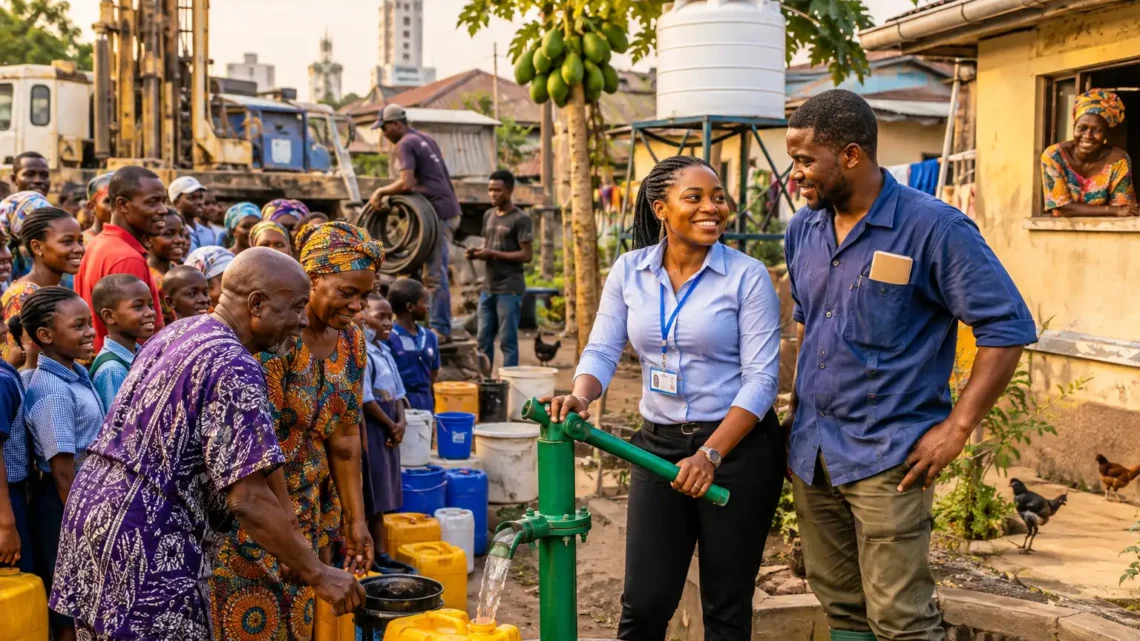
The water came on Friday at 3:15 in the afternoon. It came up clear, sweet and cold, through the hand pump first, because Chidi insisted. Rasheed worked the handle. The whole street went silent for one second, then exploded.
My mother filled a bucket and washed her face right there in the yard, in front of everyone. She did not say anything. She just kept her eyes closed for a long time.
The trouble started on Saturday.
Alhaji Lawal, who owned the plot next to ours, came with his son and a proposal. We should put a gate around the borehole. We should charge fifty naira per jerrycan. Everything has maintenance, he said. Even God collects offering.
I said I would think about it. I did not need to think.
The next person at the gate was Mama Ngozi, with no jerrycans.
She stood at the fence with her wrapper tied tight and her face closed. She had been selling water on this street for eleven years. Six thousand naira on a good day. I had just dug a hole under a pawpaw tree and ended her whole business.
So you are now the government, she said.
I did not think about you, I said, which was the honest thing, and also the cruellest.
She went away without another word.
I lay awake that night with the sound of the pump in my head. Chidi was leaving Sunday morning for Port Harcourt. His next job was already waiting, a school with no water at all. He had told me this plainly, the way he told me everything.
On Sunday I went to Mama Ngozi‘s kiosk before sunrise. I asked her to run the pump point. Free water at the tap, always.
She would manage the queue, keep the buckets in order and sell her pure water and her cold drinks to a line of customers who would now come to her every single day. I would pay her a monthly amount for the job. It was nothing like six thousand a day. It was something.
She did not agree. She did not refuse either. She just said, Go and eat.
At 6:00 that evening I came out to the compound.
The line at the borehole was thirty people long. Mama Ngozi was standing at the head of it with a plastic stool, helping old Baba Sikiru fill his can, because his hands shook too much to do it himself. She did not look at me.
Chidi‘s bus had left at noon. He had hugged my mother, shaken Baba Kunle‘s hand and pressed my fingers once, quickly, like a man signing for a parcel. He said the lab would send the water results to him, and he would bring them himself.
Bring them yourself, I said. Or send them?
Which one do you want?
I had no answer ready. I still do not.
On Monday morning I walked out at 5:40 and nobody asked me for two hundred naira. The rent in Yaba was gone. The one-bedroom with the quiet was gone.
I was still sleeping in my mother’s house, still going to a job I did not love, still wondering if I had thrown my own future into a hole in the ground.
My phone buzzed at the bus stop. It was a message from Chidi.
Water is clean. Drinkable. Paper is ready.
Then, a minute later: Saturday, if you will be home.
I stood there with the danfo engines running and the sun not yet up. I typed I will be home. I deleted it. I typed Which one are you asking about, the water or me? I deleted that too.
Some of us spend everything we saved on leaving, and end up paying for a reason to stay.