He Owed a Loan Shark $18,000: One Capoeira Fight Changed Everything
In the backstreets of Vila Madalena, a former capoeira fighter owes a debt that money alone can’t settle. One last roda under borrowed floodlights forces him to choose between the ring that built him and the life waiting quietly on the other side of it.
The scar on Doca’s left palm had healed wrong, a ridge of skin that caught on the wire when he played, and every morning at five he ran his thumb across it before he opened his eyes, the way other men reach for cigarettes.
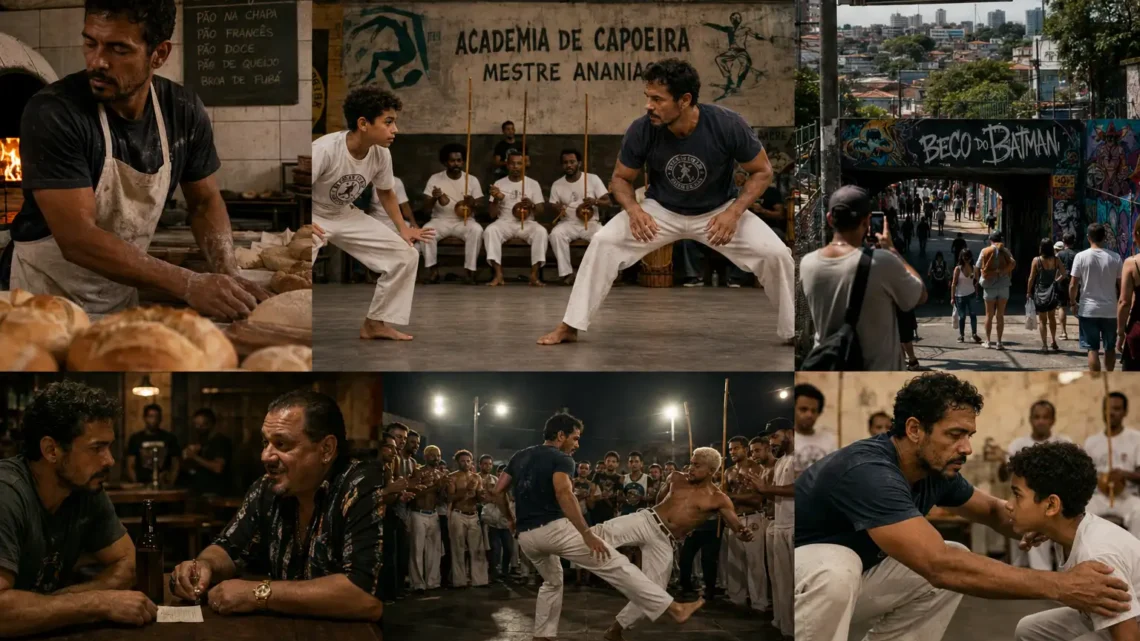
He lived above a padaria on Rua Aspicuelta in Vila Madalena, two rooms that smelled permanently of warm bread no matter how many windows he left open, and from his window, he could see the graffiti tunnel on Rua Wesley, the one tourists photographed now, though nobody who actually lived in Beco do Batman had asked the city to make it famous.
Trending Now!!:
You’re late again, said Mestre Ananias, not looking up from the roda he was setting up in the academia, a converted garage two streets over with a corrugated roof that turned every rain into a drum solo. The boy’s been waiting twenty minutes.
The boy was eleven, named Théo, and his mother had paid for six months of capoeira lessons because his school had called twice about fighting, and Doca had agreed to teach him because Ananias had vouched for him when nobody else would, three years after the thing with the loan sharks on Rua Harmonia, three years after Doca had taken money he shouldn’t have, from men who collected debts the way other men collected stamps, with patience and a complete absence of mercy.
Show me the ginga, Doca said to Théo, and the boy moved like he was already bored, feet sliding side to side without the weight shift that made it dangerous, made it beautiful.
Lower, Doca said. You’re not walking to school. You’re already inside the fight before it starts. Watch.


He dropped into the rhythm, the one his own father had taught him in Salvador before the family moved south chasing factory work that dried up within a year, and even now, thirty-four years old with a bad knee and a debt he still hadn’t finished paying off in ways that had nothing to do with money, his body remembered every angle.
Théo watched, and something in his face changed, the boredom cracking just slightly, the way ice does before it gives.
Again, Doca said. Lower.
After the lesson, Ananias handed him a sealed envelope without ceremony, the way he always did, cash from the academia’s door fees, Doca’s cut for teaching three classes a week, barely enough to cover rent above the padaria, and Ananias said, Carlinhos came by yesterday.
Doca’s hands went still on the envelope. Carlinhos doesn’t come by anywhere. People go to him.
He came by, Ananias said. Asked about you. Asked if you still played.
Tell him I retired.
I told him exactly that. He laughed.
Carlinhos had been the one who’d fronted Doca eight thousand reais four years ago, back when Doca’s wife was sick and the public hospital waiting list stretched past the point where waiting meant anything, and Doca had paid back six thousand before she died anyway, before the money became a debt with no purpose left to serve except the accumulation of itself, eleven percent a week, compounding the way grief does.
He found Carlinhos that same night, not because he wanted to, but because a man like Carlinhos finding you was always worse than finding him first.
The bar was on Rua Girassol, unmarked, the kind of place where the beer came in unlabeled bottles and nobody asked questions about the men drinking it.
Doca, Carlinhos said, smiling with teeth that had cost more than Doca’s monthly rent. Sit. You look like a man who’s been avoiding his health.
I paid you what I owed.
You paid me what you owed in 2022. Interest doesn’t read calendars the way you do. He slid a folded paper across the table, numbers that made Doca’s vision narrow at the edges. Eighteen thousand. Or you work it off.
I don’t run anymore.
Nobody’s asking you to run. Carlinhos leaned back. I’ve got a roda in Cidade Tiradentes next month, money roda, real stakes, rich kids from Jardins paying to watch real capoeiristas bleed a little for entertainment. You used to be good. Word is you’re still good. Win it for me, I take a cut of the side bets, your debt’s clean.
And if I lose?
Then you owe me eighteen thousand and a broken jaw, probably, but mostly the eighteen thousand.
Doca thought of Théo’s ginga, too high, too eager, a boy who hadn’t learned yet that the body lies low because the ground is the only thing that never betrays you, and he thought about what it would mean to step back into a roda built for other men’s entertainment, his pain as currency.
One roda, Doca said. Then we’re finished. Actually finished.
Actually finished, Carlinhos agreed, in the tone of a man who had said those words to several other people who were not, in fact, finished with him at all.
The roda in Cidade Tiradentes happened under floodlights rigged to a generator, a crowd three rows deep, Jardins money in linen shirts standing at the back with drinks they’d brought themselves because they didn’t trust the bar.
Doca’s opponent was twenty-two, fast, trained somewhere with mirrors and air conditioning, and for the first two minutes Doca felt every one of his thirty-four years in his knee, in his lungs, in the scar tissue across his palm.
Then the berimbau changed rhythm, the toque shifting from São Bento Grande to something slower, meaner, and Doca remembered that capoeira was never about speed, it was about reading a man’s weight before he’d finished shifting it, and he dropped low, lower than the kid expected, and swept the floor from under him with a rabo de arraia that the crowd actually gasped at.
He won. Carlinhos collected. The debt, on paper, dissolved.
But standing in the floodlight afterward, breathing hard, surrounded by men clapping him on the back like he’d done something to be proud of, Doca felt nothing close to relief, only the specific exhaustion of a man who has just understood that he will keep being useful to people like Carlinhos exactly as long as his knees allow it, and not one day longer.
He went back to Vila Madalena that night and didn’t sleep, and at five in the morning he ran his thumb across the scar on his palm, and instead of going to the academia, he walked to the padaria downstairs and asked Seu Raimundo, the baker, if he needed help in the mornings, real work, flour and ovens and nothing that could be collected on by men in unmarked bars.
You’re a capoeirista, Raimundo said, confused. Why would you want this?
Because nobody’s ever made me bleed for a loaf of bread, Doca said, and Raimundo, who didn’t fully understand the joke, laughed anyway and handed him an apron.
Théo still came on Tuesdays and Thursdays, ginga lower each week, and Doca kept teaching him, kept dropping into the rhythm his father had given him in Salvador, the one thing Carlinhos had never managed to take, because some inheritances simply can’t be priced.