How a Nigerian Man in Geneva Bought the One Thing His Mother Ever Truly Loved
The auction house smelled like old money and older secrets. Marcus Adeyemi had noticed that about these places the first time his father dragged him to one as a boy in Peckham, twenty-three years ago.
The smell was the same whether it was Christie’s in London, Sotheby’s in New York, or this one, tucked inside a repurposed 19th-century courthouse in Geneva. Polished wood. Nervous cologne. The faint metallic undertone of ambition.
Trending Now!!:
He adjusted his cufflinks and did not look at the painting.
Everyone else in the room was looking at the painting.
Composition in Red and Silence by Elara Voss, 1962. Oil on linen. Privately held for six decades by the estate of a deceased Swiss industrialist whose name Marcus had never been able to say without feeling something close to hatred.
The painting was 140 centimetres wide and 110 centimetres tall, which made it, in practical terms, just large enough to fill the gap above a fireplace. In every other sense it was enormous. It had been the last thing Marcus’s mother ever loved before she died.



She had written about it in her diary. He had found the diary in a shoebox three years ago, the month after she passed, tucked behind winter coats she would never wear again.
She had seen the painting once, in a small gallery in Cape Town in 1987, before it was sold and disappeared into private hands. She had written four pages about it. He had read those four pages eleven times.
It is the only painting I have ever seen that looks back at you, she had written. Not like a portrait. Like something that already knows what you are going to do and has decided to forgive you for it anyway.
Marcus finally allowed himself to look at it.
She was right. Of course she was right.
The auctioneer, a thin Belgian man named Fontaine, was still working through the pre-auction preamble, his voice tuned to the frequency of controlled excitement.
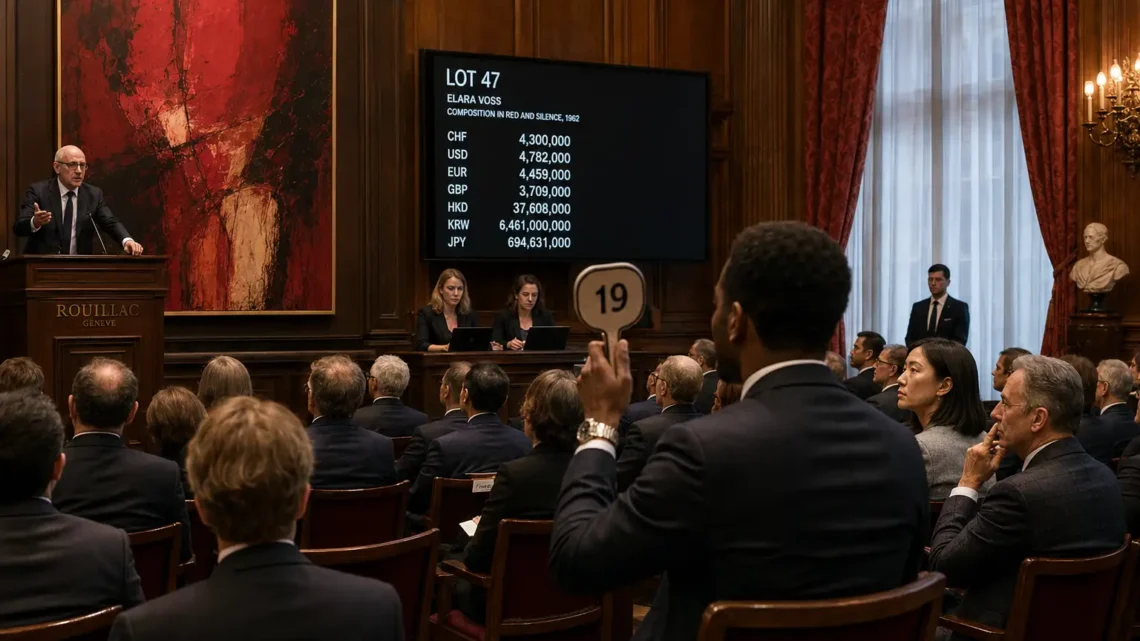
There were nineteen other registered bidders in the room and an unknown number patched in remotely. Marcus had done his research. He knew which of the physical bodies in front of him were serious and which were performance, people attending because being seen at this auction was itself a transaction.
The serious ones were three. A Korean tech billionaire represented by a quiet woman in a grey suit who had not blinked in twenty minutes.
A Russian collector Marcus had encountered before, in Milan, who collected Voss specifically and had four of her pieces already. And a New York hedge fund manager named Gerald Pitts who bought art the way other men bought watches, to display a version of himself he had not yet become.
Marcus was not in their league. Not financially. His entire available liquidity, liquidated over eight months with a cold discipline that had frightened even his accountant, came to four point two million Swiss francs.
The pre-sale estimate on the painting was three point five to four point eight million. He was at the edge of possibility. He had always lived there.
Lot 47, Fontaine announced. Elara Voss. Composition in Red and Silence. We begin at two point eight million.
The room shifted. It was not a dramatic shift. Nobody stood up or gasped. The temperature changed, the way it changes in a city just before rain, a drop of pressure that only certain people can feel.
Three million, said the woman in grey, without raising a paddle, without changing expression, by some mechanism Marcus could not identify.
Three point two, said the Russian, whose name was Volkov and who held his paddle with the relaxed certainty of a man who expected to win.
Three point four, said Pitts, too quickly.
Marcus said nothing. He had decided, sitting in his hotel room at four in the morning with the diary open on the pillow beside him, that he would not bid until four million. Every instinct in his body told him this was wrong tactically. Every other instinct told him it was the only way to do it.
Three point six.
Three point eight.
The woman in grey and Volkov were trading now, steady, rhythmic, like two people passing a ball who both knew it was going to drop eventually. Pitts had already gone quiet at three point five. The room had forgotten him.
Four million, said Volkov, and the word landed with a finality that made three people near Marcus exhale.
Fontaine let a beat pass. Four million. Do I have four point one?
Marcus raised his paddle.
He felt, rather than saw, Volkov turn to look at him. He had been an anonymous presence until this moment, a tall Nigerian man in a well-cut suit who had registered under a name that meant nothing to anyone in the room. Now he existed.
Four point one. Thank you. Four point two?
Volkov did not hesitate. Four point two.
Marcus had four point two million. That was the ceiling. That was the wall. He had stared at that number for eight months and knew its exact texture, the way you know the dimensions of a room you have lived in too long.
He sat with it for four seconds. Fontaine was already opening his mouth.
Then Marcus raised his paddle.
Four point three, he said.
His voice was steady. His body did not yet know what his mouth had just done. His mind had made a calculation so fast he hadn’t consciously participated in it, a calculation that involved a storage unit in Brixton he had not yet emptied, a car he could sell, a favour a property developer in Lagos owed him that had a cash value of roughly eighty thousand pounds if he called it in tomorrow morning.
He did not have four point three million Swiss francs. He would have it in six weeks if everything went perfectly. In his experience, nothing went perfectly. He had decided, in the space of four seconds, that this did not matter.
Four point three, Fontaine repeated, and his voice carried the particular delight of a man who has witnessed something he did not expect. A new voice in the room. Four point four, Mr. Volkov?
Volkov looked at the painting for a long time. It was the longest Marcus had ever seen a man look at anything.
No, said Volkov.
The word was soft. Not defeated. Something more complicated than defeat. The recognition, perhaps, that the thing he wanted was wanted by someone who needed it more. Marcus would think about that moment for years afterward, the particular grace of it, a rich man choosing not to win.
Four point three million. Fair warning. Fair warning. Sold.
The gavel came down.
Marcus sat very still and breathed.
The woman behind him, a French art consultant he had not spoken to, touched his arm lightly and said, Félicitations. He thanked her. Around him the room reorganised itself, the tension releasing, people shifting toward the exit or toward their phones. Someone near the door laughed at something.
Marcus looked at the painting one more time before the handlers moved in.
His mother had been twenty-six when she stood in that Cape Town gallery and wrote four pages in a diary she never expected anyone to read. She had been carrying him at the time.
He hadn’t known that until he found the diary. The date matched. She had been eight weeks pregnant, had not yet told his father, and she had wandered into a gallery on Long Street to get out of the summer heat and she had found this painting and stood in front of it for forty minutes and written about it with a love so precise and unguarded it had broken him open the first time he read it.
It already knows what you are going to do, she had written, and has decided to forgive you for it anyway.
He understood now, looking at it, what she had meant. The painting was not peaceful. It had no interest in being peaceful.
It was red in the way that wounds are red, which is also the way that sunsets are red, which is also the way that certain silences between people are red, dense with everything that has been decided but not yet said.
It looked back at him.
He let it.
Outside, Geneva was grey and cold and indifferent in the way that very old cities are indifferent. Marcus stood on the courthouse steps and called his accountant, who did not answer because it was 11pm in London. He called the property developer in Lagos, who answered on the second ring, because people in Lagos are always awake.
I need to call in what you owe me, Marcus said. And I need it liquid in six weeks.
There was a pause.
Marcus, said the developer, whose name was Chukwuemeka and who owed Marcus a favour so significant neither of them had ever referred to it directly, what have you done?
Marcus looked back at the courthouse door.
Something my mother would have liked, he said.
He could hear Chukwuemeka smiling through the phone. Then we will find the money, the developer said. We always do.
Marcus buttoned his coat against the Geneva wind and walked toward the lake, and for the first time in three years he did not feel the absence of his mother like a missing limb. He felt it the other way, like a presence just behind him, quiet and undemanding and entirely at peace.
The painting would arrive in London in ten days. He had already decided where it would hang.
Above the fireplace, of course.
Where else.