How AI Automation Nearly Destroyed My Business
The first time I heard the words “machine learning automation,” I was sitting in a cramped conference room in downtown Chicago, eating a cold turkey sandwich and pretending I understood what the consultant in the expensive blazer was saying.
It was 2017. I had been running a mid-sized e-commerce operation for six years, shipping personalized gift boxes across the Midwest, and honestly, everything felt fine. Controlled. Mine.
Trending Now!!:
“Your competitors are already using AI-driven inventory forecasting,” the consultant, a sharp-eyed woman named Dr. Patricia Holloway, said, pointing at a slide filled with ascending bar charts. “If you don’t move on this, you’ll be invisible in eighteen months.”
I nodded like I agreed. Inside, I was terrified.
I did not touch artificial intelligence for another two years after that meeting. I told myself I was being careful. Methodical. The truth is I was scared of handing my business, the thing I had bled for since I was 27, over to something I did not fully understand.
That fear dissolved in 2019, not because I became brave, but because I became desperate.




Our shipping errors had climbed to nearly 11 percent. Customers were leaving reviews that made me wince. My warehouse manager, a good-natured giant named Todd Mercer, walked into my office one afternoon looking like he had not slept in three days, which he probably had not.
“We’re pulling the wrong SKUs again,” he said, dropping a stack of return slips on my desk. “The spreadsheet system isn’t keeping up. It’s not a people problem anymore. It’s a process problem.”
I stared at the pile. I thought about Dr. Holloway and her bar charts. I finally picked up the phone.
The first AI tool we integrated was a natural language processing system for customer service automation.
Before it, I had two full-time support agents drowning in repetitive inquiries, “Where is my order?” and “Can I change my delivery address?” ate up roughly 60 percent of their day. We plugged in an AI chatbot built on a large language model, trained it on our product catalog and FAQ database, and turned it loose on a Tuesday morning.
By Thursday, I was watching the dashboard in complete disbelief.
Automated response resolution had jumped to 73 percent. My agents, a quietly brilliant woman named Serena Park and a fast-talking guy called Marcus Webb, were suddenly free to handle the complex, emotionally sensitive tickets, the customer whose anniversary gift never arrived, the grandmother trying to order for the first time, the angry returns that needed a human voice.
“I actually like my job now,” Serena told me one afternoon, and the way she said it made me feel something I was not expecting. Relief. Not just for the business. For her.
But then I got greedy. That is always where the story turns.
Emboldened by the chatbot’s performance, I threw myself deep into the world of AI-powered business automation. I started reading everything. Predictive analytics. Deep learning for supply chain optimization. Generative AI for product description writing. I started seeing the technology not as a tool but as a replacement for judgment, for instinct, for the decades of accumulated gut feeling I had spent years building.
I automated our email marketing using an AI content generation platform. I let a demand forecasting algorithm make our entire Q4 inventory order without human review. I replaced our manual quality-check process with a computer vision system I barely understood, sold to me by a very charming startup founder named Elliot Zhao who had a beautifully designed pitch deck and an answer for every question I asked.
“The model has a 94.7 percent accuracy rate on defect detection,” Elliot had told me over coffee, sliding his laptop across the table. “You don’t need to worry about the other 5.3.”
I did not worry.
I should have worried about nothing but the other 5.3.
That Q4 was the worst quarter of my professional life. The demand forecasting model had been trained on pre-pandemic consumer behavior. It did not account for the supply chain disruptions that were reshuffling every shipping route in the country.
We over-ordered on six product categories and under-ordered on our three best-sellers. The computer vision system flagged healthy inventory as defective and cleared a batch of genuinely damaged items straight to fulfillment. We shipped 340 broken products in November alone.
The AI-generated email campaign sent the wrong promotional code to 8,000 customers. Not a wrong discount level. The literal wrong code, one attached to a product line we had discontinued. The replies flooded in within hours, confused and then angry, and there was no automated response system trained to handle that specific flavor of chaos.
I sat at my desk at 11 p.m. on a Wednesday in December, surrounded by complaint tickets, logistics reports, and a cup of coffee I had completely forgotten to drink. I called Todd.
“How bad is it?” I asked.
There was a long pause on his end. “You want the honest number or the number that lets you sleep?”
“Honest.”
“We’re looking at roughly $190,000 in losses and returns, and we’ve got about forty reviews in the last two weeks that are going to hurt us on Google Shopping for months.”
I put the phone down. I sat there for a long time in the quiet of my office, listening to the building settle.
Here is what nobody tells you about AI and automation when they are selling it to you: the technology is only as intelligent as the context you give it. A generative AI model does not know your customers.
A predictive analytics engine does not feel the nervous energy in your warehouse two weeks before Christmas. Machine learning is pattern recognition at an extraordinary scale, and it is genuinely, almost supernaturally good at what it does, but it does not replace judgment. It amplifies it.
If your judgment is sound and your data is clean and your human oversight is active, artificial intelligence becomes the most powerful business tool you have ever held. If you walk away from the controls because a dashboard told you everything is fine, it will burn your house down, and the algorithm will not even notice.
I spent the first three months of 2020 rebuilding. Not the technology. The relationship between the technology and the people around it.
I brought Serena into every AI tool evaluation meeting. She had caught patterns in the customer service data that the model had completely missed, emotional escalation signals, specific product frustrations that clustered in certain zip codes, a loyalty segment we had never thought to protect.
I hired a data analyst named Priya Narayan, who had worked in AI ethics consulting and whose first act was to audit every automated decision-making process we had running.
“You were using the automation as a substitute for understanding,” Priya told me on her first week, without cruelty, just plainly. “These tools need a human in the loop. Not to slow them down. To keep them honest.”
She was 29. She was absolutely right.
By mid-2020, we had rebuilt our AI stack with that principle running through everything. The demand forecasting model was now a recommendation engine. It gave Todd a range of scenarios with confidence intervals and flagged external variables it could not account for.
Todd made the final call. The computer vision system ran alongside a human spot-check process, not instead of it. The AI-generated email content went through Serena and one other team member before it ever touched a send button.
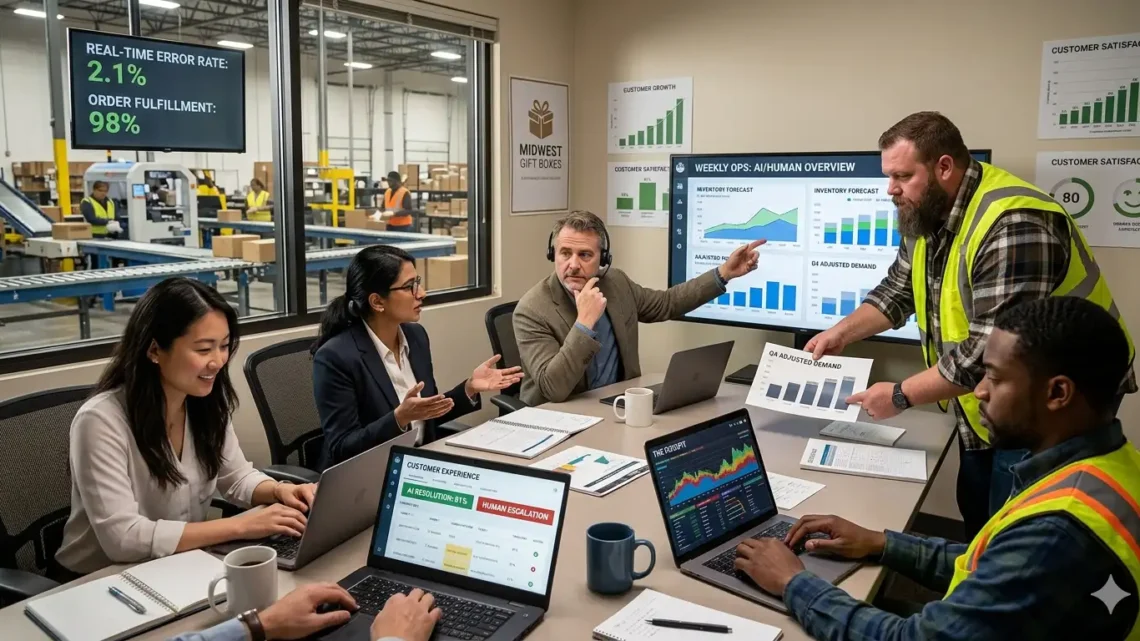
Our error rate dropped to 2.1 percent. Our customer satisfaction score climbed to its highest point in company history. Marcus built an internal dashboard he called “the cockpit,” pulling real-time data from every automated process in the business so the team could see what the machines were doing and intervene when something felt off.
“It’s like having a superpower,” Marcus told me one afternoon, spinning his chair around with the kind of grin that makes a manager’s whole week. “But we’re still the ones wearing the cape.”
I laughed at that. I still think about it.
Today, AI automation touches every layer of what we do. Intelligent process automation handles our reorder logic, our review monitoring, and our carrier performance scoring. A large language model helps generate first drafts of product descriptions that our copywriters refine and elevate.
Our customer service AI now handles 81 percent of inquiries autonomously, with a satisfaction rating that beats our previous human-only score by four percentage points.
But the most important automation I ever built was the one that told me when to turn the rest of it off.
Not a system. A habit. Every Friday morning, I walk the warehouse with Todd. No screens. No dashboards. We talk to the people pulling orders. We open boxes. We touch the product.
We ask questions that no algorithm has thought to ask because no algorithm has ever had a bad week, lost a customer it cared about, or stood in a cold warehouse in December wondering if it made the right call.
The artificial intelligence in our business is smarter than I will ever be at what it does. But it took me losing $190,000 and three months of sleep to understand the most important thing nobody put in any pitch deck.
The intelligence that matters most still lives in the room.