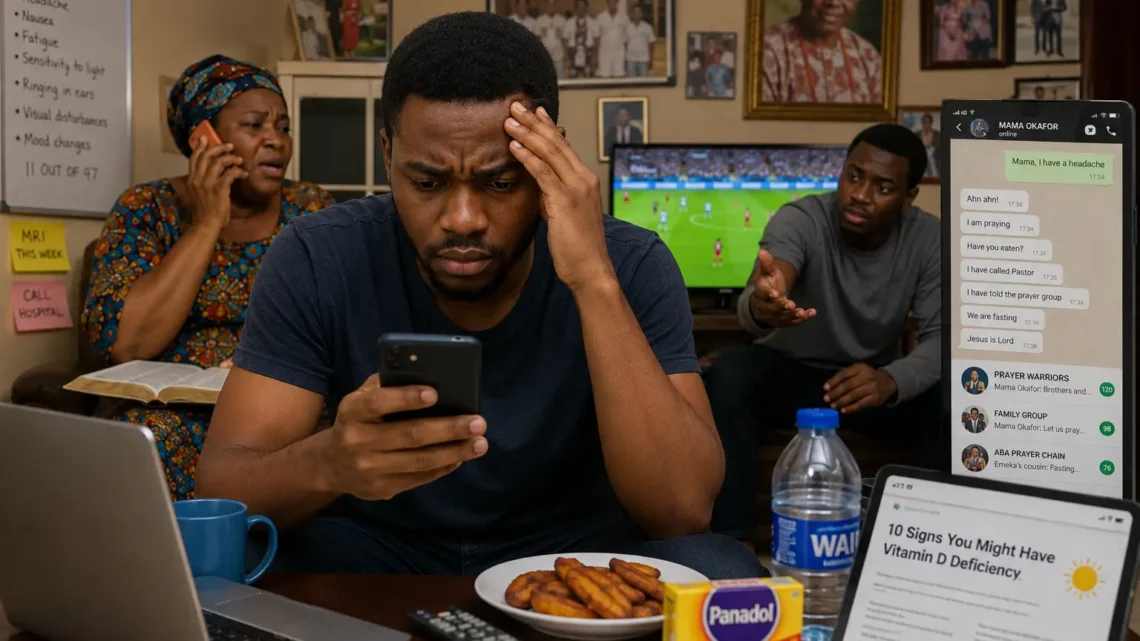
How Google Convinced My Brother He Was Dying on a Tuesday Afternoon
Emeka Okafor had never trusted doctors. Not since 2009, when Dr. Adeyemi told him his chest pain was “stress” and sent him home with a prescription for rest and pap, and three days later Emeka discovered the real problem was that he had been sleeping on his left arm every night for six months.
He had wasted a consultation fee and a bus fare for that. Since then, Emeka decided he would handle his own medical affairs. He had Google. He had data. He had, as he liked to tell people, “a sharp brain that does not panic.”
Trending Now!!:
He was wrong on all three counts.
It started on a Tuesday morning in October, with a headache.
Not a dramatic headache. Not the kind that drops a man to his knees in the middle of Shoprite and makes strangers gather to take videos. Just a dull, persistent throb above his left eye that had been sitting there since he woke up.
Emeka drank a glass of water, ignored it for forty minutes, then made the decision that would unravel the next seventy-two hours of his life.


He typed into Google: “headache above left eye.”
The first result told him it could be a tension headache. Reasonable. Manageable. He scrolled past it.
The second result mentioned cluster headaches. He read three paragraphs and decided he did not have that, because he was not a middle-aged white man in a stock photo holding his head in a kitchen. He scrolled past it too.
The third result was from a medical forum, and it mentioned, buried in the seventh paragraph, the phrase “early-stage brain aneurysm.”
Emeka stopped scrolling.
He read the paragraph four times. Then he read the comments. One person wrote that they had the same headache and turned out to be fine. Emeka dismissed them as naive.
Another wrote that their uncle had ignored a similar headache and died on a Thursday. Emeka read that one six times. By the time he put his phone down, he had already mentally updated his will.
He called his younger brother Chukwudi immediately.
“Chukwudi, I think I have a brain aneurysm.”
There was a long pause on the line.
“Emeka, did you Google yourself again?”
“This is not about Google. This is about symptoms. I have symptoms.”
“What symptoms?”
“Headache.”
Another pause. Longer this time.
“Go drink water and lie down.”
“You are not taking this seriously. This is my life we are discussing.”
Chukwudi sighed the sigh of a man who had been having this exact conversation since 2014, when Emeka had convinced himself he had malaria, dengue fever, and “possibly typhoid as a backup” because he felt hot one afternoon. Chukwudi hung up. Emeka took it as a sign that he needed to do more research.
By noon, Emeka had a new diagnosis.
The headache, he had now determined, was not an aneurysm. It was a brain tumor. Specifically, he had found a list of symptoms online that included persistent head pain, occasional fatigue, and sensitivity to light. He had all three.
He was also, he noticed, feeling slightly nauseous, which he added to his symptom list before realizing the nausea had started after he spent three hours reading about brain tumors on an empty stomach.
He ordered fried plantain from the woman downstairs. He ate it. The nausea disappeared.
He decided the tumor must be intermittent.
At 2 p.m., he texted his colleague Blessing Adaeze at the office to inform her he might need to take medical leave. When she asked why, he typed: “Possible neurological situation. Still investigating.”
She sent back three question marks and a voice note asking if he was joking. He did not respond because he was already on a new website that had introduced him to a condition called “intracranial hypertension,” which, according to the site, was rare but underdiagnosed, frequently mistaken for ordinary headaches, and featured a forum full of people who said doctors never believed them.
Emeka felt deeply seen.
He joined the forum under the username EmekaSurvivor1987 and posted his symptoms. Within twenty minutes, four people had responded telling him to “trust his instincts” and “push for an MRI.” One person sent him a 47-point checklist of symptoms.
Emeka went through the checklist carefully and discovered he had eleven of them, including “occasional ringing in ears” (he had been sitting near a generator for two hours the previous evening), “visual disturbances” (he had looked directly at his phone torch by accident that morning), and “unexplained mood changes” (his landlord had called about the rent).
By 4 p.m., Emeka had been diagnosed, by himself and his new online community, with three separate conditions, two of which contradicted each other.
He had also opened a tab on “how to write a final letter to your family” before catching himself and closing it with the specific energy of a man who was not ready to admit he had gone too far.
He called his mother.
This was a mistake.
Mama Okafor received the news of her son’s possible neurological condition the way she received all difficult news: loudly, and with immediate theological implications.
Within four minutes, she had called her pastor, her prayer group, two cousins in Aba, and Emeka’s father, who was watching football and did not appreciate the interruption. By 5 p.m., there were three separate prayer chains active on different WhatsApp groups, all petitioning heaven on behalf of Emeka’s skull.
Emeka himself was on hold with a private hospital, trying to book an emergency MRI.
The receptionist, a young woman named Sola, asked him calmly what his presenting complaint was.
“Possible intracranial hypertension,” he said. “Or a brain tumor. I have not ruled out aneurysm.”
Silence.
“Sir, are you experiencing severe pain? Vomiting? Loss of consciousness?”
“No, but the internet says these things can be silent killers.”
Sola breathed through her nose. Emeka could hear it. It was the breath of someone paid not to say what they were thinking.
“Sir, MRI slots are booked three weeks out. If you believe you have an emergency, you can visit the ER.”
He did not go to the ER. Instead, he went back to Google and searched “how to tell if your headache is serious.”
The first result said to see a doctor if the headache was sudden and severe, described as “the worst of your life.” Emeka reconsidered. His headache was more of a 4 out of 10. A mild inconvenience, honestly. He had had worse headaches after arguments with his landlord.
He sat with that thought for a moment.
Then he searched “can you have a brain tumor with only mild headaches?”
The answer was yes. Of course the answer was yes. The internet always said yes.
At 7 p.m., Chukwudi showed up at his door with a bottle of Panadol Extra, a sachet of Rehydration Salts, and the expression of someone who had driven across Lagos traffic for this.
“Take two of these,” he said, handing Emeka the Panadol.
“You cannot just suppress symptoms,” Emeka said, accepting the tablets anyway. “That is not medicine. That is denial.”
“You have a headache from staring at your phone for eight hours.”
“You are not a doctor.”
“Neither is Google.”
They sat in silence. Emeka took the Panadol. Chukwudi turned on the TV and found a football match. Thirty minutes passed. The headache, which had been a 4 out of 10, moved to a 1. By the time the first half ended, it was gone entirely.
Emeka stared at the ceiling.
“I feel better,” he said quietly.
“I know,” said Chukwudi.
More silence.
“I want you to know,” Emeka began carefully, “that this does not mean the internet was wrong. Sometimes conditions resolve temporarily before—”
“Emeka.”
“What.”
“Close the tab.”
He closed the tab.
Outside, the prayer chains were still running. His mother’s group was on their second round of intercession. Somewhere in Aba, a cousin was fasting on his behalf.
His forum username EmekaSurvivor1987 had accumulated twelve new responses, all encouraging him to “stay strong” and “not let the doctors gaslight him.”
Emeka quietly deleted the account.
He ate jollof rice that night. He slept well. In the morning, he woke up feeling fine, in excellent health, with no symptoms of any kind.
He stretched. He checked his phone.
He saw a notification from a health website he had subscribed to at some point during the previous day’s research. The headline read: “10 Signs You Might Have a Vitamin D Deficiency.”
Emeka clicked the article.
He read the first three signs.
He had all of them.
He sat up slowly, reached for his phone with the focused calm of a man who had learned absolutely nothing, and typed into Google: “Vitamin D deficiency symptoms.”
The cycle, as it always does, began again.