How I Finally Developed a Personal Style That Actually Felt Like Mine
I remember standing in front of a full-length mirror in a Lagos boutique on a sticky Thursday afternoon, holding a burnt-orange wrap dress that cost more than my electricity bill, and thinking: Who exactly am I dressing for?
It was 2013. I had just turned twenty-six. And I had spent the better part of a decade wearing other people’s taste like a second skin.
Trending Now!!:
My earliest memories of fashion are not glamorous. They are my mother pulling a stiff church blouse over my head every Sunday morning and saying, “You have to look presentable.
People are watching.” And so I grew up believing that clothes were not self-expression. They were a performance. A social contract. A way of saying, I am acceptable. Please approve of me.
By the time I entered the professional world, my wardrobe was a graveyard of other people’s opinions. Pencil skirts because my first boss said they looked “serious.”
Flat shoes because an ex-boyfriend said heels were “too much.” A rotating wardrobe of neutral tones because a fashion magazine I read in 2009 said that capsule wardrobe essentials were the smartest investment a woman could make.


I owned a perfectly curated, completely soulless closet.
And nobody told me that was strange. Because from the outside, I looked put together. I understood sustainable fashion choices. I knew the difference between fast fashion and slow fashion. I could talk about timeless wardrobe staples, the best skincare routine for my skin type, the right color theory for my complexion. I was, by all external metrics, a fashion and beauty enthusiast.
But I felt absolutely nothing when I got dressed in the morning.
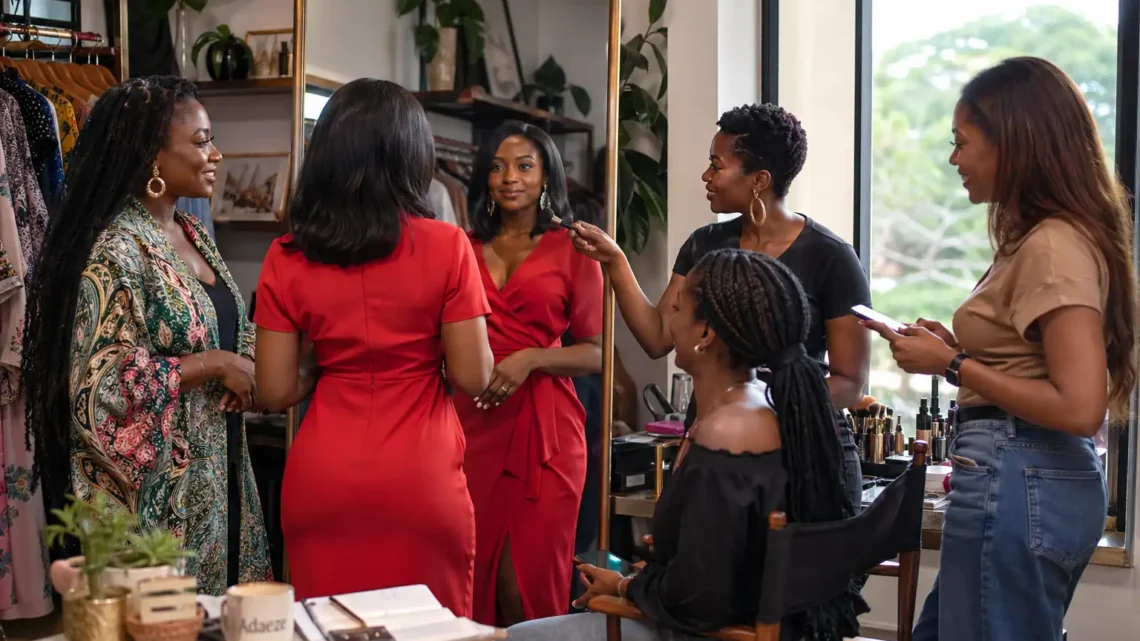
Her name was Adaeze. She had locs down to her waist, nails painted in clashing colors she called “intentional chaos,” and a laugh that arrived before she did. She was a personal stylist who had just opened a studio in Victoria Island, and a mutual friend dragged me there one Saturday with the energy of someone staging an intervention.
“You dress like you’re apologizing,” Adaeze said, not unkindly, the moment I walked in. She tilted her head and looked at me the way a doctor looks at an X-ray. “Everything is correct. Nothing is wrong. And yet nothing is you.”
I laughed nervously. “I thought neutral tones were classic.”
“Classic for who?” she said, pulling a deep cobalt blue blazer off a rack and holding it against my shoulder. “Classic is just a word people use when they are afraid of color.”
She handed me the blazer. I put it on. And I stood in front of her studio mirror and felt something shift very quietly in my chest. Like a door opening somewhere in a dark house.
“That,” Adaeze said, pointing at my reflection, “is a woman who has an opinion.”
The beauty industry will sell you a ten-step skincare routine, the best anti-aging serums, the perfect foundation for your undertone, and a highlighter that promises to make you glow like a solar panel. The fashion industry will show you the hottest runway trends, the must-have luxury handbags, the designer collaborations you cannot miss. And all of it is real, and some of it is genuinely useful.
But nobody sits you down and tells you that personal style is not a product. It is a conversation. A continuous, evolving, sometimes uncomfortable conversation between who you are and who you are becoming.
I spent two hours with Adaeze that first day. We went through her racks and I kept reaching for the “safe” things. The grey. The beige. The structured, responsible blazer in a color that matched everything and said nothing.
“Stop,” she said at one point, gently. “Before you touch anything, tell me: what is a color that makes you feel powerful?”
I thought about it. Really thought about it, for the first time in years.
“Red,” I said. “But I never wear it. It feels like too much.”
“Too much for who?”
I did not have an answer. And that silence was one of the most important moments of my adult life.
Three weeks after meeting Adaeze, I decided to apply the same logic to my beauty routine. I had been doing my makeup the same way since 2010. Subtle eye makeup. Nude lip. A light foundation that my beauty blogger of choice had called “skin-like.” Safe. Invisible. Politely pretty.
I walked into a beauty store on a weekday afternoon with my friend Temi, who has the kind of confidence that makes strangers want to follow her around like ducklings.
“I want to try something different,” I told the makeup artist behind the counter, a young woman named Funke who had a dramatic cut crease and a red lip that looked like a declaration of war. “I don’t know what. Just something I’ve never done.”
Funke looked at my face for a long moment the way Adaeze had looked at my clothes. Then she smiled slowly.
“Bold brows,” she said. “And a berry lip. You have the bone structure for it and you’ve clearly been hiding it.”
“I have?”
“For years, from the look of it.”
I sat in that chair for forty-five minutes. Temi sat next to me, scrolling her phone, occasionally looking up to say things like, “Yes, that,” and “Oh she’s getting there.” When Funke finally turned me to face the mirror, I felt that same thing I had felt in Adaeze’s studio. That quiet door, opening.
“Is this still me?” I asked.
“It’s more you than that other thing was,” Temi said, without looking up from her phone.
I want to be honest here because the internet is full of fashion and beauty glow-up stories that skip the awkward middle part. So here is my awkward middle part.
I overcorrected, spectacularly.
The month after my epiphany, I bought everything in bold colors and nothing in practical silhouettes. I showed up to a client meeting in a silk printed co-ord that was, objectively, a vacation outfit. I experimented with skincare products without patch testing and broke out in a rash across my jawline that took three weeks and a dermatologist visit to resolve. I went through a phase of wearing statement earrings so large that my neck genuinely ached by the afternoon.
I also spent money I did not entirely have. Because nobody warned me that discovering personal style can briefly turn into a very expensive hobby before it becomes a philosophy.
But here is what I learned from the mistakes: the point was never to be perfect. The point was to be intentional. Real personal style, the kind that holds up across years and seasons and fluctuating dress sizes and changing jobs and heartbreaks, is not about having the best outfit. It is about knowing why you put it on.
By year three of what I privately call my “fashion education,” I had started to make genuinely smart choices. I was building a wardrobe of quality basics, ethically made where I could manage it, and investing in versatile pieces that worked across multiple occasions.
I understood my body type not as a limitation but as useful information. I knew my color palette. I had a skincare routine I had built slowly and carefully, one product at a time, with ingredients I had actually researched: niacinamide for uneven skin tone, hyaluronic acid for hydration, SPF every single morning without exception.
I was not following trends anymore. I was following myself.
Adaeze and I had become genuine friends by this point. I called her one evening and said, “I think I finally understand what you meant that first day.”
“What did I mean?” she asked.
“That dressing for yourself is not selfishness. It’s a form of self-knowledge.”
She laughed her big, arriving-before-she-did laugh. “You got there,” she said. “Took you long enough.”
Here is where the story takes a turn I did not expect.
About two years ago, I was at a friend’s birthday dinner, wearing a red wrap dress. Bold brows. A berry lip. Large earrings that no longer hurt my neck because I had found the right lightweight pair. I looked, for the first time in my adult life, exactly like myself.
A woman I did not know came up to me near the bar. Her name was Chiamaka. She was younger, maybe twenty-three, and she was dressed in the way I used to dress. Safe. Correct. Invisible.
“You look incredible,” she said. “Like, genuinely. I never dress like that. I’m always scared it’s too much.”
And I heard myself, before I could think about it, saying the exact words that had changed my life:
“Too much for who?”
She blinked. I smiled.
“Come, let me introduce you to someone,” I said, reaching for my phone to find Adaeze’s contact. “She will ruin your wardrobe in the best possible way.”
Chiamaka laughed. And we stood there at that bar, two women at completely different points on the same journey, and I felt something I had not expected when I started all of this: I felt useful. Not just beautiful. Useful.
Fashion and beauty, at their most powerful, are not about vanity. They are about the extraordinary human project of figuring out who you are, and then being brave enough to show up in that truth every single day.
Even when it costs more than your electricity bill.