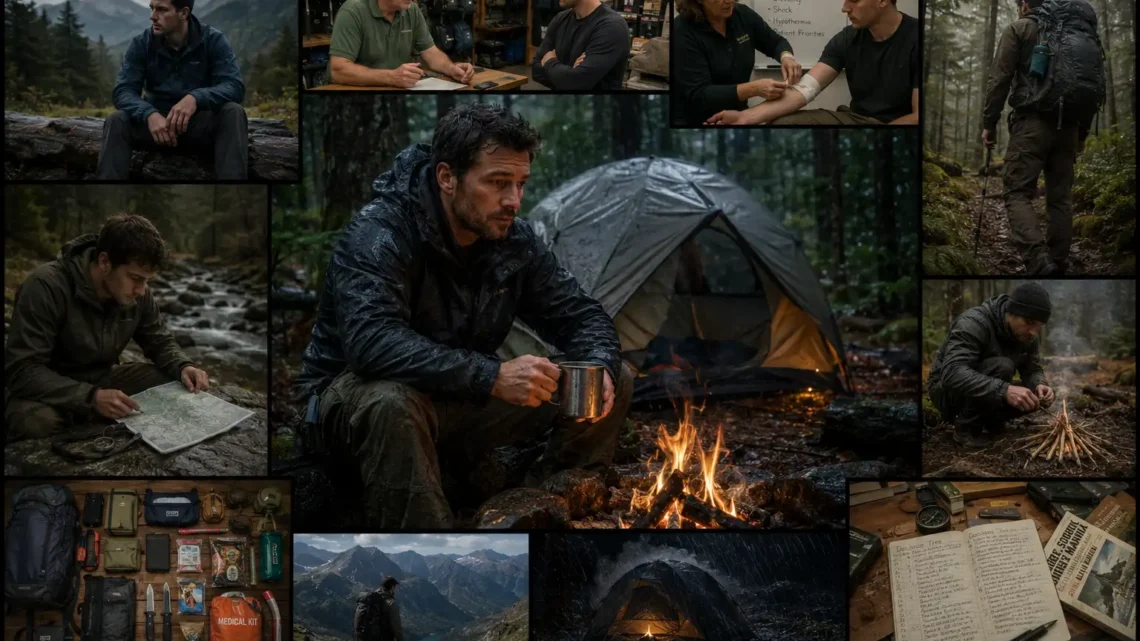
How I Went From Lost in the Woods to Prepared for Anything
The rain started three hours after I pitched my tent.
Not the gentle kind that taps on canvas and sends you to sleep. This was the kind that comes sideways, the kind that has weight and intention.
Trending Now!!:
I was forty miles deep into the Appalachian backcountry, alone, on day six of what was supposed to be a twelve-day solo survival expedition. My fire was already dead.
My emergency bivouac was holding, barely. And somewhere behind the tree line, something large was moving through the underbrush.
I had been prepping for moments like this for eleven years.
I still wasn’t ready.




It had started, as most things do, with a bad experience. I was twenty-four, fresh out of a desk job I hated, and convinced that spending a weekend in the woods with a single backpack would clear my head.
I drove three hours north, parked at a trailhead in Virginia, and walked in with a store-bought survival kit I had never once opened. No map. No compass. A phone that lost signal before I had gone a mile.
By Saturday evening, I was sitting on a wet log, eating a granola bar I had crushed in my jacket pocket, watching the sun disappear behind a ridge I did not recognize. I was not in danger, technically. But I was lost, I was cold, and I was completely and utterly humbled.
I found my way out by following a stream downhill for four hours in the dark.
That night changed everything.
The following Monday, I walked into an outdoor supply store and spent three hours talking to a man named Dale. He was sixty-something, with the kind of forearms you get from actual labor, and he had a habit of pausing before he answered any question, like he was checking the answer against lived experience before he let it out of his mouth.
“You said you followed the stream,” he said, after I told him my story. “That was correct. Water always finds its way to people. But what would you have done if the stream went underground? Or if it dropped off a cliff?”
I had no answer.
“That’s why you learn before you go,” he said. He was not unkind about it. He was just precise. “Survival isn’t about the gear. Gear fails. Survival is about the decision tree inside your head. You build that tree before you ever leave your driveway.”
I bought a topographic map, a quality baseplate compass, and a beginner’s bushcraft manual that afternoon. I also signed up for a wilderness first aid course that Dale recommended, run by a woman named Carol who had spent fifteen years as a search and rescue volunteer in the Rockies.
That was the beginning.
Over the next decade, I became what people in the prepper community call a “serious practitioner.” Not the doomsday-bunker type. Not someone stockpiling enough freeze-dried food to outlast a government collapse.
I was interested in real-world skills: fire starting in wet conditions, water purification without tablets, shelter building with natural materials, off-grid navigation, emergency first aid, foraging for edible wild plants, and long-distance wilderness navigation.
I learned how to build a debris hut. I learned how to use a ferro rod with birch bark in the middle of November. I learned the difference between a useful emergency blanket and a cheap Mylar sheet that will disintegrate in forty-five minutes of real wind.
I learned, through an embarrassing afternoon in the Montana high country, that altitude sickness does not care how experienced you think you are.
I also learned that the best survival tool any human being carries into the field is not a fixed blade knife, not a water filtration system, not a fire kit. It is calm decision-making under physical stress. That skill is harder to build than any other, and it only comes from putting yourself in genuinely uncomfortable situations and practising your way through them.
Which brings me back to that rainy night in the Appalachians.
I had planned the trip carefully. Thirteen days. Solo. No resupply. I was carrying a well-tested bug-out bag configuration, a quality water filter, a 30-litre dry bag with redundant fire-starting systems, and enough high-calorie trail food to push through unexpected delays.
My shelter was a four-season tent I had used in conditions worse than this. My navigation kit included a detailed topo map, a reliable baseplate compass, and a backup GPS device I promised myself I would only use in a genuine emergency.
By midnight on day six, I was beginning to wonder if this qualified.
The temperature had dropped fast, the way it does when cold rain follows a warm afternoon. My tent was holding, but my vestibule had flooded, which meant my boots were sitting in two inches of water.
The noise from the tree line had turned out to be a black bear moving through about thirty meters away, not interested in me, just going about its evening. But the bear had gotten my adrenaline up, and adrenaline in wet cold weather is a physiological problem, not just an emotional one. It burns through your core temperature reserves faster than you think.
I made myself eat. Not because I was hungry, but because I knew I needed the calories. I had a headlamp, dry socks in a sealed bag inside my sleeping bag, and a small canister of emergency hand warmers. I activated two of the warmers, placed them strategically, pulled on the dry socks, and forced myself to lie still inside my sleeping bag for twenty minutes before I assessed anything else.
That discipline, lying still, eating, warming deliberately, came directly from a training weekend I had done two years earlier with a survival instructor named Marcus, a former Army Ranger who now ran backcountry skills workshops in Tennessee.
“When your brain is loud,” Marcus used to say, “your body needs quiet. Feed it, warm it, still it. Then you think. In that order. Always in that order.”
I thought of him while the rain hammered my rain fly and the forest heaved and groaned around me.
By one in the morning, I was warm. By two, I was asleep.
I woke up to birdsong and pale gold light coming through the tent fabric.
Everything outside was soaked. My boots took forty minutes of stuffing with dry moss and rotating near a small fire to reach wearable condition. I lost half a day of planned mileage. But I was intact, I was warm, my water supply was clean, and I had everything I needed to keep going.
I sat by that small fire with a metal cup of instant coffee, watching steam rise off the wet canopy overhead, and I felt something I have only ever felt in the backcountry after a hard night. It is not quite pride. It is quieter than that. It is the specific satisfaction of knowing that you were tested by something real, something that did not grade on a curve or allow a do-over, and that you met it.
I thought about that younger version of myself, sitting on a wet log in Virginia, scared and granola-bar-fed and clueless.
I thought about Dale and his forearms and his careful answers. I thought about Carol teaching me how to improvise a pressure bandage from a piece of clothing. I thought about Marcus telling a group of us, in the rain, that suffering is just information your body is sending you, and that information can be managed.
Seven days later, I walked out of those mountains on schedule.
If you are thinking about getting into wilderness survival, emergency preparedness, or backcountry travel, I will give you the same advice Dale gave me in that outdoor supply store over a decade ago, translated through everything I have learned since.
Start with the decision tree. Before the gear, before the knife reviews and the bug-out bag checklists and the freeze-dried food comparisons, build the mental framework. Take a wilderness first aid course. Learn your map and compass before you rely on any GPS device.
Practice your fire craft in your backyard in November, when everything is wet. Sleep outside in uncomfortable conditions on purpose, close to home first, before you take that discomfort forty miles into the backcountry.
The forest will test you. It is not personal. It is not malicious. It is simply indifferent, and indifference requires preparation in a way that hostility does not.
And when the rain comes sideways at midnight, and something large is moving in the dark, and your boots are wet, and your adrenaline is high, you will be very glad you did the work.
You will eat. You will warm yourself. You will lie still.
And in the morning, there will be birdsong.