I Built a Career on Honest Software Reviews. Then I Stopped Being Honest With Myself
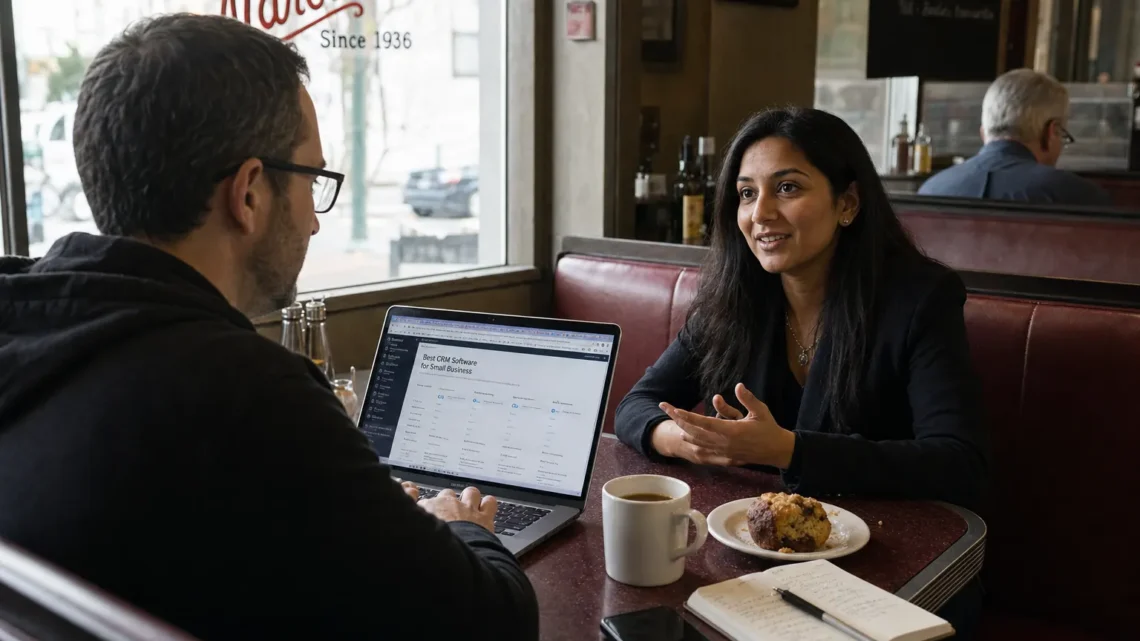
The coffee at Marco’s diner on the corner of Fifth and Clement was always terrible. Burnt, thin, and served in a cup too small for the mood I was usually in when I sat there.
But I kept going back every Tuesday morning because the corner booth had an outlet, strong Wi-Fi, and nobody ever bothered me.
Trending Now!!:
That particular Tuesday in 2017, I had seventeen browser tabs open, a half-eaten blueberry muffin going stale beside my laptop, and a growing sense that I was about to ruin someone’s business.
I had been reviewing software professionally for nine years by then. SaaS products, cloud-based platforms, project management tools, CRM software, enterprise resource planning systems, you name it. If it ran on a subscription model and promised to change the way your team worked, I had probably spent forty hours inside it, breaking things on purpose just to see how it would behave.
“You’re the guy who reviews the apps, right?”
That was how Priya introduced herself to me the first time, three years earlier at a tech networking event in San Francisco. She had the kind of energy that made you feel like you were already behind on something important, and she shook my hand like she was closing a deal.




“I read your breakdown of that project management software last year,” she said, not letting go of my hand yet. “The one where you compared the five most popular platforms side by side. That piece saved my company four thousand dollars.”
I told her I was glad. I meant it. That was exactly why I did what I did.
When I started writing software reviews back in 2008, the SaaS industry was still young enough that most small business owners had no idea how to evaluate a cloud-based tool on their own. Free trial periods were confusing. Pricing pages were deliberately opaque. Sales reps called you the moment you signed up for a demo, and by the time the call ended, you had somehow agreed to an annual subscription for features you would never use.
My job was to cut through all of that. I would sign up for the free tier, then pay out of pocket for the paid plan, document every click, test every integration, hammer the customer support team with questions at 11 p.m., and then sit down and write the most honest, detailed review I could produce.
I covered everything from marketing automation software to cloud accounting platforms to AI-powered customer service tools. I became known for being fair but brutal. If a SaaS product had a beautiful landing page and a broken onboarding flow, I said so. If the pricing model was structured to trick users into upgrading before they were ready, I said that too.
“You’re not a reviewer,” my editor James once told me during one of our early phone calls. “You’re a consumer protection officer with better adjectives.”
I laughed at that. But I also kept it.
By 2015, my site was pulling serious traffic. I had developed a reputation as one of the most trusted voices in independent SaaS reviews and software comparisons. Affiliate commissions were coming in from multiple directions, software companies were offering me early access to beta versions, and I had built an audience of startup founders, operations managers, and small business owners who actually waited for my verdicts before making purchasing decisions.
That kind of trust is a heavy thing to carry. I did not always understand how heavy until the Tuesday with the terrible coffee.
Priya had reached out to me two weeks earlier. Her startup had scaled from eight to forty employees in eighteen months, and the homemade spreadsheet system they had been using to track customer relationships was falling apart at the seams. She needed a CRM. Something robust enough for a growing sales team, flexible enough to integrate with their existing marketing automation software, and priced in a way that would not crush a Series A budget.
She had narrowed it down to three options and wanted my recommendation.
I reviewed two of them thoroughly. The third one, I had covered in a short piece the previous year and I told myself I remembered it well enough. The platform had looked solid back then. Clean interface, strong pipeline management features, decent API documentation. I gave Priya my recommendation based largely on that twelve-month-old memory and a forty-minute skim of their updated feature list.
I did not go back and actually use the product.
That was the mistake.
Three weeks after Priya’s team deployed the new CRM, she sent me a message that I read standing in my kitchen at 7 a.m. and then sat down on the floor and read again.
“The CRM you recommended doesn’t support bulk email sequences the way we need it to. The API integration with our marketing stack is broken, and their support team has been giving us the runaround for eleven days. Our sales pipeline is a mess. I trusted your recommendation.”
I stared at that last sentence for a long time.
I trusted your recommendation.
I called her. She picked up on the second ring and her voice was tired in the way that only comes from nights spent fixing someone else’s problem.
“I’m not calling to yell at you,” she said. “I just want to understand what happened.”
I told her the truth. I told her I had relied on outdated experience with that particular platform and had not done the deep testing I should have done before attaching my name to it. I told her it was my fault. There was no deflecting it.
“How long have you been doing this?” she asked.
“Ten years,” I said.
There was a pause.
“Ten years and you still made that mistake,” she said. Not angrily. More like she was filing the information away somewhere.
“Yes,” I said. “I did.”
She ended up migrating to a different platform three months later, one that I recommended after spending six full weeks inside it, testing every single feature from the contact management system to the sales forecasting tools to the mobile app performance on a four-year-old Android phone.
I wrote the review as a public correction on my site. I explained what I had done wrong with my previous recommendation, why it had failed Priya’s team, and what I had done differently this time.
That post generated more reader mail than anything I had published in the previous four years.
“Thank you for being honest about the mistake,” one reader wrote. “Most people in your position would have quietly deleted the old review.”
Another one, a founder from Austin named Derek, told me the correction piece had become required reading in his company’s software evaluation process.
“You showed us what real software due diligence looks like,” he wrote. “Both times. The mistake and the fix.”
Priya and I stayed in contact. She went on to build one of the better-known SaaS comparison resources for mid-market companies in the hospitality space, and she hired me to consult on their review methodology in 2020. We met for coffee when she was in the city, and she always insisted on choosing the place, which meant the coffee was always good.
One afternoon, sitting across from her in a bright little cafe near Union Square, I watched her pull up a software pricing page on her laptop and immediately start clicking toward the fine print in the terms of service.
“You learned that from me,” I said.
“I learned that from you,” she confirmed, without looking up.
I have reviewed hundreds of SaaS products over the course of my career. Cloud-based tools, subscription software platforms, enterprise business software, AI-driven productivity apps, no-code automation tools, digital collaboration suites.
The industry keeps expanding and the products keep multiplying and the marketing keeps getting more sophisticated and more difficult to see through.
But the job has never actually changed. You sign up. You dig in. You break things on purpose. You read the fine print. You talk to customer support at 11 p.m. And then you sit down and tell the truth, even when the truth includes the part where you got it wrong.
Especially then.
The coffee at Marco’s diner is still terrible. I still go there on Tuesday mornings because the outlet works and nobody bothers me. But now, before I write a single word of any review, I open the product itself. Not the website. Not the feature changelog. The actual product.
It sounds obvious.
The obvious things always do, once you have learned them the hard way.