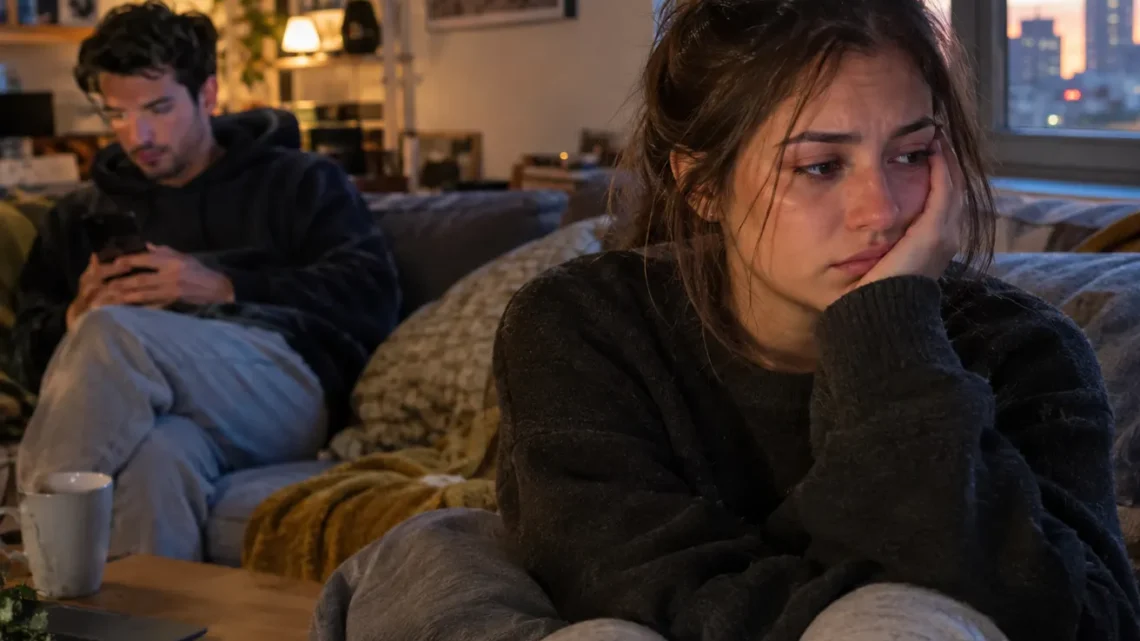
I Cheated on My Girlfriend, Then Called Her Insecure for Suspecting Me
The first time Amara asked me if I was cheating, I laughed.
Not because the question was funny. Not because I was innocent. I laughed because I had spent six months building a lie so carefully that, for a moment, I actually believed I could talk my way out of anything.
Trending Now!!:
We were sitting in my car outside her apartment in Surulere, Lagos. The air conditioner was making a tired clicking sound, my phone was face down between the seats, and a half-empty bottle of water had been rolling around the floor since the previous evening.
Amara looked at me without blinking.
I need you to tell me the truth, Daniel. Just this once.
I kissed my teeth, adjusted my seat belt even though the car was parked, and asked her what she was talking about.




That was how I answered the woman I had spent three years telling I would never hurt.
My name is Daniel, and at the time, I thought being smart meant knowing how to get away with things. I was twenty-nine, working in a small digital marketing agency around Ikeja, earning enough to pay my bills if I behaved myself and not nearly enough to live the life I kept showing people online.
Amara was twenty-seven. She worked as an administrator for a private school in Surulere. She had a small collection of perfumes, loved fried plantain with almost everything, and could spend forty minutes choosing a movie only to fall asleep twenty minutes into it.
She was the kind of woman who remembered small things.
If I mentioned that my mother needed new glasses, Amara would ask about them two weeks later. If I complained that my work shoes were hurting me, she would send me a link to a sale she had seen on Instagram.
She remembered my interview dates, my father’s birthday, and the names of colleagues I had mentioned only once.
I remembered those things about her too. I just stopped treating them as reasons to be careful with her.
We met in 2022 at a friend’s birthday dinner in Yaba. I arrived late because of traffic, and she was already complaining that the restaurant had taken nearly an hour to bring their food.
She looked at me when I sat down.
You must be the famous Daniel. The one who is always coming.
Coming where?
Late. Apparently, it is your brand.
Everyone laughed. I laughed the loudest.
After that evening, we started talking. The conversations became daily, then nightly, then the kind where you no longer ask whether the other person is free before calling.
When my salary was delayed one month, she lent me money for transport without making me feel small. When her younger brother had problems with his university registration, I spent an afternoon helping her figure out the payment process.
We were not a perfect couple. We argued about my habit of cancelling plans at the last minute. She could be stubborn when she believed she was right. I sometimes felt that she wanted to know too much about where I was and who I was with.
At the time, I called that pressure.
Looking back, I think I wanted the comfort of a relationship without accepting the responsibilities that came with it.
The trouble started at a colleague’s birthday party in Lekki.
Her name was Tomiwa. She worked in sales for a company that supplied office equipment, and she had a way of making every ordinary conversation feel like something exciting was about to happen.
She laughed at my jokes. She told me I dressed well. She noticed when I changed my haircut.
None of those things were unusual. People flirt. People enjoy attention. The problem was what I did with it.
I started looking forward to her messages.
At first, our conversations were about work. Then they became jokes about colleagues, complaints about our bosses, and discussions about where to get good food after work. Eventually, we were sending messages after midnight.
I told myself it was harmless because we had not slept together.
That was the first lie I told myself.
The second was that Amara did not need to know about Tomiwa because there was nothing serious between us.
The third was that I could stop whenever I wanted.
I became very good at hiding things.
I changed Tomiwa’s contact name to Office Projects on my phone. I turned off message previews. When Amara called while I was with Tomiwa, I would say I was in a meeting or that the office was noisy.
Sometimes, I would be sitting beside Amara on her bed, watching her scroll through videos, while I replied to another woman’s messages under the blanket.
I knew what I was doing.
That is the part I cannot soften, no matter how many times I tell this story.
I was not confused. I was not trapped in a complicated situation. Nobody forced me to continue.
I enjoyed the attention, and I enjoyed the feeling that I was clever enough to manage two different versions of my life.
Whenever Amara asked why I had become distant, I blamed work. When she complained that I was always holding my phone, I accused her of being insecure.
One Friday, she asked me to accompany her to buy a birthday present for her mother. I had already arranged to meet Tomiwa after work.
I told Amara that an urgent client meeting had come up.
She went shopping alone.
That evening, she sent me a picture of a handbag she had bought. She wanted to know whether her mother would like it. I looked at the picture while sitting across from Tomiwa at a restaurant in Victoria Island.
I replied that it looked perfect.
Then I put my phone away and continued eating.
I did not think about what Amara had done that afternoon. I did not picture her carrying shopping bags through the crowded streets, checking her phone to see whether I had finished my meeting.
I thought about whether Tomiwa would agree to see me again the following week.
That is how selfishness works sometimes. It does not always look like a person shouting or doing something obviously cruel. Sometimes it looks like an ordinary man enjoying his meal while somebody who loves him waits for a message.
By the time Amara began asking direct questions, I had already convinced myself that the relationship was becoming difficult.
I told my friends that she was suspicious of everything. I said I felt like I had to report my movements to her. One friend, Femi, told me that if I wanted to be single, I should simply end the relationship.
I laughed at him.
You think life is that simple?
No, he said. I think you want to eat your cake and still complain that somebody is watching you eat it.
I told him he had been watching too many relationship podcasts.
I did not stop cheating.
The night everything began to fall apart was not special. There was no storm, no dramatic party, no strange coincidence that I could blame on fate.
It was a Wednesday.
I had arrived home late after work and spent twenty minutes in the bathroom replying to Tomiwa. When I came out, Amara was sitting on the edge of the bed, eating biscuits from a small packet.
She had come over to spend the night because we had planned to attend a family event together the next morning.
She looked tired.
Who were you talking to?
Work.
At eleven thirty?
Some people have work to do, Amara.
She looked at the phone in my hand.
Can I see it?
I stared at her.
Are you serious?
Yes.
I started laughing again. I told her that adults should have privacy, that relationships needed trust, and that it was unfair to treat a partner like a criminal.
Everything I said sounded reasonable if you ignored the fact that I was using it to protect a secret.
She did not shout. That made me more uncomfortable than shouting would have.
She put the biscuits on the bedside table and asked me one question.
If I gave you my phone right now, would you be comfortable with me reading every message inside it?
I said yes.
She held out her hand.
For a few seconds, I considered giving her the phone. Then I remembered the messages, the pictures, the jokes, the plans I had made with Tomiwa while telling Amara that I was too busy to see her.
I told her she was being childish.
She stood up, picked up her handbag, and said she was going home.
I followed her to the door. I apologised for the argument without admitting what had caused it. I told her I loved her. I said I was stressed and that she was making everything harder than it needed to be.
She listened.
Then she left.
I did not follow her downstairs. I told myself she needed time to calm down.
The next morning, she sent me a message asking if we could meet after work. I agreed, and I spent most of that day trying to prepare for a conversation I still believed I could control.
I deleted messages from Tomiwa. I cleared recent calls. I removed a few pictures from my gallery and checked my phone settings twice.
I even practised what I would say if Amara asked me again.
That afternoon, we met in my car outside her apartment in Surulere.
That was when she asked if I was cheating.
I laughed, denied it, and asked what had put the idea in her head.
She reached into her handbag and took out her phone.
She did not show me a long conversation or a collection of photographs. She opened a single message and turned the screen towards me.
It was from Tomiwa.
Tell your girlfriend you cannot come this weekend. You already promised me Saturday.
I knew the message. I had seen it two nights earlier.
What I did not know was how Amara had seen it.
Apparently, I had once connected my WhatsApp account to a computer at her apartment while using her Wi-Fi. I had forgotten to log out. A few days before our argument, she had opened her laptop to print a document and seen my messages appear on the screen.
She told me she had not gone looking for them.
I wanted to believe her. I also wanted to be angry about the invasion of privacy, because anger felt better than shame.
You read my private messages? I asked.
She looked at me for a long time.
That is what you are worried about?
I opened my mouth, then closed it.
She told me she had read enough to understand what was happening. She had seen the late-night messages, the plans, and the things I had said about her. She had also seen messages where I complained that she was becoming suspicious and difficult.
She did not tell me everything she had read. I think some of it was too painful to repeat.
I started explaining.
I said Tomiwa and I had made a mistake. I said things had gone further than I intended. I said I was going to end it. I told Amara that she was the woman I wanted to be with, that what we had was real, and that I had never planned to leave her.
She listened until I ran out of things to say.
Then she asked something I had not prepared for.
How long have you been making me feel stupid for noticing what you were doing?
I had no answer.
She reminded me of the nights she had apologised for asking questions. She remembered the time I accused her of ruining a good evening because she wanted to know why I had disappeared for four hours. She remembered the day she cried in my room and I told her she needed to work on her trust issues.
I remembered those things too.
I had thought I was winning every time she accepted my explanation.
I had not understood that I was teaching her to doubt herself.
I started crying. Not in a way that made me look good, either. My nose was running, my voice kept breaking, and I was wiping my face with the sleeve of a shirt I had bought the previous week.
I told her I was sorry.
I told her I would block Tomiwa. I said we could go for counselling if she wanted. I offered to give her my phone whenever she needed it. I promised there would be no more secrets.
She looked out of the window at a woman carrying a plastic bowl across the street.
You know what is painful? she said. I believed you every time.
I reached for her hand. She moved it away.
I kept thinking that maybe I was becoming the kind of person who suspects everybody. I was trying to fix myself because you kept telling me the problem was in my head.
I wanted to tell her that I had never meant to make her feel that way.
The words stayed in my throat because I knew they would not change anything.
I had not planned to destroy her trust. I had simply decided, day after day, that my enjoyment mattered more than her peace of mind. The damage was not an accident just because I had failed to imagine its full size.
She told me she still loved me.
That was worse than if she had said she hated me.
I still love you, Daniel. I just do not know what to do with that anymore.
I asked whether there was any chance we could work things out.
She said she did not know.
Then she opened the car door and stepped outside. Before closing it, she leaned down and looked at me.
Please do not make me explain this to you again.
She walked towards her building.
I sat in the car for nearly an hour. I watched people buying food from a roadside seller and heard the horns of cars fighting for space on the road. A man in a faded football jersey was arguing with a delivery rider about a package.
The world continued with an almost insulting level of normality.
My phone buzzed.
It was Tomiwa asking if I was still coming to see her that evening.
I stared at the message until the screen went dark.
Then I replied that we needed to stop seeing each other.
She asked if something had happened. I said yes. She asked whether Amara knew.
I did not answer that question.
I blocked her number, although I cannot pretend that blocking it was some great act of sacrifice. I should have done it months earlier, before there was anything to confess.
For the next few weeks, I kept finding reasons to contact Amara.
I sent messages about things she had left at my apartment. I asked whether she had received a parcel that was delivered to my address by mistake. I forwarded a funny video because it reminded me of something we used to laugh about.
Sometimes she replied with one sentence. Sometimes she did not reply at all.
I started going to places we had visited together, partly because I missed her and partly because I did not know what to do with the hours we used to spend together.
The restaurant in Yaba where we first met became uncomfortable to pass. I stopped buying the biscuits she liked because seeing them on a supermarket shelf made me feel ridiculous.
I also became angry with myself for being sad.
I was the one who cheated. I was the one who lied. Yet I sometimes caught myself thinking that Amara had abandoned me when I was trying to change.
It took time to understand how unfair that thought was.
I had mistaken her willingness to forgive me for an obligation to remain with me.
Months later, Femi asked whether we had got back together. We were sitting at a small restaurant in Ikeja, waiting for plates of rice that had taken too long to arrive.
I told him we had not spoken properly in weeks.
He nodded and continued eating.
I wanted him to tell me I was a good person who had made a bad decision. I wanted him to say that Amara would eventually realise how much I loved her. I wanted a version of the story where my regret counted as much as her pain.
He did not give me any of that.
Instead, he asked whether I had learnt anything.
I told him I had learnt not to cheat.
He looked at me.
You already knew that before you started.
I could not argue with him.
The harder lesson was that I had become comfortable hurting someone as long as I could control what they knew about it. I thought honesty was something I could choose when it became convenient. I thought loyalty meant never getting caught doing something wrong.
I was smart enough to hide the messages.
I was not smart enough to understand what I was destroying.
Amara and I have not got back together. I heard from a mutual friend that she has been doing well, although I do not ask for details anymore. I sometimes wonder whether she remembers the good parts of our relationship or whether everything has been coloured by the way it ended.
That is a selfish thing to wonder, I know. Even now, a part of me wants to know whether I still occupy a good place in her memory.
I have dated since then, but I have not told every woman I meet the full story. I tell them I once handled a relationship badly. I say I learnt from it. Those statements are true, but they are also convenient.
The full truth is uglier.
I knew Amara trusted me. I knew she was afraid of being betrayed because she had watched people she loved go through it. I knew that when she questioned me, she was asking for reassurance, not trying to control my life.
I used those fears against her because they made my lies easier to maintain.
Sometimes I think about calling her and apologising again. Then I ask myself whether the call would be for her benefit or mine. I have already said sorry. She has already heard me. Another apology would not return the nights she spent wondering whether she was losing her mind.
There is a picture of us somewhere in my old phone. We are standing outside a supermarket, arguing about which ice cream to buy. Amara is laughing at something I said, and I am looking at her instead of the camera.
I have not deleted it.
I am not sure whether keeping it means I still love her, whether I am holding on to the man I thought I was, or whether I simply cannot bring myself to remove the last easy piece of a life I ruined with my own decisions.
I used to think being smart meant having an answer ready before anyone asked a question.
Now, when I remember that day in the car, I remember the way Amara looked at me after I laughed. She was not looking at a man who had made one terrible mistake. She was looking at someone who had spent months teaching her that her own eyes and instincts could not be trusted.
I lost her long before she opened that car door.
I just did not know it yet.
The worst part of cheating is not always losing the person you love. Sometimes it is realising that you made them feel foolish for trusting you, then discovering that no amount of regret can make them feel safe with you again.
I thought I was smart enough to cheat without getting caught, but all I really did was teach the woman I loved how to live without me.