I Quit My Job, Packed One Bag, and Worked From 14 Countries. Here Is What Nobody Tells You
The coffee in Chiang Mai costs less than a dollar. The Wi-Fi was faster than anything I ever had in my apartment back in Manchester.
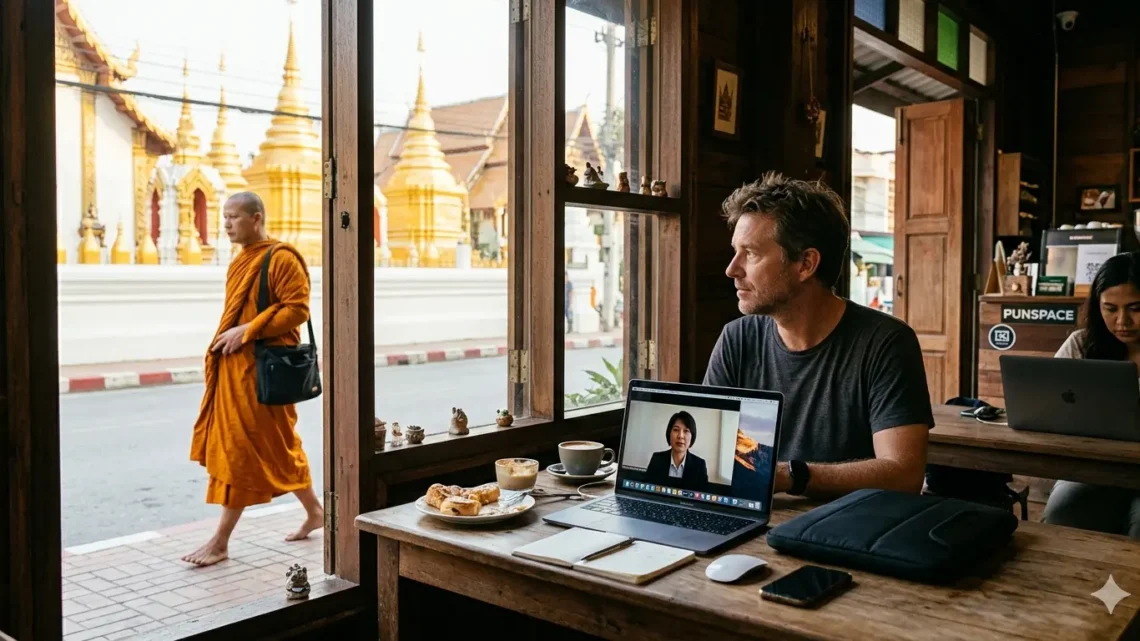
Outside the window, a monk in saffron robes walked barefoot past a row of golden temples, and I was on a Zoom call with a client in San Francisco who had absolutely no idea I was sitting inside a wooden café in northern Thailand at seven in the morning, still wearing the same linen shirt I had slept in.
Trending Now!!:
That was 2015. I had been a remote worker for exactly eleven days, and I genuinely believed I had cracked the code of modern living.
I had not.
But let me back up, because the real story does not start in Thailand. It starts in a grey open-plan office in London, where I spent four years as a UX designer, staring at the same damp water stain on the ceiling tile above my desk and wondering if this was actually it.
My manager at the time was a man named Derek. Derek had a habit of scheduling Monday morning meetings at eight-thirty sharp, not because anything urgent ever came out of them, but because, as he once told me with the confidence of someone who had never questioned a single decision in his life, “Face time builds culture, mate.”




I used to sit in those meetings with my coffee going cold, watching the clock, calculating how many more Mondays I had left before I retired, and feeling something close to physical pain.
I was twenty-eight. The math was not encouraging.
The pivot happened on a Tuesday, which is perhaps the most unromantic day of the week for a life-changing decision, but that is how it actually went. I was browsing a remote work forum late at night, deep in a rabbit hole of blog posts and Reddit threads about the digital nomad lifestyle, when I found a thread from a guy named Marcus, a freelance developer from Berlin who had been working remotely for three years.
He had posted a photo of himself working from a rooftop in Lisbon, laptop open, a glass of wine beside him, the Tagus River glittering behind him in the late afternoon sun.
Somebody in the comments had typed, “Must be nice. How do you actually pay your bills though?”
And Marcus replied, without a single drop of defensiveness: “Same way you do. I just do it in a nicer view.”
I screenshot that exchange. I still have it.
I spent the next eight months building a freelance UX design portfolio on the side of my full-time job. I took on small projects through platforms like Toptal and Upwork. I learned about asynchronous communication, about building client relationships entirely through email and video calls, and about how to price remote freelance work properly so you are not constantly undercutting yourself to land jobs.
I read every article about remote work productivity I could find. I watched YouTube channels run by people living the laptop lifestyle in places like Bali and Medellín, half inspired, half skeptical, because even then I suspected the curated version of nomadic living was hiding something true and difficult underneath.
I resigned from my job in April. Derek looked genuinely confused, like I had told him I was leaving to become a lighthouse keeper. “You’re throwing away stability,” he said. “You know that, right?”
“I know,” I said. And I meant it as a compliment to myself.
My first destination was Chiang Mai, Thailand, which at the time was arguably the most popular digital nomad hub in the world, and for good reason. The cost of living was extraordinarily low. There were co-working spaces everywhere. The food was incredible.
The internet infrastructure was reliable. And there were dozens, maybe hundreds of other remote workers and location-independent professionals scattered across the city’s cafes, doing exactly what I was trying to do, which meant there was a built-in community waiting for me before I had even unpacked.
I found a co-working space called Punspace on my second day. I walked in, paid for a weekly hot desk membership that cost less than two cups of coffee back home per day, opened my laptop, and immediately felt something I had not felt in years sitting at a desk. I felt present.
The woman at the desk beside mine was a copywriter named Aisha, originally from Toronto, who had been nomading for fourteen months and had the calm, slightly weathered energy of someone who had already made every mistake I was about to make.
“First week?” she asked, without looking up from her screen.
“Is it that obvious?”
“You have a brand new laptop sleeve, you keep checking your Wi-Fi speed, and you look terrified.” She finally looked over and smiled. “Relax. It gets less scary. Then it gets complicated. Then it becomes your normal.”
She was exactly right, in exactly that order.
The terrifying part lasted about three weeks. I was chasing clients across ten-hour time differences, sleeping at odd hours to make myself available for calls, undercharging because I was still not confident enough to hold my rates, and eating pad thai for every meal because decision fatigue had completely destroyed my ability to choose anything more complex than pointing at a menu photograph.
I missed deadlines by hours, not because I was lazy but because I had wildly underestimated how much mental energy it takes to manage your own schedule when there is no office structure forcing you into shape.
I also learned something that no remote work guide I had ever read told me clearly: loneliness in the digital nomad life is not the absence of people. It is the presence of people who are always leaving.
Aisha moved to Vietnam after six weeks. A guy named Tomás, a Spanish SEO consultant I had befriended over shared lunches and long conversations about passive income strategies, left for Medellín after two months. Every person I got close to had a flight booked to somewhere else.
The transience was built into the lifestyle, and while it made every connection feel intense and meaningful, it also meant that nothing ever settled long enough to feel like home.
By month four, I was in Bali. By month seven, I was in Lisbon. I worked from beachside cafes in Porto, from a tiny apartment above a bakery in Barcelona, from a co-living space in Budapest full of remote software engineers, digital marketers, and one extremely enthusiastic podcast producer named Priya who could explain content monetization strategy in between bites of a chimney cake and somehow make it sound like the most exciting thing happening on the planet.
The work, I should say, was genuinely good. I had built a stable roster of four long-term clients. My monthly income had grown steadily as I learned how to position myself as a specialist rather than a generalist, which is the single most important freelance business lesson I can pass on to anyone starting this journey.
I was earning more working remotely than I had ever earned in my London office job, and I was working fewer hours. The productivity gains from cutting out the commute, the pointless meetings, the office politics, the performance theater of being seen to be busy, were enormous. The flexibility was real. The freedom was real.
But so was the cost.
In month nine, in a small apartment in Lisbon with a view of the River Tagus, I sat on a video call with my mother back in Manchester. She was showing me the garden she had been working on all spring. The roses were blooming. My younger sister’s daughter, my niece Ella, was toddling around in the background, grabbing at petals, laughing at nothing in particular the way only very small children can.
“She’s walking properly now,” my mother said, with this quiet, careful note in her voice that I recognized immediately because she used it only when she was trying very hard not to say what she was actually feeling. “She asked where Uncle was last Sunday.”
I did not say anything for a moment.
“I’ll be back for Christmas,” I said eventually.
“I know,” she said. And she smiled, and we talked about something else, and when the call ended I sat in the Lisbon light for a long time and thought about the real arithmetic of the lifestyle I had chosen, the calculation that nobody includes in the blog posts and YouTube thumbnails.
Location independence is real. But so is emotional geography. The places you love most are not always places with great Wi-Fi and low cost of living. Sometimes they are just the specific kitchen where someone who loves you is making tea.
I went home for three weeks at Christmas. Ella climbed into my lap on day one and fell asleep there. My mother cooked a lamb roast and we sat around the table talking for four hours, and my father told the same two stories he always tells and I laughed at both of them like I was hearing them for the first time because in a way I was, because I had missed him enough that even the familiar things felt precious.
I came back to the nomad life in January. But something had shifted in how I held it.
I am writing this from Medellín, Colombia, which has become my primary base for the last two years. I am not fully nomadic anymore. I have an apartment here.
I have a coffee shop three minutes away where the owner, a man named Carlos, knows my order before I open my mouth. I have a local gym, a farmers market I go to every Saturday, a small circle of friends who are mostly a mix of local Colombians and long-term expat remote workers who all made similar choices to mine, arrived somewhere, slowed down, and decided to stay long enough for the place to become real.
I still travel. I still work entirely remotely. I took a two-week workation in Japan last autumn, sitting in a co-working space in Tokyo with a view of the city skyline, marveling at the absolute precision of everything around me while on a call with a client in New York who could not comprehend how I was available at ten in the morning his time while simultaneously being very much alive and not miserable. I went to Cape Town in March. I am planning Buenos Aires in September.
But Medellín is home now. A real one.
The digital nomad lifestyle, the genuine version of it, not the Instagram version, is not a permanent vacation. It is a serious restructuring of how you organize your professional life, your financial life, and your emotional life all at once. The remote work skills that actually matter are not the glamorous ones.
They are things like communication discipline, output-based time management, client expectation setting, knowing how to build a remote income stream that is resilient enough to survive a bad month in an unfamiliar country, learning to protect your mental health when there is no office community holding you in place, and no manager checking whether you are okay.
I have made every mistake this lifestyle offers. I have lost a major client because of a time zone miscommunication, which I was too arrogant to double-check. I have taken too many trips in too short a time and arrived somewhere beautiful, feeling too exhausted to enjoy it.
I have had weeks in foreign cities where the loneliness sat on my chest like something physical, and I ordered room service and watched television and did not talk to another human being for three days.
I have also sat on the terrace of my apartment in Medellín on a Friday evening, with the Andes visible in the distance going pink and amber in the fading light, finishing a project for a client in Amsterdam, thinking about absolutely nothing difficult, and felt a quality of contentment that I am honestly not sure I have a good word for.
Derek emailed me once, about two years after I quit. He was asking if I knew any good remote UX designers he could recommend to a contact. I told him I would keep an ear out. Before he signed off, he added a line at the bottom: “Looks like you figured it out, mate. Fair play.”
I did not write back that I was still figuring it out. I did not write back that figuring it out is the wrong frame entirely, because the point is not to arrive somewhere perfect but to build something honest and sustainable and yours.
I just wrote “Thanks, Derek” and closed the laptop and walked downstairs to meet Carlos for a coffee that cost eighty cents and tasted like something I would fly across the world for.
Which, in a sense, I did.