I Spent $14,000 on a Degree That Couldn’t Get Me a Job. Then a $29 Course Changed Everything.
The fluorescent light above my cubicle flickered every forty seconds. I know because I counted.
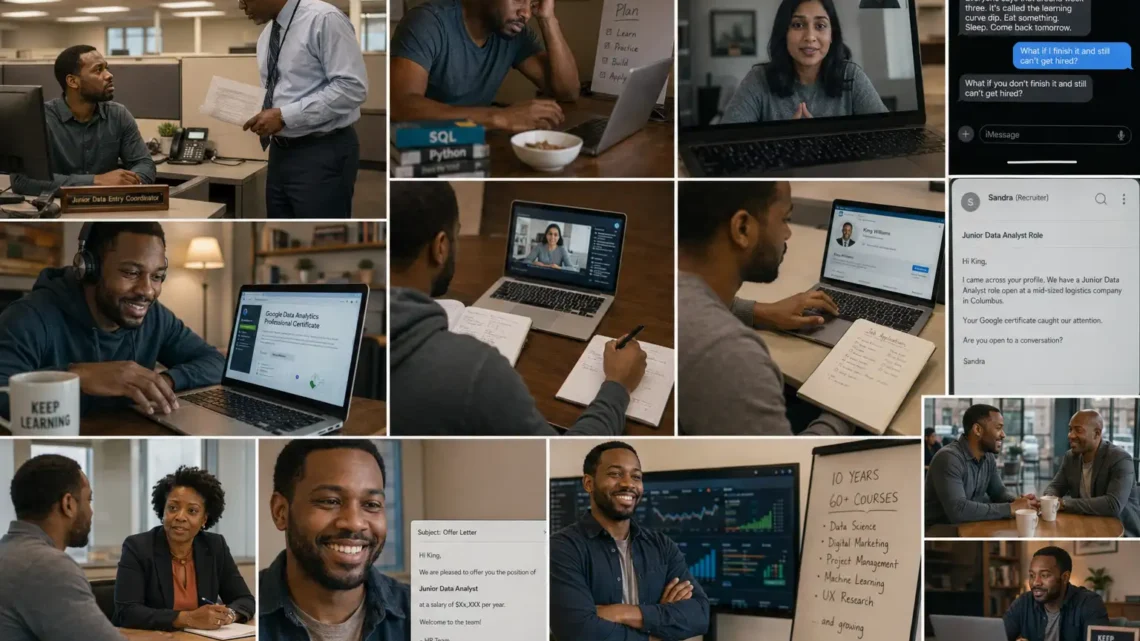
It was a Tuesday in March, the kind of Tuesday that feels like it has always existed and will never end. I had a bachelor’s degree in Business Administration from a state university in Ohio, a student loan payment that arrived every first of the month like an unwanted relative, and a title that read “Junior Data Entry Coordinator,” which is a very long way of saying I typed things into spreadsheets for a living.
Trending Now!!:
I was thirty-one years old.
Marcus, my supervisor, stopped by my desk that afternoon, holding a printout like it was evidence at a trial.
“King, we’re restructuring,” he said. He didn’t look at me when he said it. He looked at the paper. “Your role is being absorbed into the automation system. HR will reach out by end of week.”
That was it. No dramatic music. No slow zoom on my face. Just a flickering light and the sound of Marcus walking back to his glass office.




I drove home in silence. Not the peaceful kind.
Here is the thing nobody tells you about traditional education: it is designed to prepare you for a world that is always three years behind the one you actually graduate into.
I had done everything right, at least by the rulebook I was handed in high school. Went to college. Took the safe major. Graduated with a 3.4 GPA. Sent out 200 resumes. Took the first offer that came with health insurance.
The total cost of that journey: $14,000 in tuition, plus interest, plus four years of my life.
The return on investment: a cubicle that no longer wanted me.
That night, I sat on my apartment floor with my laptop open and a bowl of cereal going soggy on the coffee table. I typed into Google: “how to learn new skills without going back to school.”
That search changed my life. I am not being dramatic. It literally, structurally, financially changed the direction of my life.
The first platform I landed on was Coursera. Then Udemy. Then LinkedIn Learning. Then edX. Then I had seventeen tabs open and the cereal was completely inedible.
I called my friend Priya, who worked in UX design at a startup in San Francisco.
“Priya, have you ever done one of these online courses? Like the ones on Udemy?”
She laughed. “Done one? I’ve done about thirty. Why?”
“I just got laid off.”
A pause. “Oh. Okay. What do you want to learn?”
That was the question that stopped me. What did I want to learn? I had spent so long doing what I was supposed to do that I had never seriously asked myself what I actually wanted to be competent at.
“I don’t know,” I admitted. “Data? Tech? Something that pays?”
“Search ‘Google Data Analytics Certificate’ on Coursera,” Priya said. “It’s beginner-friendly, it’s from Google, and it is actually recognized by employers. Start there. Stop opening seventeen tabs.”
“How did you know I had seventeen tabs?”
“Because that’s what everyone does.”
She was right. I closed fifteen of them.
I enrolled in the Google Data Analytics Professional Certificate program that same night. The price was something like $39 a month on Coursera. Compared to $14,000, it felt like shoplifting.
The first week was a rush. I was learning SQL basics, understanding data cleaning, watching instructors who actually worked in the field explain concepts with real-world examples. The e-learning format was nothing like I expected. These were not PowerPoint slides with a bored professor reading from them. These were interactive, video-based, project-driven lessons that felt alive.
I was hooked.
By week three, I had hit what every serious online learner hits eventually. The Wall.
The videos kept coming. The assignments piled up. My job search was producing nothing. My savings account was bleeding. One evening, I sat in front of my laptop and genuinely could not make myself click play on the next lesson. I stared at the screen. The screen stared back.
I texted Priya: “I don’t think I can finish this.”
She replied in four minutes: “Everyone says that around week three. It’s called the learning curve dip. Eat something. Sleep. Come back tomorrow.”
“What if I finish it and still can’t get hired?”
“What if you don’t finish it and still can’t get hired?”
I ate a sandwich. I slept. I came back.
Six months after losing my job, I submitted my capstone project for the Google Data Analytics Certificate. It was a case study analyzing bike-sharing usage patterns in Chicago. I had built charts in Tableau, written SQL queries that actually worked, and put together a presentation that looked, to my own shock, genuinely professional.
The certificate landed in my inbox on a Thursday morning. I stared at it for about ten minutes.
I updated my LinkedIn profile that same day, added the certification, rewrote my headline, and applied to eleven jobs before noon.
Two weeks later, I got a message from a recruiter named Sandra.
“Hi, I came across your profile. We have a Junior Data Analyst role open at a mid-sized logistics company in Columbus. Your Google certificate caught our attention. Are you open to a conversation?”
My hands were shaking slightly when I typed back: “Absolutely.”
The interview was three rounds. In the second round, the hiring manager, a sharp woman named Dr. Femi Okonkwo, walked me through a case scenario involving warehouse inventory data and asked me to identify inefficiencies.
I had done almost this exact exercise in week four of my online course.
“Walk me through your thought process,” Dr. Femi said, leaning forward.
And I did. Calmly. Confidently. With the language of someone who had been studying this not in a classroom, but by actually doing it.
She smiled slightly. “You taught yourself all of this in six months?”
“Online learning,” I said. “Coursera, mostly. And a $29 Python course on Udemy that I finished in three weeks.”
“That $29 course,” she said, “just got you to round three.”
I got the job. The salary was 40 percent higher than what I was making before the layoff.
That was ten years ago.
Since then, I have completed over sixty online courses. I’ve gone through certifications in data science, digital marketing, project management, machine learning fundamentals, and UX research. Some of those courses came from top platforms like Coursera, edX, Skillshare, and Udemy. Some came from free resources on YouTube and Khan Academy. One particularly brutal six-week program came from MIT OpenCourseWare and humbled me in ways I will never fully describe.
Here is what a decade in the e-learning space has genuinely taught me, the things no review article will tell you:
The certificate matters less than the project. Employers in tech, data, and digital fields consistently respond better to a portfolio of real work than to a list of credentials. Build things. Put them on GitHub. Write about what you built. The certificate just gets you in the door; the project closes the offer.
Platform reputation is real but not absolute. A Google or IBM certificate on Coursera carries weight because the brand is attached. But a completed, well-reviewed course on Udemy with a strong project outcome can outperform a prestigious certificate you half-finished. Completion rates and demonstrable skills matter more than the logo.
Self-paced learning is a double-edged sword. The flexibility of asynchronous online education is its greatest selling point and its most dangerous feature. Without a deadline, the human brain will reschedule everything to “later.” Set artificial deadlines. Tell someone about them. Treat your online learning schedule like a class you paid $3,000 to attend, because in terms of career impact, you probably did.
The best investment in online education is the community. Every major platform now has forums, Discord servers, cohort-based learning options, and peer review systems. The learners who get the most out of digital education are the ones who engage with other learners, not just the content. Priya giving me one specific recommendation on one specific night did more for my career than any algorithm.
Let me be honest with you in a way that the higher education industry will not.
A traditional four-year degree in the United States averages between $100,000 and $200,000 in total cost when you include tuition, room, board, and the quiet expense of four years not earning a full-time salary. That number climbs higher for graduate programs.
A structured online learning path in a high-demand field, let’s say data analytics, digital marketing, cybersecurity, or UX design, costs between $300 and $2,000 for all the professional certifications you need to get hired. At the high end. Some people have done it for under $200 using free-tier resources strategically combined with one or two paid certificates.
I am not saying a university education has no value. I am saying the return on investment calculation has changed dramatically, and most people are still using a 2005 model to make a 2025 decision.
Last spring, I ran into Marcus, my old supervisor, at a coffee shop near downtown Columbus. He looked exactly the same, just a little grayer.
“King,” he said. He seemed genuinely happy to see me. “How have you been?”
“Really well,” I said. “I run a data strategy team now. Twelve people. Mostly remote.”
He nodded slowly. “That’s great. That’s really great.” He stirred his coffee. “You know, that layoff still bothers me. I didn’t handle it well.”
“It was the best thing that happened to me,” I said honestly.
He laughed, a little uncomfortably. “I’m actually thinking about going back to school. For an MBA. Trying to figure out if it’s worth it.”
I looked at him for a moment.
“Have you looked at online programs?” I said. “There are some genuinely good ones now. Affordable. Recognized. You can finish some of them in under a year.”
Marcus pulled out his phone. “Send me a link?”
I sent him three. One from Coursera. One from edX. One from a platform called Maven that does cohort-based courses for senior professionals.
He texted me two weeks later: “Enrolled. Starting Monday.”
That flickering light above my old cubicle was never replaced. I know because someone told me the whole floor was converted into open office space. Nobody sits there anymore.
But somewhere in the glow of a laptop screen, in apartments and spare bedrooms and kitchen tables across the world, people are clicking play on lessons that will quietly, steadily, permanently rewrite the story of what their lives were supposed to look like.
I was one of them.
Maybe you are too.