I Thought Green Living Was for Rich People. Then My Water Bill Humbled Me
The first time I heard the phrase “sustainable living,” I was sitting in a cramped apartment in Portland, Oregon, eating cereal from a plastic bowl, surrounded by three overflowing trash bags I had not taken out in a week.
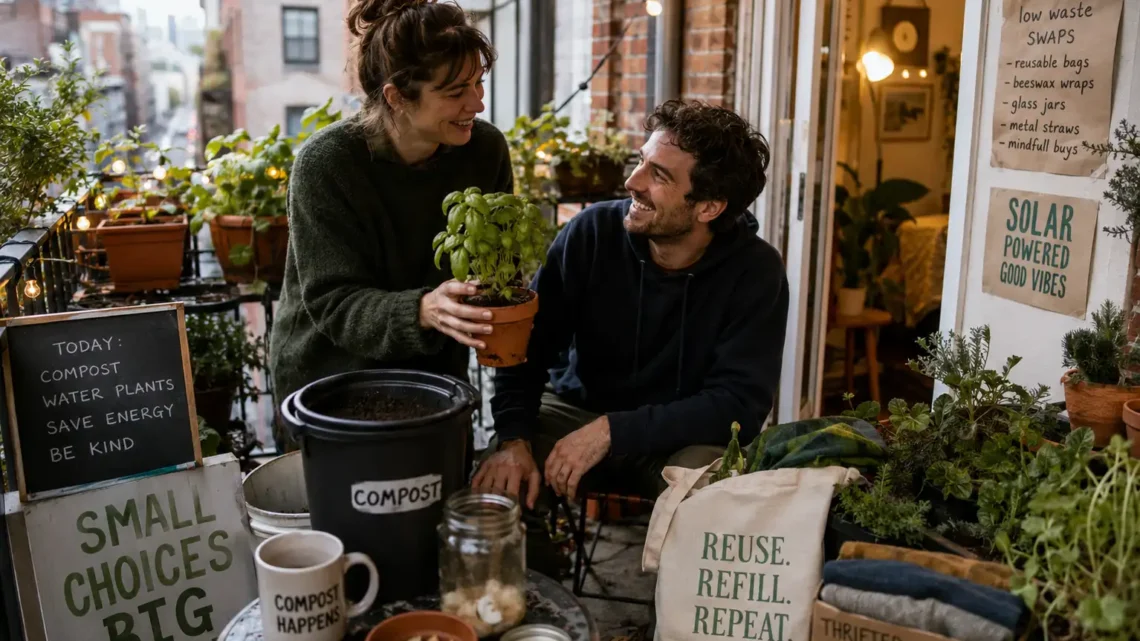
My neighbor, Sara, knocked on my door holding a small clay pot with a basil plant in it, smiling like she had just discovered the meaning of life.
Trending Now!!:
“I grew this on my windowsill,” she said, pushing it gently into my hands. “No soil bags, no pesticides. Just coffee grounds and eggshells.”
I stared at the plant. Then I stared at her. Then I said, “Sara, I can barely keep myself alive.”
She laughed. But she left the plant anyway.
That was eleven years ago. That small basil plant, sitting on a windowsill I never cleaned, was the beginning of everything.




I want to be honest with you because most articles about eco-friendly living are written by people who already have solar panels on their roofs and a $400 bamboo toothbrush. That is not my story. My green living journey started from desperation, not inspiration.
My electricity bill had gone so high one winter that I sat under a blanket and googled, “how to survive without heating.” What came up instead changed my entire relationship with energy consumption, waste, and the planet I had been quietly destroying one plastic bag at a time.
The first thing I tried was turning off power strips at night. Not glamorous. Not a TED Talk moment. But my bill dropped by nineteen dollars the following month. Nineteen dollars felt like a victory lap. I called my older brother Marcus just to tell him.
“Nineteen dollars?” he said flatly.
“Nineteen dollars, Marcus.”
“You called me for this.”
“It is the principle.”
He hung up. But I was hooked.
The next step was reducing my carbon footprint in the kitchen, which is where most households silently destroy the environment and their budgets at the same time. I started meal planning, not because I was suddenly passionate about sustainability, but because I had started tracking how much food I was throwing away each week.
The number shocked me. I was tossing out nearly a third of everything I bought. Perfectly good vegetables, wilting because I forgot them. Leftovers from Tuesday becoming biology experiments by Saturday. I was essentially buying groceries for myself and for the trash can, and the trash can was eating better.
I started composting that same month. I bought a small countertop compost bin, the kind that looks like a stylish container and does not smell if you layer it properly.
Fruit peels, coffee grounds, eggshells, vegetable scraps. Within eight weeks I had rich, dark compost that I used on the small container garden I had started on my fire escape. Tomatoes, herbs, lettuce. Nothing Instagram-worthy at first, just lopsided and determined little plants trying their best, much like me.
Sara came over one evening, looked at my fire escape garden and my compost bin, and said, “Who are you and what did you do with my neighbor who used the same paper towel twice because he was too lazy to buy more?”
“I am evolving,” I told her.
“You are composting,” she said, grinning. “It is the same thing.”
The bigger shift came when I decided to go plastic-free, or at least try. This was the part where I made the most mistakes and felt the most frustrated, because plastic is not just in obvious places. It is inside the lining of your coffee cup. It is coating your canned beans.
It is inside your clothes, releasing microplastics every single time you wash them. The first time I stood in a grocery store holding a packet of crackers, reading the packaging, and realizing there was no recyclable alternative on the shelf, I wanted to give up entirely. I texted Sara.
“This is impossible,” I typed.
She replied in three seconds. “Don’t try to fix everything at once. Pick one thing and swap it. Just one.”
I switched to reusable grocery bags that week. The week after, I replaced my plastic cling wrap with beeswax wraps. Small swaps. Sustainable changes that stuck because they were not overwhelming.
This is the mistake most people make when they start a zero waste lifestyle, trying to overhaul everything simultaneously, burning out within two weeks, and going back to buying bottled water by the case.
I did not go zero waste. I went low waste. And the difference in pressure, mentally and financially, was enormous.
About three years into this journey, I moved into a house. My first real house with a yard and actual wall sockets I could do something with. The first investment I made was not furniture. It was a programmable smart thermostat and LED lighting throughout every room. The thermostat alone cut my heating and cooling costs by a figure that made Marcus actually listen when I called.
“How much?” he said.
“Three hundred dollars over the winter,” I told him.
Silence.
“Three hundred,” he repeated.
“Three hundred, Marcus.”
He did not hang up this time.
The solar panel conversation came later, after I had spent a year researching renewable energy options for residential homes. I was not in a position to buy panels outright, so I looked into solar leasing programs and community solar subscriptions, which are options most people do not know exist.
Community solar lets you subscribe to a share of a solar farm in your region and receive credits on your utility bill without installing a single panel on your roof. I signed up. My electricity bill dropped again, and this time I did not call Marcus. I sat quietly with it, the way you sit with something that finally makes sense after years of confusion.
The sustainable fashion piece came last, honestly. I had always justified fast fashion to myself with the classic reasoning that eco-friendly clothing was too expensive, and for a long time, it genuinely was for my budget. But I discovered thrift stores not as charity but as strategy.
I started buying secondhand for nearly everything except underwear and shoes. Linen shirts, wool coats, denim, all of it bought secondhand, washed, and worn with the same pride as anything new.
My wardrobe’s environmental impact dropped significantly, and I was spending sixty percent less on clothes per year. The dopamine hit of finding a near-perfect wool coat for twelve dollars is something I will never fully explain to someone who has not experienced it.
I am not going to pretend this journey was smooth or that I became some green living guru who never buys a plastic bottle or always remembers his reusable cup. I forget the cup constantly.
I still buy things in plastic packaging when there is no reasonable alternative. I ate at a fast food chain last month and did not compost the napkins because I was tired. The point is not perfection. The point is direction.
Sara got married two years ago and moved to Vermont to start a small organic garden on a plot of land she and her husband Daniel bought together. She sent me a photo last spring of their first full vegetable harvest laid out on the kitchen floor, colorful and abundant and ridiculous in the best way. The caption said, “It started with your basil plant.”
I had to read that twice.
She meant it started with her giving me the basil plant. But for a moment, reading it in my kitchen surrounded by my compost bin and my beeswax wraps and my reusable everything, I felt like it had somehow started with me too. Like the smallest, most ordinary act of keeping something alive had quietly led to all of this.
Your version of green living does not have to look like anyone else’s. It does not require a zero waste pantry with glass jars lined up like a lifestyle magazine. It does not require solar panels or an electric vehicle or a capsule wardrobe made entirely of organic cotton. It requires one honest look at your habits, one small swap, and the willingness to let that swap lead to another.
Mine started with a basil plant I almost let die.
Yours can start anywhere.