I Was $26,000 in the Hole When a Retired Financial Planner Sat Down Next to Me
I was thirty-one years old, sitting in a coffee shop in downtown Atlanta on a Tuesday morning, pretending to work on my laptop, when the truth hit me harder than any bill I had ever received.
My bank account had $214 in it. Not $214 after bills. $214 total. And payday was nine days away.
Trending Now!!:
I had a job. A decent one. I was pulling in $67,000 a year as a mid-level marketing coordinator, which sounds fine until you realize I had $18,000 in credit card debt, a car note that was suffocating me every month, and absolutely zero investments. Not a single index fund. Not a savings bond. Not even a 401k contribution beyond the bare minimum my company auto-enrolled me into.
I was making money. I just had no idea where it was going.
So there I was, nursing a $6 oat milk latte, which, yes, is exactly the kind of irony that personal finance Twitter would roast me for, when a man sat down at the small round table next to mine. He looked like he was in his early sixties, wearing a plain grey sweater and reading glasses pushed low on his nose. He had a yellow legal pad in front of him, full of numbers. He was not using a laptop. Just a pen and paper, circling figures, drawing arrows.
I noticed because it looked so out of place. Who does math by hand anymore?


He caught me staring and smiled.
“Don’t mind me,” he said, tapping the pad. “Old habit. I still track everything manually once a month. Keeps me honest.”
I smiled back politely and went back to my screen. Then my phone buzzed. It was a notification from my bank. A $12 overdraft fee.
For a $9 Spotify subscription.
I actually laughed out loud. Not because it was funny. Because it was embarrassing and I had no one to be embarrassed in front of except this stranger.
“Bad news?” he asked.
“Just my life,” I said.
He chuckled. “Want to talk about it? I’ve got nowhere to be until noon.”
I don’t know why I said yes. Maybe because I was tired of carrying it alone. Maybe because strangers are easier than friends. I told him the whole thing, the salary, the debt, the $214, the latte I probably should not have bought.
He listened without interrupting. That was the first thing that impressed me.
When I finished, he said, “You’re not broke because you don’t earn enough. You’re broke because you haven’t decided what your money is for.”
I blinked. “What does that mean?”
He put his pen down. “Most people think personal finance is about restriction. Cut the coffee, skip the vacation, live like a monk. But that’s not it. It’s about intention. Every dollar you earn needs a job. Right now, your dollars are just wandering around until they disappear.”
His name was Gerald. He introduced himself properly after that, like we were starting over. He had spent 35 years as a certified financial planner before retiring at 58. He did not say it to impress me. He said it because I asked what he did for a living, and he answered simply.
“So you’re rich,” I said.
“I’m financially free,” he corrected me. “Those aren’t the same thing.”
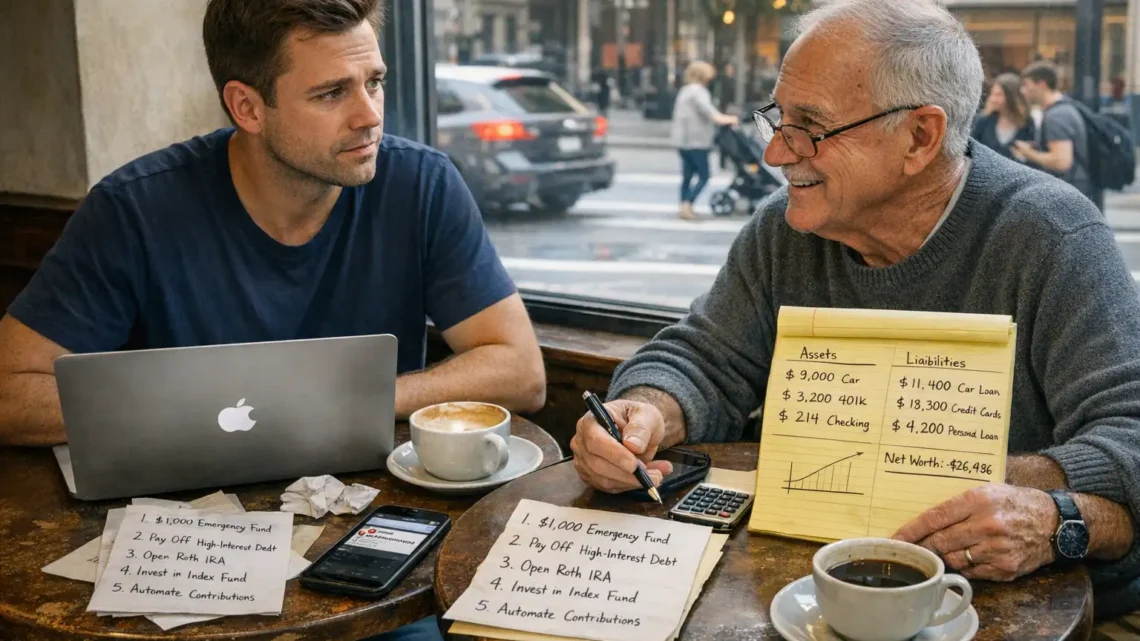
He asked me if I knew what my net worth was. I said I had never calculated it. He handed me his yellow legal pad and told me to write down everything I owned on the left side, and everything I owed on the right.
It took about four minutes.
Assets: one used Honda Accord, maybe worth $9,000. A 401k with $3,200 in it, which I had barely touched in two years. Checking account, $214.
Liabilities: car loan, $11,400. Credit card debt across three cards, $18,300. A personal loan I had taken for a vacation two years ago, $4,200 remaining.
Gerald looked at the numbers and said nothing for a moment.
“Your net worth is negative $26,486,” he said quietly. “That’s where you’re starting from. Not the salary. Not the job title. This number.”
I felt the air leave my chest.
He must have seen it on my face because he immediately said, “This is not a disaster. This is just a map. You can’t get anywhere until you know where you are.”
He spent the next forty minutes with me, and I want to be honest, it was not glamorous. There were no secrets. No crypto tips. No hot stock picks. What he told me was so simple it almost made me angry that no one had said it clearly before.
He said the first thing I needed was an emergency fund, three to six months of expenses sitting in a high-yield savings account, completely separate from my regular checking. Not invested. Just sitting there, liquid, boring, and safe. Because without it, every small financial shock, a car repair, a medical bill, a job gap, would drive me straight back into debt.
“Most people skip this step because it feels unproductive,” he said. “Money just sitting there earning 4% feels like a waste when the stock market is returning 10%. But that emergency fund is not an investment. It’s insurance. It’s the thing that stops you from cashing out your index funds at the worst possible time because your transmission died.”
I had cashed out a small retirement account in 2021 to cover a car repair. Paid a 10% penalty plus income tax on it. Lost almost a third of the money to taxes and fees. I told him that.
He did not wince or lecture me. He just nodded and said, “That’s the tax on not having a buffer. You’ll never do that again once you build the cushion first.”
Then he talked about debt payoff strategy. He asked me the interest rates on my three credit cards. I pulled them up on my phone. 26.99%, 22.49%, and 19.99%.
“Avalanche method,” he said without hesitation. “Highest interest rate first, minimum payments on everything else, throw every extra dollar at the top card. It’s not emotional like the snowball method, but mathematically it saves you the most money.”
I asked him which method he had used.
“Snowball,” he said, and smiled. “Because at twenty-seven I needed the psychological win more than I needed the math. You’re thirty-one. You’re past needing the trophy. You need efficiency.”
After debt, he said, the conversation changes completely. Once you are out of high-interest debt and have your emergency fund built, every dollar you don’t spend becomes a dollar that can start compounding. And that, he said, is where most people miss the entire point of wealth building.
“Compound interest,” he said, “is not interesting until about year seven. The first few years you’re investing, you look at your portfolio and think nothing is happening. The numbers move slowly. People quit. They pull out the money. They try something else. And they never see the exponential curve that starts around year ten, eleven, twelve, where the growth on the growth starts to outpace everything you’ve contributed manually.”
He drew a rough curve on his legal pad. Flat at first, then bending sharply upward.
“Albert Einstein may or may not have called compound interest the eighth wonder of the world, but whoever said it first was not wrong,” he said. “A 25-year-old who invests $300 a month into a diversified index fund and does nothing else for 40 years will retire with somewhere between $900,000 and $1.2 million at an average 8% annual return. The same person who waits until 35 to start will retire with less than half of that, even if they invest the same monthly amount.”
“I’m 31,” I said.
“So you’re late, but not finished,” he said. “Stop thinking about what you should have done and start with what you can do Thursday.”
He told me to open a Roth IRA that same week. Not to overthink it. Not to wait until I understood every nuance of tax-advantaged accounts and contribution limits and income thresholds. Just open it, link my bank account, and set up an automatic contribution of even $50 a month to start.
“The account being open and active is worth more psychologically than the $50,” he said. “Once it exists, you’ll protect it. You’ll feed it. People protect what they can see.”
I asked him what to put the money into once it was inside the Roth.
“A total market index fund,” he said. “Something that tracks the S&P 500 or the whole U.S. market. Low expense ratio, ideally under 0.1%. Set it to dividend reinvestment. Then forget you have it for six months.”
“That’s it?”
“That’s it.”
“But what about individual stocks? What about real estate investing? What about dividend stocks, REITs, all of that?”
He looked at me patiently. “Those conversations happen after you have a foundation. Right now you have negative net worth and no emergency fund. A Tesla stock pick is not going to save you. Discipline and a boring index fund will.”
I sat back in my chair. Outside the window, Atlanta traffic crawled past. A woman pushed a stroller. Two college kids argued over something on a phone screen. The world kept moving, completely indifferent to the financial reckoning I was having over a table covered in oat milk latte rings.
“Can I ask you something personal?” I said.
“Go ahead,” he said.
“Did you ever make a big mistake? Financially, I mean. Or did you just always know what to do?”
He laughed, a real one, from the chest.
“I put $40,000 into a friend’s restaurant in 2003,” he said. “He was passionate, the food was incredible, the location was perfect. It closed in eight months. I lost every dollar.”
“What did you learn from that?”
He thought for a second. “That passion is not a business plan. And that no matter how much you like someone, investing in a private business is essentially a donation unless you’ve read the financials and stress-tested the model. I was a financial planner and I still let friendship override my own rules.”
He paused, then added, “Also that diversification is not just about stocks and bonds. It’s about making sure no single decision, no single investment, no single relationship can take you out entirely. My portfolio survived that loss because the restaurant was only a small percentage of my total net worth. If it had been 60% of my assets, I would have been devastated beyond recovery.”
Portfolio diversification. I wrote that down. Actually wrote it down, on a napkin, like he was doing a lecture and I was finally paying attention.
We talked for another twenty minutes. He told me about passive income streams he had built over the years, rental income from a small duplex he bought at 42, dividend income from a portfolio he had been growing since his late twenties, and royalties from a small e-book he had written about financial literacy for first-generation college students.
“None of those happened fast,” he said. “The duplex took me eight years of saving for the down payment. The dividend portfolio took twelve years to generate meaningful monthly income. The e-book earns $200 a month and I wrote it in 2009. But they all compound on each other now, and I haven’t needed to work since I was 58.”
Financial independence. I had heard the term before on YouTube videos I half-watched at 1 a.m. But hearing it from a real person sitting three feet away, a person with a yellow legal pad and a grey sweater, made it feel achievable for the first time.
Before he left, Gerald wrote down five things on a clean sheet of the legal pad, tore it off, and handed it to me.
- Calculate your real net worth today.
- Build a $1,000 starter emergency fund before touching anything else.
- Attack the highest-interest debt first, aggressively.
- Open a Roth IRA this week. Even $50.
- Invest in a low-cost index fund and automate the contribution.
“These are not tips,” he said, standing up and tucking the pad under his arm. “These are the sequence. Most people fail because they do them out of order or try to do them all at once. One step at a time.”
I thanked him, genuinely, the way you thank someone when you can’t think of words proportional to what they gave you.
He waved it off. “You bought yourself a $6 latte this morning,” he said. “Use the guilt productively.”
Then he was gone. Just like that. Back into Atlanta, into the traffic and the Tuesday noise.
I sat there for another hour. I opened my laptop, which I had barely touched, and started actually working, not on my job tasks, on my numbers.
I found a high-yield savings account with 4.6% APY. I opened it in eleven minutes.
I Googled “how to open a Roth IRA” and spent thirty minutes going through the process at a brokerage I had heard of but never used. I chose a total market index fund with a 0.03% expense ratio and set up a $75 monthly auto-contribution, which was $25 more than I planned because I felt reckless and brave at the same time.
I called my credit card company with the 26.99% rate and asked, point blank, if they could lower my interest rate. The first rep said no. I asked to speak to a supervisor, politely but firmly, and explained I had been a customer for four years with no missed payments. The supervisor lowered it to 21.99%. Five points. Not dramatic, but real.
That was three years ago.
Today my net worth is positive. Not by millions, not yet, but positive. My emergency fund has six months of expenses in it. My high-interest credit card debt is completely gone. The other two cards are 80% paid off. My Roth IRA has grown to just over $14,000 between contributions and market returns, and I have not touched it once, not even when the market dropped 18% in 2022 and every voice in my head told me to panic.
I think about Gerald every time I look at my investment portfolio dashboard. I never got his last name. I never saw him again. He was just a man with a yellow legal pad who had nowhere to be until noon on a Tuesday.
But I will tell you this, and I mean it without any exaggeration, that $6 latte was the best financial decision I ever made.
Because I was in the right place, broke enough to listen, and lucky enough to sit next to someone who had already made the mistakes I was heading toward.
If you are reading this in your twenties, your thirties, your forties, it does not matter. The best time to start building wealth was ten years ago. The second best time is Thursday, when you open that account, set that automatic contribution, and stop waiting for permission to take your own financial future seriously.
The stock market will fluctuate. Interest rates will shift. Real estate will cycle. But the one thing that never loses value is the discipline to start, and the patience to let time do the compounding for you.
I still drink oat milk lattes. Gerald would probably roll his eyes. But I drink them as a line item in a budget I actually track now, guilt-free, because I know exactly what my money is doing everywhere else.
That, more than any investment return, is what financial freedom actually feels like.